
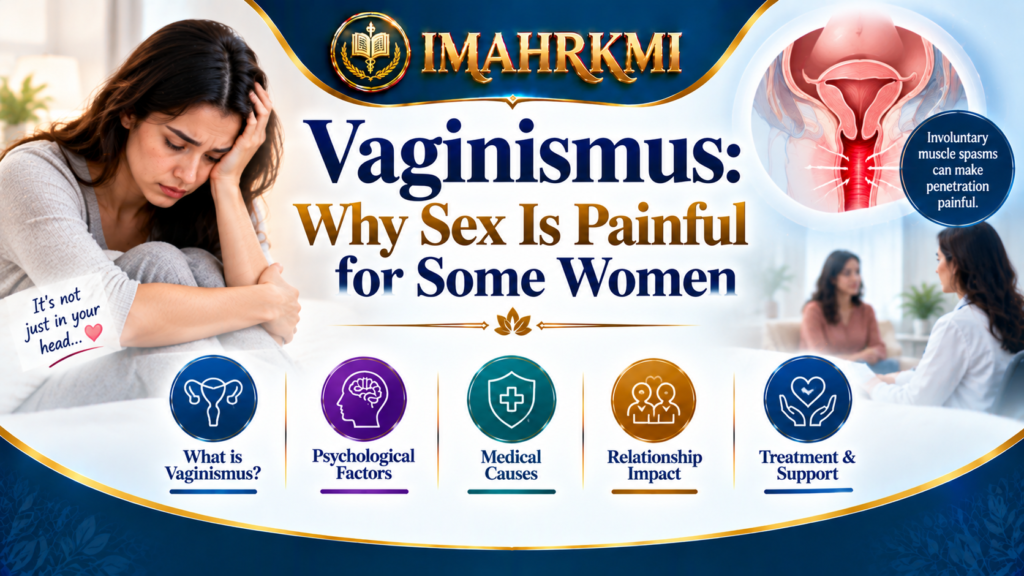
Vaginismus: Why Sex Is Painful for Some Women
For some women, sexual intimacy is not simply uncomfortable—it can be painful, frightening, or extremely difficult.
A woman may want emotional closeness with her husband but still experience involuntary tightening of the muscles around the vaginal opening when penetration is attempted.
She may think:
“Why does my body react this way?”
“Why does sex hurt when I want to be close to my husband?”
“Is something physically wrong with me?”
Her husband may have completely different questions:
“Why is my wife afraid of intimacy?”
“Does she not want me?”
“Why can other married couples have normal sex but we cannot?”
These misunderstandings can create significant emotional and relationship distress.
One important fact needs to be understood:
Vaginismus is a real sexual-health problem, and it is not simply a matter of a woman refusing intimacy.
It can involve involuntary muscle responses, pain, fear, anxiety, anticipation of pain, and other physical or psychological factors.
The good news is that vaginismus can often be treated, and many women can improve significantly with appropriate assessment and individualized care.
What Is Vaginismus?
Vaginismus refers to involuntary tightening or increased activity of muscles around the vaginal opening associated with attempted vaginal penetration.
The response can occur even when a woman consciously wants intimacy.
This distinction is extremely important.
A woman may consciously think:
“I want to be close to my husband.”
But her body may respond:
“Something feels threatening or painful.”
The resulting muscle response can make penetration painful, difficult, or sometimes impossible.
Vaginismus exists on a spectrum, and symptoms can vary considerably between women.
What Does Vaginismus Feel Like?
Women may describe the experience differently.
Possible symptoms include:
- Pain with attempted penetration
- Burning or discomfort
- A sensation of tightness
- Involuntary muscle tightening
- Fear or anticipation of pain
- Difficulty with vaginal penetration
- Avoidance of penetration because of previous painful experiences
- Anxiety surrounding gynecological examinations
- Distress about sexual intimacy
Not every woman experiences every symptom.
And not every case of painful sex is vaginismus.
That distinction matters.
Vaginismus vs. Other Causes of Painful Sex
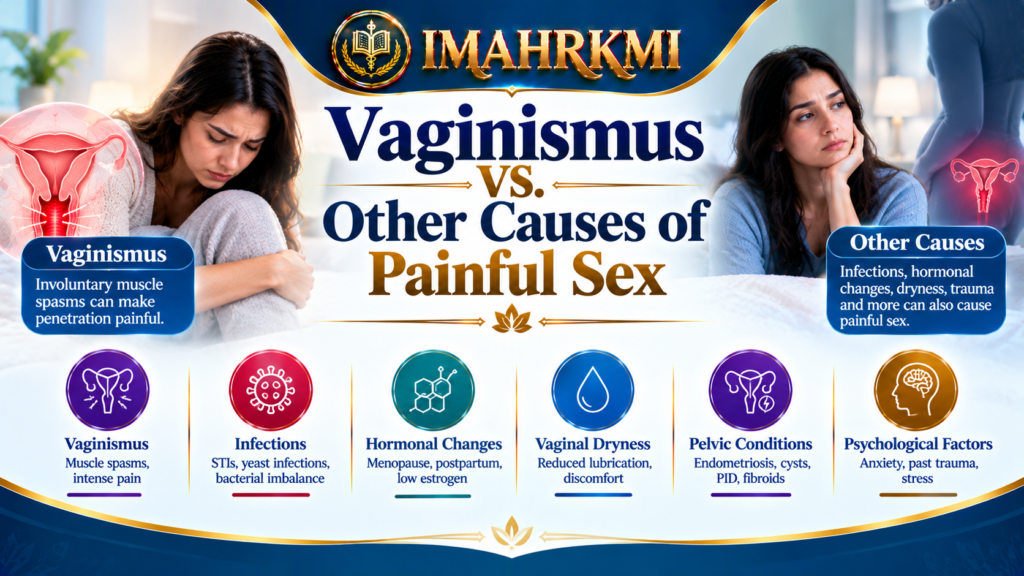
Pain during sex can have many causes.
For example, pain may be associated with:
- Vaginal dryness
- Infections
- Hormonal changes
- Pelvic floor problems
- Skin conditions
- Endometriosis
- Other gynecological conditions
- Postpartum changes
- Menopause
- Psychological factors
- Relationship-related anxiety
Painful sex is sometimes referred to more broadly as dyspareunia.
Vaginismus is a specific condition involving involuntary tightening or overactivity of muscles associated with attempted penetration.
Because several conditions can overlap, professional assessment is important.
Why Does Vaginismus Happen?
There is no single explanation for every woman.
Vaginismus can involve an interaction between physical, psychological, emotional, and relational factors.
1. Fear of Pain
A woman who expects penetration to hurt may become anxious before intimacy begins.
That anxiety can increase muscle tension.
The increased tension can then contribute to pain.
This can create a cycle:
Fear → Muscle Tension → Pain → More Fear → More Avoidance
Breaking this cycle is an important part of treatment.
2. Previous Painful Experiences
If a woman has experienced painful intercourse in the past, she may begin anticipating the same experience in the future.
The nervous system can learn to associate penetration with danger or pain.
Even when the original cause of pain has changed, the learned fear response may remain.
Professional treatment can help address both the physical and psychological components.
3. Anxiety
General anxiety can influence sexual functioning.
A woman may worry about:
- Pain
- Pregnancy
- Sexual performance
- Her husband’s expectations
- Her body
- Religious concerns
- Medical examinations
- Previous experiences
Anxiety does not mean the symptoms are “imaginary.”
Psychological factors can produce genuine physical responses.
4. Negative Sexual Messages
Some women grow up hearing that sexuality is:
- Dirty
- Shameful
- Dangerous
- Something that should never be discussed
Such messages can create confusion when a woman enters marriage and suddenly needs accurate information about sexual health.
This does not mean religious modesty causes vaginismus.
Rather, misinformation, fear, shame, and lack of appropriate sexual-health education may contribute to anxiety for some individuals.
5. Lack of Sexual-Health Education
Many women enter marriage without receiving medically accurate education about:
- Female anatomy
- Sexual response
- Pain
- Lubrication
- Pelvic-floor function
- Sexual anxiety
- Common sexual-health conditions
As a result, normal questions can become sources of fear.
Professional sexual-health education can help replace misinformation with medically appropriate knowledge.
6. Previous Trauma or Negative Experiences
For some women, previous unwanted or distressing experiences may contribute to sexual anxiety or avoidance.
However, it is important not to assume that every woman with vaginismus has experienced trauma.
A proper assessment should explore the individual’s history rather than making assumptions.
When trauma is relevant, trauma-informed psychological care may be particularly important.
7. Relationship Problems
Sexual functioning does not occur in isolation from the relationship.
Conflict, mistrust, resentment, emotional disconnection, or fear of a spouse can influence sexual comfort.
For this reason, assessment may sometimes need to consider the couple’s relationship as well as the woman’s physical symptoms.
8. Medical Conditions
Sometimes another medical condition contributes to pain or discomfort.
Examples can include:
- Infections
- Hormonal changes
- Vulvovaginal conditions
- Pelvic conditions
- Postpartum changes
- Menopause-related changes
A healthcare professional can determine whether additional medical investigation is needed.
Is Vaginismus "All in the Head"?
No.
This is one of the most damaging misconceptions.
Psychological factors can contribute to muscle responses and pain, but that does not make the condition imaginary.
Pain is real.
Muscle tightening is real.
Anxiety is real.
The physical and psychological systems influence one another.
Modern sexual-health care therefore considers both body and mind.
Can a Woman Have Vaginismus Even If She Loves Her Husband?
Yes.
Vaginismus does not mean a woman does not love her husband.
A woman may:
- Love her husband
- Feel emotionally connected
- Want a healthy marriage
- Want intimacy
- Be attracted to her spouse
and still experience involuntary pain or muscle tightening.
This is why husbands should avoid interpreting the condition automatically as personal rejection.
Does Vaginismus Mean a Woman Does Not Want Sex?
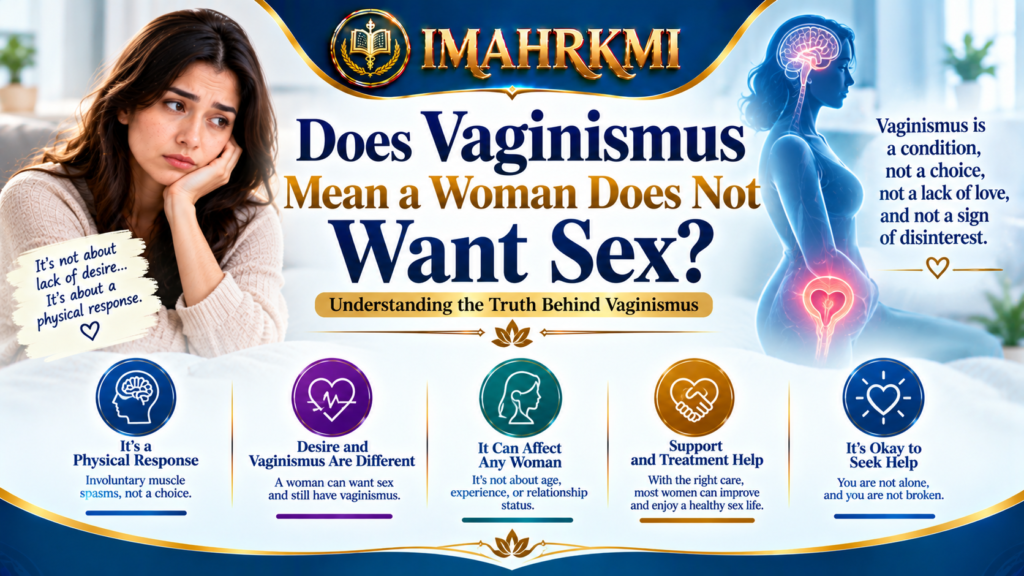
Not necessarily.
There is a major difference between:
“I do not want this.”
and
“I want to be close to my husband, but my body reacts with pain or involuntary tightening.”
The distinction is essential.
A woman’s subjective desire and her physical sexual response do not always operate perfectly together.
The Relationship Impact of Vaginismus
Vaginismus can affect both partners.
A woman may experience:
- Shame
- Frustration
- Fear
- Sadness
- Embarrassment
- Anxiety
- Feelings of inadequacy
A husband may experience:
- Confusion
- Rejection
- Frustration
- Worry
- Emotional distance
Without communication, both partners may misunderstand each other.
The husband may think:
“She doesn’t want me.”
The wife may think:
“He doesn’t understand what I’m experiencing.”
Professional education can help couples understand that the problem is not necessarily a lack of love.
Vaginismus and Marriage
When vaginismus occurs in marriage, both partners may need education.
The wife may need help understanding her physical and emotional response.
The husband may need to understand that pressure, criticism, or repeated demands can increase anxiety and make the problem more difficult.
A supportive spouse can help create an environment of:
- Safety
- Patience
- Communication
- Respect
- Emotional reassurance
- Appropriate professional care
Treatment should focus on the health of the individual and the relationship—not on blame.
Does Vaginismus Affect Fertility?
Vaginismus itself does not necessarily mean that a woman has a problem with reproductive organs or fertility.
However, if vaginal penetration is extremely difficult or impossible, conception through intercourse may become difficult.
Fertility and vaginismus are therefore related questions but should not automatically be treated as the same medical problem.
A woman or couple concerned about fertility should receive individualized medical advice.
Can Vaginismus Be Treated?
Yes.
Many women can improve with appropriate treatment.
Treatment depends on the underlying causes, severity, symptoms, medical history, and individual circumstances.
There is no single treatment that is appropriate for every woman.
Medical Assessment
The first step may be an appropriate healthcare evaluation.
The purpose is to determine whether another physical condition is contributing to the pain.
A clinician may consider:
- Symptoms
- Medical history
- Menstrual and hormonal history
- Pregnancy or childbirth history
- Medications
- Pain characteristics
- Previous gynecological problems
- Psychological factors
The exact evaluation should be individualized.
Pelvic Floor Therapy
For some women, pelvic-floor physical therapy can be an important component of treatment.
A trained pelvic-health professional may help a patient understand:
- Pelvic-floor muscle function
- Muscle tension
- Relaxation
- Body awareness
- Pain patterns
Treatment should be appropriately supervised and tailored to the patient.
Psychological Treatment
When anxiety, fear, trauma-related symptoms, or other psychological factors contribute to the problem, psychotherapy may be beneficial.
Treatment can address:
- Fear of pain
- Anxiety
- Negative beliefs
- Avoidance
- Shame
- Previous distressing experiences
The goal is not to tell a woman that the pain is imaginary.
The goal is to address the interaction between psychological and physical responses.
Sex Therapy
Sex therapy can help address sexual-health concerns within a professional therapeutic framework.
Depending on the situation, therapy may focus on:
- Sexual anxiety
- Communication
- Pain-related fear
- Couple dynamics
- Sexual expectations
- Avoidance cycles
- Emotional intimacy
Sex therapy is not the same as giving explicit sexual instructions.
It is a professional approach to sexual and relationship concerns.
Couple Therapy
If vaginismus is creating serious marital conflict, couple therapy may also be appropriate.
Couples can learn to communicate without:
- Blaming
- Shaming
- Threatening
- Pressuring
- Accusing
The objective is to transform:
“Why won’t you?”
into:
“How can we understand what is happening and get appropriate help?”
That change in communication can be extremely important.
What Should a Husband Avoid?
If your wife experiences symptoms of vaginismus, avoid:
Blaming her
Statements such as “You don’t love me” can increase emotional distress.
Mocking her
Sexual difficulties should never become a source of humiliation.
Comparing her with other women
Every woman’s body and sexual-health experience is different.
Applying pressure
Pressure can increase fear and muscle tension.
Assuming she is intentionally refusing
Involuntary symptoms should not be treated as deliberate rejection.
Searching for unverified internet cures
Online advice can be inaccurate and may delay appropriate care.
What Can a Wife Do?
A woman experiencing symptoms should know that she is not alone and that seeking help is reasonable.
She can consider:
- Speaking with an appropriate healthcare professional.
- Describing her symptoms honestly.
- Discussing pain rather than hiding it.
- Exploring psychological factors when relevant.
- Considering pelvic-floor assessment when appropriate.
- Discussing relationship concerns.
- Seeking qualified sex-therapy support when indicated.
- Obtaining reliable sexual-health education.
There is no shame in asking for help with a sexual-health condition.
Vaginismus and Islam
For Muslim couples, vaginismus may also raise religious and marital questions.
Islam places importance on marriage, affection, mercy, mutual responsibilities, and avoiding harm.
A medical condition should not simply be interpreted as deliberate disobedience or rejection.
At the same time, specific Islamic questions concerning marital sexual rights and obligations require careful consideration of the relevant Qur’anic principles, authentic Hadith, jurisprudence, circumstances, and scholarly interpretation.
Therefore, couples with specific religious questions should consult a qualified and trustworthy Islamic scholar.
Medical treatment and religious guidance can coexist.
A Muslim woman does not have to choose between seeking appropriate healthcare and maintaining her religious values.
Islamic Sex Education and Female Sexual Health
One reason sexual-health problems can remain untreated is that people are afraid to ask questions.
In some communities, even married couples may have difficulty discussing:
- Pain
- Sexual desire
- Female anatomy
- Menstrual and hormonal changes
- Vaginismus
- Sexual anxiety
- Marital intimacy
- Sexual rights and responsibilities
Appropriate education can provide a respectful framework for discussing these subjects.
For Muslim audiences, this education can include both:
Medical and psychological knowledge
and
relevant Islamic perspectives based on the Qur’an, authentic Hadith, and responsible scholarship.
The objective should be education—not embarrassment, sensationalism, or explicit entertainment.
Why Professional Sexual-Health Education Matters
The internet contains enormous amounts of sexual information.
Unfortunately, not all of it is accurate.
Some websites:
- Oversimplify medical conditions.
- Promote unproven treatments.
- Confuse personal opinions with medical facts.
- Present cultural beliefs as religious law.
- Encourage couples to compare themselves with unrealistic expectations.
- Turn serious sexual-health problems into entertainment.
Vaginismus deserves a more responsible approach.
Patients and professionals need to understand the interaction between:
Anatomy + physiology + psychology + relationships + culture + health + individual circumstances.
Clinical Sex Education: Beyond Sexual Techniques
Clinical sex education is not simply about learning “how to have sex.”
It is about understanding sexual health scientifically and professionally.
A comprehensive approach may include:
- Human sexual anatomy
- Sexual physiology
- Female sexual health
- Male sexual health
- Sexual desire
- Sexual response
- Sexual dysfunction
- Sexual pain
- Vaginismus
- Psychological influences
- Relationship dynamics
- Sexual communication
- Clinical assessment concepts
- Treatment and referral principles
- Cultural considerations
- Islamic perspectives
- Professional ethics
This broader knowledge can be particularly valuable for healthcare and relationship professionals.
Learn More Through the IMAHRKMI Clinical Sex Education Course
If you are a healthcare professional, counselor, relationship professional, or student who wants to understand sexual-health concerns more systematically, the IMAHRKMI Clinical Sex Education Course provides structured education in clinical sexual health.
The course is designed to help learners understand sexuality through a combination of:
Medical science
Psychology
Female and male sexual health
Relationship and couple dynamics
Clinical sexual-health concerns
Cultural considerations
Relevant Islamic perspectives
Qur’an and authentic Hadith
The objective is responsible education and professional understanding—not explicit instruction.
Who Should Study Clinical Sex Education?
This type of education can be particularly relevant for:
- Physicians
- Healthcare professionals
- Medical students
- Mental-health professionals
- Counselors
- Relationship professionals
- Sexual-health educators
- Professionals working with married couples
It can also be valuable for anyone seeking a structured and medically informed understanding of sexual health.
When Should You Seek Professional Help?
Consider seeking professional assessment when:
- Penetration is consistently painful.
- Penetration is extremely difficult or impossible.
- Fear of pain is causing avoidance.
- Sexual difficulties are creating significant marital distress.
- You suspect an underlying medical condition.
- Symptoms developed after childbirth or another major health event.
- The problem has persisted despite attempts to address it.
- You feel significant anxiety or emotional distress about intimacy.
Early professional assessment can help prevent years of unnecessary suffering.
Final Thoughts
Vaginismus is not simply a woman saying “no.”
For some women, it is an involuntary physical and psychological response associated with attempted penetration.
It can involve pain, muscle tightening, anxiety, anticipation of pain, and avoidance.
It can affect marriage and emotional well-being—but it does not mean that a woman does not love her husband.
It does not mean that she is intentionally rejecting her spouse.
And it does not mean that the problem cannot be treated.
The most helpful approach is to replace:
Blame with understanding.
Shame with education.
Pressure with communication.
Misinformation with professional care.
When appropriate, medical assessment, pelvic-floor therapy, psychotherapy, sex therapy, and couple therapy may all have a role.
For Muslim couples, relevant Islamic principles and scholarly guidance can be considered alongside appropriate medical care.
Most importantly, women experiencing sexual pain should know that their symptoms deserve to be taken seriously.
If you want to understand vaginismus, female sexual health, sexual dysfunction, marital intimacy, psychology, relationship dynamics, and relevant Islamic perspectives in greater depth, structured clinical sex education can provide a stronger foundation than random internet information.
Enroll in the IMAHRKMI Clinical Sex Education Course
Learn the science. Understand the psychology. Understand relationships. Explore relevant Islamic perspectives. Develop responsible sexual-health knowledge.
Your sexual-health questions deserve education, compassion, and evidence-based understanding—not shame or misinformation.