
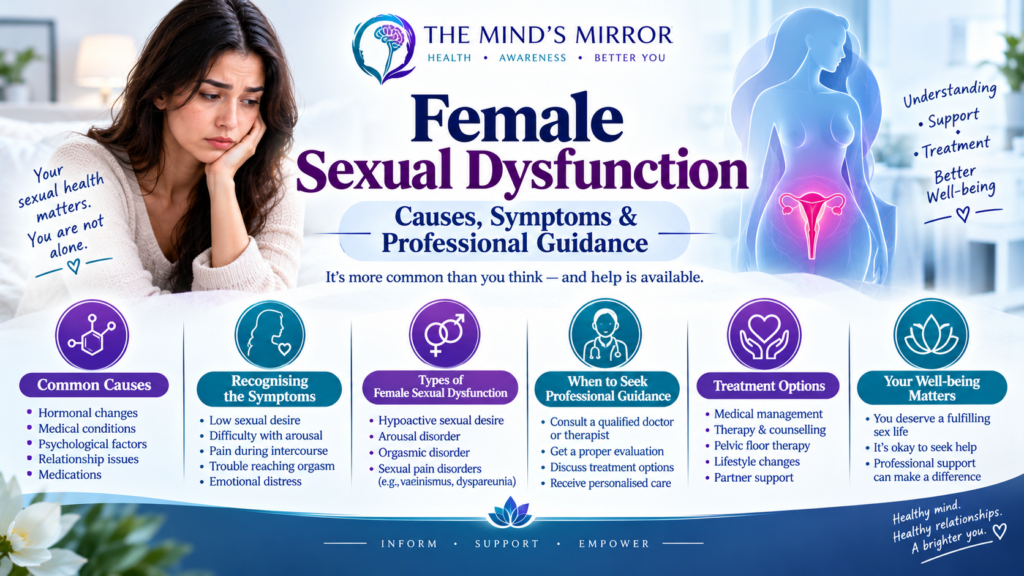
Female Sexual Dysfunction: Causes, Symptoms & Professional Guidance
Sexual health in women is an essential component of their holistic health needs; however, issues related to female sexual health are often misinterpreted, overlooked, or talked about in the sense of whether the woman wants sex.
It is much too simplistic.
The female may encounter problems with:
- Sexual desire
- Sexual arousal
- Physical sexual response
- Orgasm
- Pain
- Penetration
- Emotional comfort during intimacy
These problems might happen now and then or even go on for a while. They could be associated with health issues, hormones, medication, psychological reasons, relationship issues, situations in life, or a combination of more than one factor.
This general list of worries usually goes by the name of female sexual dysfunction.
In a marriage, such issues can become even more difficult.
A husband may ask:
“Why has my wife lost interest in intimacy?”
A wife may wonder:
“Why does my body not respond the way I expect?”
Both participants may wrongly assume that:
“There must be something wrong with our marriage.”
Occasionally a relational issue arises.
In some instances, the problem lies in the realm of medicine, psychology, hormones, or sexuality.
Recognizing the distinction is the initial stage to giving proper assistance.
What Is Female Sexual Dysfunction?
FSD is a clinical term which refers to problems in sexual function that occur persistently and recurrently with associated distress or impairment in an individual’s life.
Based on the person’s specific situation, it could entail:
- Sexual desire
- Sexual arousal
- Orgasm
- Sexual pain
- Penetration-related difficulties
The precise diagnosis will be based on the symptoms, period of time, suffering, medical history, personal relationships, among others.
Importantly, not every difference in sexual desire or response is a disorder.
There are natural differences in sexuality.
The fact that a woman’s husband needs more sex does not necessarily mean that she is suffering from a sexual disorder.
It is imperative that clinical evaluation is done with utmost caution.
The Major Areas of Female Sexual Dysfunction
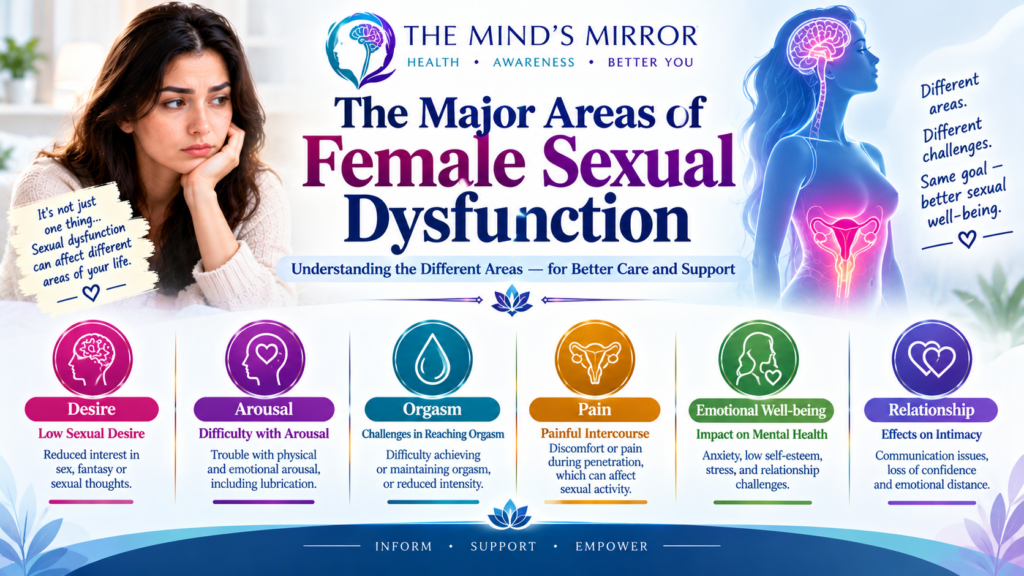
Sexual problems among females can manifest in diverse ways.
1. Low Sexual Desire
A woman might have continuous decrease in her sexual drive.
She may:
- Rarely think about sex
- Rarely initiate intimacy
- Experience lack of interest in sex
- Take note of how much her lust has increased since before
Causes of low desire are numerous.
It can result from stress, depression, relationship issues, hormone imbalance, medicines, sexual pain, or something else entirely.
2. Sexual Arousal Difficulties
It is possible that some women can feel sexually interested but have problems with arousal.
Possible experiences can include:
- Difficulty becoming sufficiently aroused
- Reduced physical sexual response
- Difficulty maintaining arousal
- Experience emotional detachment during sexual intercourse
Arousal is affected by physical as well as psychological factors.
Thus, the solution may not lie in just advising her to “relax.”
3. Orgasm Difficulties
Women can sometimes face problems achieving orgasm even though they feel aroused sexually.
It can be either life-long or developed following a phase of normal sexual function.
Possible contributing factors include:
- Psychological factors
- Anxiety
- Depression
- Medication effects
- Relationship difficulties
- Lack of sexual-health education
- Medical or neurological factors
What is the right way to test him/her?
4. Sexual Pain
Sexual pain in women is also an important sexual health problem.
It may involve:
- Pain at the vaginal orifice
- Deeper pelvic pain
- Burning
- Irritation
- Dryness
- Muscle tightening
- Pain from being penetrated in the past
One cannot consider pain as an aspect that a woman must endure.
It deserves appropriate assessment.
5. Vaginismus
Vaginismus is characterized by spasms of the involuntary muscles surrounding the vagina during an attempt at penetration.
Intentionally seeking sexual intimacy is not always aligned with involuntary physical responses.
This can cause a cycle:
Expected Pain > Anxiety > Muscle Tension > Pain > Increased Fear > Avoidance
Vaginismus can impact sexual well-being and marital life.
Fortunately, there is hope for many women through proper management.
6. Dyspareunia
The term dyspareunia, in general, is used for pain occurring during sexual intercourse.
There can be various causes that may include:
- Vaginal dryness
- Infections
- Hormonal changes
- Pelvic-floor dysfunction
- Gynecological conditions
- Menopause-related changes
- Postpartum changes
- Psychological factors
Self-diagnosis is not advised because pain can result from different causes.
What Are the Symptoms of Female Sexual Dysfunction?
They depend on the specific issue at hand.
A woman may notice:
- Reduced sexual desire
- Reduced interest in intimacy
- Difficulty becoming aroused
- Reduced physical sexual response
- Difficulty reaching orgasm
- Pain during sexual activity
- Vaginal discomfort
- Fear of sexual activity
- Involuntary muscle tightening
- Avoidance of intimacy
- Distress about sexual functioning
One symptom alone cannot necessarily lead to the diagnosis of a disease.
The important questions are:
How long has it been happening?
How severe is it?
What changed?
Is there significant distress?
Are there medical, psychological, or relationship factors involved?
What Causes Female Sexual Dysfunction?
There is seldom a single cause.
Sexual function in women depends on the intricate interplay of the physical, psychological, relational, and environmental factors.
Medical Causes
Hormonal Changes
Changes in hormones can influence sexual desire, arousal, lubrication, and comfort.
Significant life milestones may consist of:
- Pregnancy
- Postpartum recovery
- Breastfeeding
- Perimenopause
- Menopause
Hormones play an essential role; however, they do not solve all problems associated with female sexuality.
Chronic Medical Conditions
Some illnesses can affect your sexual performance.
Based on the disease, they might impact:
- Energy
- Hormones
- Blood flow
- Nerve function
- Mood
- Physical comfort
Examples may include hormonal diseases, nervous system disorders, heart problems, chronic pain problems, among others.
The connection of a disease to sexuality must be assessed on an individual basis.
Medications
Some drugs may influence sexual function.
Potential impacts on may include:
- Sexual desire
- Arousal
- Lubrication
- Orgasm
If a woman is experiencing a sexual change as a result of taking a drug, she should consult her prescribing practitioner.
Prescribed medication should not be stopped abruptly without medical advice.
Pregnancy and Postpartum Changes
Pregnancy, birth, and the postnatal period are periods of considerable physical and psychological change.
A new mother can have:
- Fatigue
- Sleep deprivation
- Hormonal changes
- Physical recovery
- Changes in body image
- Increased responsibilities
- Emotional adjustment
These factors can impact sexual desire and ease greatly.
A decrease in sexual desire during a significant life change is not always an indicator that the woman no longer loves her husband.
Menopause and Female Sexual Health
Menopause affects various functions related to sexuality.
Some women experience:
- Lower sexual desire
- Vaginal dryness
- Pain
- Changes in arousal
- Sleep difficulties
- Mood changes
Distressed women must bring up their problems to a qualified healthcare practitioner.
Sexual wellness is always an issue for women in all their lives.
Psychological Causes
Sexual performance is significantly influenced by the mind.
Anxiety
Anxiety can interfere with:
- Sexual desire
- Relaxation
- Arousal
- Comfort
- Sexual confidence
A lady might worry so much about pain, conception, performance, and expectations of her partner that sexual intimacy becomes linked with anxiety.
Depression
Depression may decrease one’s enjoyment in various aspects of life, including sexual activity.
A depressed woman may suffer from:
- Low energy
- Reduced pleasure
- Emotional numbness
- Sleep changes
- Reduced motivation
- Reduced sexual interest
Some of the antidepressants can also influence sexual function.
Professional assessment will be able to separate out the impact of depression on medications and other influences.
Stress and Mental Overload
Being married today may be quite demanding mentally and emotionally.
The woman could be handling:
- Children
- Employment
- Household responsibilities
- Family obligations
- Financial concerns
- Caregiving
- Academic responsibilities
Chronic stress reduces the desire for sex as well as making intimacy challenging.
This is the reason why the health of women sexually is inseparable from their well-being.
Body Image
If a woman is ashamed of her body, she may have a problem being relaxed when having sex.
Concerns may relate to:
- Weight
- Pregnancy
- Childbirth
- Aging
- Scarring
- Skin changes
- Physical illness
Communication that is supportive could be better than criticizing.
Previous Negative Experiences
Prior experiences of pain or fear can affect one’s sexuality.
Some women may experience:
- Anxiety
- Avoidance
- Fear
- Shame
- Difficulty trusting
- Difficulty relaxing during intimacy
Nonetheless, it is crucial to note that not all women suffering from sexual dysfunction have had traumatic experiences.
Clinical evaluation needs to investigate the real history of the individual.
Relationship Factors
Sexual function takes place in a relational setting.
Relationship problems may include:
- Frequent conflict
- Resentment
- Lack of emotional connection
- Loss of trust
- Infidelity
- Poor communication
- Feeling criticized
- Feeling unappreciated
- Unequal responsibilities
- Sexual pressure
They can influence one’s sexuality and libido.
Emotional Intimacy and Sexual Desire
In many cases, emotions and sex go hand-in-hand for couples.
It might be hard for a woman to become aroused when she is:
- Ignored
- Criticized
- Emotionally disconnected
- Unsafe
- Unappreciated
This does not imply that all sexual problems arise from the husband or from the relationship.
This implies that sexuality must be considered within the broader context of one’s life.
Desire Differences Between Husband and Wife
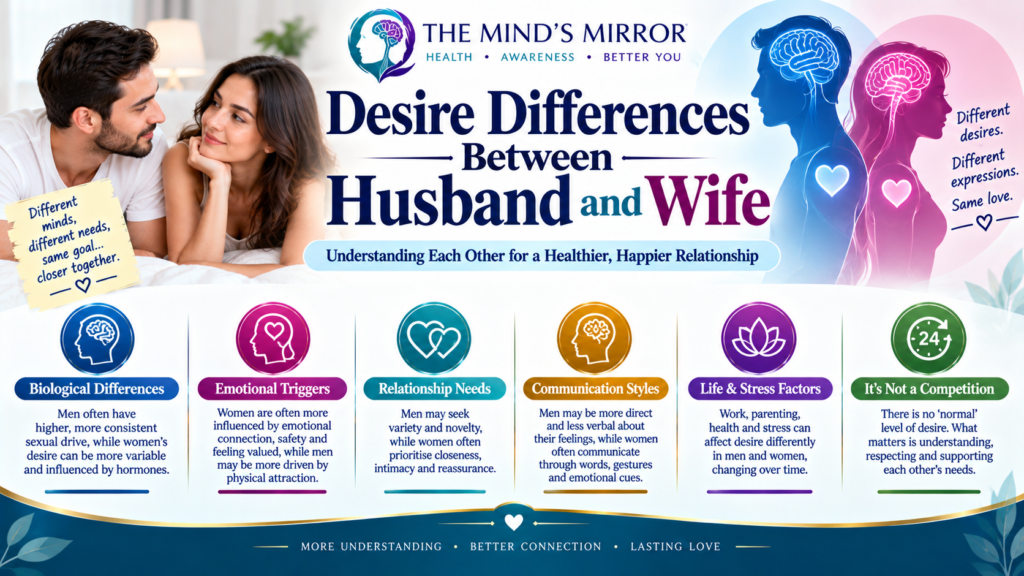
Among the common causes of friction in marriage is the disparity in sexual desire.
Intimacy for the man could occur more often.
His wife might desire it less often.
The difference in itself does not show that either one is unhealthy.
Problems occur when partners react via:
- Pressure
- Anger
- Rejection
- Blame
- Shame
- Threats
- Emotional withdrawal
Healthy partners learn to talk about their differences.
Is Female Sexual Dysfunction a Sign That a Woman Does Not Love Her Husband?
No.
Sexual activity and love connections are connected but not the same.
A woman may love her husband dearly and yet feel:
- Low desire
- Pain
- Anxiety
- Hormonal changes
- Depression
- Medication effects
- Sexual dysfunction
Thus, taking all sexual problems as an indication of marital love could worsen the situation.
Is Female Sexual Dysfunction Common After Marriage?
Sexual dysfunction may arise at various ages and in marriages.
Some women encounter difficulties even when they first become sexually active.
Some exhibit symptoms later due to:
- Pregnancy
- Childbirth
- Menopause
- Medical illness
- Medication
- Psychological stress
- Relationship changes
Any alteration in sexual function is worthy of consideration, especially if it results in substantial distress.
Female Sexual Dysfunction and Islamic Perspectives
Sexual health queries may be related to medicine as well as religion for Muslim women and couples.
Marriage in Islam is considered a relationship that involves love, mercy, intimacy, obligations, and rights.
Description of spouses in the Qur’an includes tranquility, tenderness, and mercy.
These guidelines offer an essential platform when speaking about marital intimacy.
On the other hand, there are specific issues pertaining to sex, marriage, and religion that need to be considered based on the Qur’an and Hadith.
Islamic law is not necessarily implied in cultural traditions.
Similarly, a medical problem cannot be understood as a spiritual deficiency or conscious denial.
Does Islam Recognize Female Sexual Needs?
Islamic discourse on marriage recognizes that spouses owe duties to each other.
Thus, a balanced view of sexual intimacy within marriage cannot overlook the sexual well-being of women.
Women can experience:
- Sexual desire
- Sexual pleasure
- Sexual pain
- Sexual dysfunction
- Emotional needs
- Intimacy concerns
They are human experiences and must be treated with respect.
However, when a particular religious ruling becomes necessary, personal situations and scholarly expertise become important.
Treatment for Female Sexual Dysfunction
It all depends on the condition.
One size does not fit all for women’s health care issues.
An effective strategy might require the expertise of one person or multiple people.
- Medical Evaluation
The healthcare practitioner might assess:
- Symptoms
- Medical history
- Hormonal factors
- Medications
- Pain
- Menstrual and reproductive history
- Other health conditions
Based on the symptoms presented, further investigation is sometimes warranted.
- Treating Underlying Medical Conditions
When a disease is causing sexual dysfunction problems, curing the disease might help improve one’s sex life.
Examples may include addressing:
- Hormonal problems
- Infections
- Pain conditions
- Menopause-related symptoms
- Medication side effects
- Other relevant health problems
Treatment should be individualized.
- Psychological Treatment
Psychotherapy is helpful when there are psychological issues affecting one’s sexuality.
Treatment will depend on the scenario and include:
- Anxiety
- Depression
- Negative beliefs
- Sexual fear
- Shame
- Body-image concerns
- Previous distressing experiences
Psychological treatment based on scientific evidence could help females learn more appropriate attitudes toward sexual problems.
- Sex Therapy
Sex therapy is a formal therapeutic process for sexual health problems.
It could be suitable for:
- Low sexual desire
- Sexual anxiety
- Sexual pain
- Vaginismus
- Orgasm difficulties
- Arousal difficulties
- Desire differences
- Sexual communication problems
Sex therapy does not only entail teaching of sexual skills.
It entails the understanding of sexual functions medically, psychologically, and relationally.
- Couple Therapy
If the sexual problems are heavily related to marital problems, then couple therapy might prove effective.
It can address:
- Communication
- Emotional intimacy
- Trust
- Conflict
- Resentment
- Desire differences
- Relationship expectations
Sometimes a better relationship creates a more healthy atmosphere to deal with sexual problems.
- Pelvic-Floor Therapy
In cases where there is an issue with the pelvic floor muscles or pain during sex, pelvic floor physical therapy might be recommended.
A skilled pelvic health therapist can evaluate muscle function and decide on the need for special treatment.
- Education
Sexual health education is frequently neglected.
A woman may have to comprehend:
- Female anatomy
- Sexual physiology
- Desire
- Arousal
- Hormonal influences
- Pain
- Pelvic-floor function
- Psychological influences
- Relationship factors
Education can help overcome fears and clear misconceptions.
What Women Should Avoid
Females facing problems with sexuality must be careful about:
- Unverified internet “cures”
- Unregulated supplements
- Self-prescribing hormones
- Taking medicines without doctor’s consultation
- Comparing themselves with pornography
- Assuming that pain is normally acceptable
- Given that all problems are psychological
- Assuming that all problems are hormonal
Professional evaluation is more secure than self-assessment.
What Husbands Should Understand
In case your wife suffers from female sexual dysfunction, take into account:
Her symptoms are not necessarily a rejection of you.
Perhaps she is suffering from a physical, mental, hormonal, or emotional problem.
Instead of saying:
“You don’t love me anymore.”
A more productive way could be:
“I have observed that intimacy has been hard for you. Is there anything going on that we need to understand?”
That shift in communication can decrease defensiveness and foster help-seeking behavior.
What Couples Can Do Together
Couples can begin by:
- Talking without blame.
- Discussing pain honestly.
- Determining the point where the issue originated.
- Taking into consideration medical and life changes.
- Checking medication with a health practitioner.
- Addressing relationship conflict.
- Requesting professional evaluation if required.
- Learning accurate sexual-health information.
- Respecting personal boundaries.
- Taking into consideration proper medical, psychological, sex therapy, or couples therapy.
When Should a Woman Seek Professional Help?
Professional assessment is particularly suitable if sexual problems are:
- Persistent
- New or unexplained
- Painful
- Also linked to physical signs
- Causing significant emotional distress
- Creating serious marital conflict
- Affecting quality of life
- Associated with medication changes
- Following a significant health or reproductive experience
Why should you bear your suffering silently for years?
When Is It Not a Sexual Dysfunction?
This is a crucial issue.
Just because a woman does not necessarily have female sexual dysfunction because:
- He is sexier than she is.
- Her desires are of a different magnitude.
- She is not frequently sexually proactive.
- Her desire is affected temporarily due to stress.
- She is exhausted because she gave birth.
- Her reactions are not necessarily those of her husband.
Human sexuality varies.
Clinical diagnosis entails a thorough evaluation of the patient’s symptoms and suffering as opposed to comparison between spouses.
Why Female Sexual Health Education Matters
Many females have not gotten medically correct information regarding their own sexual health.
This could lead to unnecessary:
- Fear
- Shame
- Confusion
- Self-blame
- Marital conflict
- Delayed treatment
Sexual-health education for professionals may enable women and healthcare professionals to realize that sexuality includes far more than mere sexual arousal.
It requires the interactions of:
Body + Brain + Hormones + Emotions + Relationships + Health + Environment
Clinical Sex Education: Beyond “How to Have Sex”
Sex education clinically is not the same as sex education explicitly.
An expert educational framework emphasizes the study of human sexuality in terms of health and behavior.
Important areas include:
- Sexual anatomy
- Sexual physiology
- Female sexual health
- Male sexual health
- Sexual desire
- Sexual arousal
- Orgasm
- Sexual pain
- Vaginismus
- Sexual dysfunction
- Psychological influences
- Relationship dynamics
- Sexual communication
- Clinical assessment
- Treatment principles
- Referral considerations
- Cultural factors
- Islamic perspectives
- Professional ethics
The larger perspective is especially relevant for health practitioners whose patients may present with sexual health problems.
Learn More Through the IMAHRKMI Clinical Sex Education Course
If you are a healthcare provider, a medical student, counselor, or sexual health educator, then learning about female sexual dysfunction is something that can be integral to building your sexual health education.
IMAHRKMI’s Clinical Sex Education course is designed to provide educational material regarding sexuality from various viewpoints such as medically, psychologically, relationship-wise and culturally.
The educational framework includes:
- Female sexual health
- Male sexual health
- Sexual desire
- Sexual dysfunction
- Sexual pain
- Vaginismus
- Psychological factors
- Relationship and couple dynamics
- Sexual-health communication
- Clinical considerations
- Relevant Islamic perspectives
- Role of the Qur’an and Hadith in education
- Professional and ethical considerations
The idea is to educate learners about sexual health issues in a responsible manner, rather than depending on misconceptions, pornography, social media, and rumors.
Who Can Benefit From Clinical Sex Education?
Such an education system might prove particularly pertinent to:
- Physicians
- Healthcare professionals
- Medical students
- Mental-health professionals
- Counselors
- Relationship professionals
- Sexual-health educators
- Professionals who deal with couples
Increased knowledge about the health and wellness of women sexually could enable professionals to identify patients who require evaluation, psychological intervention, sex therapy, couples’ therapy, or other referral.
Final Thoughts
Female sexual dysfunction is not one single problem.
It covers many aspects of sexual wellbeing and may include things like desire, arousal, orgasm, pain, penetration, and psychological upset.
The reasons may be just as diverse.
She can suffer from:
Medical factors
Changes in hormones, sickness, drugs, pain, or reproduction.
Psychological factors
Anxiety, depression, stress, shame, body image, or past trauma.
Relationship factors
Arguments, emotionally detached, poor communication, bitterness, or sexual coercion.
Life circumstances
Pregnancy, birth, parenthood, work, tiredness, or life transitions.
Cultural and religious factors
The beliefs, expectations, Islamic teachings, and sexual health education.
The key lesson here is that
Female sexual difficulties should be understood—not mocked, blamed, or ignored.
Pain deserves medical attention.
Psychological stress requires appropriate psychological intervention.
Relationship conflicts require constructive communication.
Sexual health education is very important.
The marriage of the Muslims is one where medical and psychological treatment may be supplemented by an appreciation of Islamic guidelines and scholarship.
As a medical professional or anyone else who would like to gain further insight into women’s sexual well-being, you may want to explore clinical sex education.
Enroll in the IMAHRKMI Clinical Sex Education Course
Learn the science, understand the psychology, understand the relationships, explore the Islamic perspectives and become an expert in your own sexual health.
This is how your sexual health questions deserve to be responded to, not with shame but with science and understanding.
This article is intended for general educational purposes. It does not replace individualized medical evaluation, diagnosis, treatment, psychotherapy, sex therapy, or a personal religious ruling from a qualified Islamic scholar.