
Medical, Psychological, Relationship & Islamic Perspectives
Introduction
Many couples start out married on a high note, full of emotional connection and high expectations for sexual fulfillment.
However, time passes, and some things might happen.
The two people may be in love with each other, take good care of their family, work together as a couple—but sex just isn’t as pleasurable and natural anymore.
Some couples ask:
“Why don’t we enjoy sex like we used to?”
Others wonder:
“Why has our sexual relationship become routine?”
“Why does my husband seem less interested?”
“Why has my wife lost interest?”
“Why do we keep having the same sexual problems?”
These kinds of questions are asked a lot—but there is no single answer.
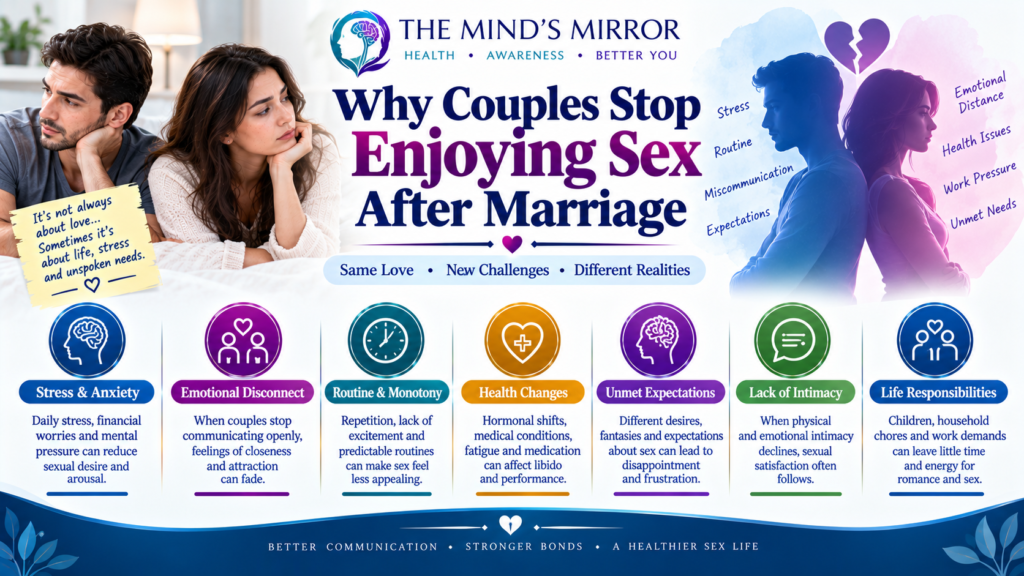
Sexual dissatisfaction can come from a number of different places:
- Relationship conflict
- Emotional disconnection
- Stress
- Fatigue
- Parenthood
- Medical conditions
- Hormonal changes
- Sexual dysfunction
- Sexual pain
- Anxiety or depression
- Medication effects
- Unrealistic expectations
- Poor sexual communication
- Differences in sexual desire
- Cultural or religious concerns
Sometimes the reason that couples no longer enjoy intimacy is because their relationship is different.
Sometimes the body has changed.
Sometimes the mind has changed.
Or perhaps they never learned how to communicate about sex.
This understanding will prove to be much more valuable than pointing fingers at either partner.
Does Losing Sexual Excitement Mean the Marriage Is Failing?
Not necessarily.
Long-term relationships naturally change.
The first period of marriage might include elements of novelty, thrill, anticipation, and less responsibility.
Later, couples may face:
- Children
- Work pressure
- Financial responsibilities
- Household responsibilities
- Health problems
- Aging
- Sleep deprivation
- Family obligations
Stability could be achieved in the relationship, but the state of being sexually excited would change.
It does not necessarily mean that love was gone.
But if there is a continual reduction in sexual satisfaction which causes problems, it should be addressed.
1. The Transition From Novelty to Familiarity
In the beginning of the relationship, everything is new.
Over time, familiarity increases.
They get to know each other’s ways and styles of life.
This is good from an emotional security perspective, but too much routine may sometimes make intimacy predictable.
It does not have to mean searching for continuous thrill.
Couples would be better off developing:
- Emotional connection
- Communication
- Affection
- Mutual understanding
- Appreciation
- Relationship quality
Sexual satisfaction usually takes place within the overall relationship.
2. Stress Can Reduce Sexual Interest
Stress is one of the leading contributors to problems with intimacy.
Someone who works all day with:
- Work
- Children
- Financial concerns
- Household responsibilities
- Family problems
- Academic pressure
- Caregiving
will not have much emotion left in him by the time he gets home from work.
The body will be there, but the mind will still be involved with its tasks.
This stress can contribute to problems with libido, arousal, and sexual satisfaction.
3. Fatigue and Sleep Problems
Physical intimacy takes effort and availability of energy.
Sleep deprivation can affect:
- Mood
- Concentration
- Energy
- Stress tolerance
- Sexual desire
Sometimes, this is very relevant to parents of young children.
The husband might take the tiredness of his wife as a rejection signal.
The wife might take the irritation of her husband as a signal of lack of understanding.
They might both have the same problem — chronic tiredness.
4. Having Children Changes Married Life
Becoming parents may change their day-to-day life.
More time than children before:
- Privacy
- Time
- Flexibility
- Rest
- Emotional space
For children, they can become limited.
Parents may experience:
- Sleep deprivation
- Constant responsibilities
- Reduced privacy
- Physical exhaustion
- Changes in body image
- Postpartum changes
- Increased mental workload
Temporary reduction in sexual activity during important life events is not always an indication of problems within the marriage.
5. Emotional Disconnection
Emotional attachment becomes a key component for achieving intimacy between spouses.
Couples can live together and talk to each other every day without growing closer emotionally.
These people might talk about:
- Children
- Money
- Work
- Shopping
- Household responsibilities
but rarely talk about:
- Feelings
- Fears
- Appreciation
- Relationship concerns
- Emotional needs
If emotional intimacy goes away, it might be harder to have sexual intimacy for some couples.
6. Unresolved Resentment
Little issues can pile up over time.
A couple might never really solve:
- Repeated arguments
- Broken promises
- Financial disagreements
- Family conflicts
- Unequal responsibilities
- Emotional neglect
In time, the unaddressed resentment will impact intimacy.
One spouse may think:
“How can I feel close to someone when I am still angry with them?”
This is the reason that sexual difficulties sometimes need to look at relationships and not just sex.
7. Poor Communication About Sex
Many married couples can talk about anything but sex.
This includes talking about:
- Money
- Children
- Jobs
- Family
but feel uneasy when talking about:
- Sexual desire
- Pain
- Sexual preferences
- Boundaries
- Expectations
- Dissatisfaction
Thus, assumption replaces communication.
A spouse may think:
“My partner should already know what I need.”
However, mind-reading is not possible for partners.
Respectful dialogue is key to healthy sexual communication.
8. Differences in Sexual Desire
It is not necessary that all couples have equal sexual drive.
One partner might need more intimacy.
The other partner might want intimacy less often.
That doesn’t necessarily mean that one partner has a problem.
But the problem of desire difference can be a serious problem when the partners react to it by:
- Pressure
- Anger
- Blame
- Rejection
- Shame
- Withdrawal
Healthy couples learn to communicate about their differences without using character assassinations.
9. Female Sexual Health Problems
Sexual problems in women may have a serious impact on the intimate relationship of couples.
Examples include:
- Low sexual desire
- Difficulty with arousal
- Orgasm difficulties
- Sexual pain
- Vaginismus
- Vaginal dryness
- Hormonal changes
The issue might be that sex is uncomfortable for her and not that she loves him any less.
It makes a tremendous difference.
10. Male Sexual Health Problems
Men also suffer from sexual health concerns that can cause a decline in marriage satisfaction.
These may include:
- Erectile difficulties
- Ejaculatory problems
- Low sexual desire
- Performance anxiety
- Medication-related sexual changes
- Medical problems associated with sexual functions
The husband may feel ashamed to talk about it.
The wife may take his reticence to indicate lack of interest.
The underlying problem could still be medical or psychological, not relationship-related.
11. Sexual Pain Can Destroy Enjoyment
Sex is not necessarily going to be enjoyable for all people.
Some women may suffer from pain with sexual intercourse due to:
- Vaginismus
- Vaginal dryness
- Hormonal changes
- Infections
- Pelvic-floor problems
- Gynecological conditions
- Other medical causes
The anticipation of pain is created by the repetition of pain.
This can result in:
Pain → Fear → Avoidance → Relationship tension → More anxiety
Medical evaluation is necessary if the pain continues.
12. Anxiety and Performance Pressure
Sexual relations become stressful if one of the spouses feels the pressure of “performing.”
A person may worry:
- Am I good enough?
- What will my wife think?
- Will there be an erection?
- Will I reach orgasm?
- What will my partner think about me?
Anxiety can affect one’s sexual performance.
Intimacy is transformed into a test.
It could slowly take away pleasure from both individuals.
13. Depression and Emotional Health
Depression may also impact sex drive and pleasure.
Depressed people can be expected to display:
- Low energy
- Reduced pleasure
- Emotional numbness
- Sleep problems
- Reduced motivation
- Difficulty connecting emotionally
Certain antidepressant drugs may also have an impact on sexual function.
If sexual changes co-exist with significant mood disturbances, then consultation may be warranted.
14. Hormonal Changes
Sexual function can vary throughout one’s lifetime.
Important periods can include:
- Pregnancy
- Postpartum recovery
- Breastfeeding
- Perimenopause
- Menopause
- Other hormonal changes
Hormonal influences can impact one’s desires, arousal, lubrication, pleasure, and general wellbeing.
However, hormones are just one possible explanation for such changes.
15. Medication Effects
Some medications can influence sexual functioning.
Based on the medication and individual case, effects can include:
- Sexual desire
- Arousal
- Lubrication
- Erectile function
- Orgasm
In case a change happens after starting or changing medication, then one needs to consult a healthcare professional.
One should not discontinue prescribed medication without medical advice.
16. Body Image and Attraction Concerns
Physical changes are expected during marriage and aging process.
Changes in weight, pregnancy, delivery, illness, aging, and others may have an effect on body image.
A partner who finds himself/herself unattractive will feel less comfortable during intimacy.
It will just exacerbate the situation.
More effective ways include emotional support and courteous communication.
17. Unrealistic Expectations
People often start a marriage with an illusion of sexual intimacy.
Those expectations could stem from:
- Movies
- Social media
- Pornography
- Friends
- Cultural myths
- Unverified online information
Actual intimacy within marriage is far from being entertaining.
Real couples experience:
- Different levels of desire
- Stress
- Illness
- Fatigue
- Pregnancy
- Aging
- Emotional changes
Good sex should not always be based on an impossible ideal.
18. Pornography and Sexual Expectations
Pornography can set up impossible standards for:
- Sexual frequency
- Appearance
- Sexual performance
- Desire
- Arousal
- What one’s partner “ought” to be into
Comparing one’s spouse to pornography can have negative effects on intimacy.
Sexual relations within marriage are between two real persons, not actors.
Sexual health education can aid couples in distinguishing between information about sexual health and entertainment.
19. Lack of Affection Outside Sexual Activity
Some couples find themselves making affection into an activity only done with the intent of having sex.
This has the potential to become a side effect.
When affection such as hugging or kissing is perceived as a sexual invitation, one spouse will eventually start shunning affection in order to avoid feeling forced.
Couples don’t have to limit themselves to just sexual affection.
Intimacy does not have to be accompanied by an assumption of sex all the time.
20. Feeling Pressured
Obligation may end up lessening sexual satisfaction over time.
A spouse may feel:
“I have to do this because my partner expects it.”
Sex can become less enjoyable when intimacy is accompanied by fear or stress.
Both willingness and consideration are essential elements of a marriage relationship.
21. Relationship Trust
Trust is the foundation of intimacy.
Things that could lead to loss of trust are:
- Infidelity
- Repeated lying
- Financial secrecy
- Emotional betrayal
- Broken promises
- Excessive criticism
When there is a loss of trust, intimacy can also be affected.
In such scenarios, paying too much attention to sex alone may ignore the underlying relationship issues.
22. Anger and Conflict
Unresolved anger may exist between some couples.
These couples can argue constantly and then immediately seek intimacy afterwards.
Sometimes that works temporarily.
Unresolved conflicts could persist below the surface nonetheless.
Relationship counseling could assist couples in dealing with their conflicts without just treating symptoms of these conflicts.
23. Religious and Cultural Concerns
In the case of Muslim couples, their sexual relationship might include issues related to:
- Marital rights
- Responsibilities
- Modesty
- Permissible and impermissible practices
- Purification
- Sexual health
- Husband-wife communication
Couples may get mixed messages on the issue from family, social media, or anonymous websites.
Not all traditions are necessarily Islamic teachings.
Not all Internet opinions are Islamic opinions.
Questions related to religion ought to be researched using trustworthy sources from the Qur’an and Hadith, and for any specific ruling, using Islamic scholars.
Islamic Perspective on Marital Intimacy
Marriage is viewed in Islam as an institution comprising:
- Affection
- Mercy
- Companionship
- Responsibility
- Mutual rights
- Respect
Spouses are characterized by peace, love, and mercy in the Qur’an.
The larger picture becomes relevant while talking about marital intimacy.
Marital sexuality cannot therefore be divorced from the qualities of character, generosity, accountability, and consideration.
On the other hand, the detailed religious positions with regards to the various sexual acts have to be treated carefully through valid sources.
Does Losing Interest in Sex Mean Losing Love?
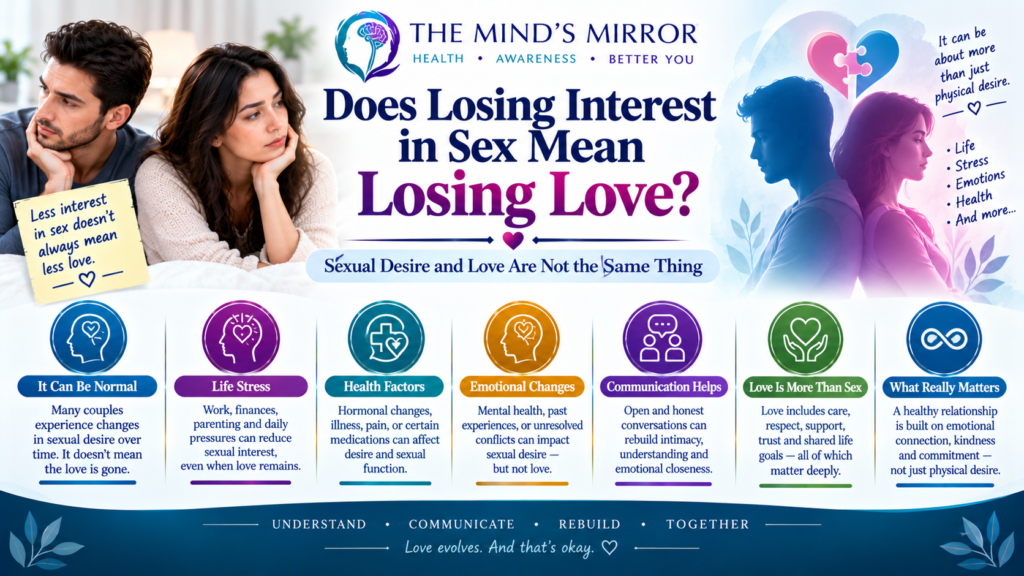
Not necessarily.
Many factors can lead to alterations in sexual desires.
A married man or woman may love his/her partner despite experiencing:
- Stress
- Depression
- Hormonal changes
- Pain
- Sexual dysfunction
- Medication effects
- Exhaustion
- Relationship resentment
Therefore:
Low sexual desire ≠ lack of love.
Nevertheless, should a change be chronic and cause discomfort, it should be addressed.
Why Couples Sometimes Stop Talking About Sex
This pattern is quite common:
Problem → Embarrassment → Silence → Misunderstanding → Resentment → More Distance
For example:
A wife suffers from pain without willing to talk about it.
He believes that she is rejecting him.
He becomes frustrated.
She feels pressured.
She withdraws from physical contact even further.
Neither of them knows the reason behind this issue.
To break this cycle, communication should take place.
How Couples Can Rebuild Sexual Connection
In most cases, intimacy cannot be restored by solving just one problem.
This is frequently started by comprehending the overall relationship.
Start With Communication
Discuss the issue without assigning blame.
Instead of:
“You never want me anymore.”
try:
“I have realized that intimacy is becoming challenging for us. I want to know why this is happening and how we could possibly solve it.”
Discuss Health
Consider if there have been any modifications in:
- Physical health
- Medications
- Hormones
- Pregnancy
- Childbirth
- Menopause
- Sleep
- Mental health
Address Relationship Problems
In case of tension or disputes between the couple that affects intimacy, there could be an issue with the relationship.
Remove Unnecessary Pressure
Intimacy should never turn into a competition or a test.
Good communication can lessen anxiety.
Rebuild Emotional Connection
Spend some time with your partner in activities other than sexual ones.
Talk.
Listen.
Show appreciation.
Create intimacy without linking it sexually.
When Should Couples Seek Professional Help?
Getting professional help is recommended when:
- Sexual problems persist.
- Intimacy has become painful.
- The individual(s) is(are) extremely distressed.
- There is a large disparity in their sexual needs.
- Sexual dysfunction is suspected.
- A person is suffering from depression/anxiety that affects intimacy.
- There is continuous conflict within the relationship.
- Trust has been damaged.
- Communication repeatedly fails.
- They cannot discuss sexual issues without arguing.
Asking for assistance doesn’t indicate that the marriage has ended.
At times, this implies that the marriage is being taken seriously.
Medical Treatment
In cases where health-related issues contribute to sexual problems, the treatment will depend on the condition involved.
Healthcare provider may determine:
- Hormonal factors
- Medication effects
- Chronic health conditions
- Pain
- Sexual dysfunction
- Reproductive or gynecological concerns
Treatment should be individualized.
Psychological Treatment
Treatment involving psychological intervention might be useful if there are:
- Anxiety
- Depression
- Stress
- Body-image concerns
- Sexual fear
- Previous distressing experiences
contribute to sexual difficulties.
Sex Therapy
Sexual therapy will allow an individual and even a couple to comprehend sexual issues from a professional therapeutic perspective.
It may address:
- Desire differences
- Sexual anxiety
- Sexual pain
- Sexual dysfunction
- Communication
- Intimacy
- Relationship patterns
Sexual therapy does not just include sexual education or advice.
It is a professional approach to sexual and relationship issues.
Couple Therapy
Couple therapy may be especially appropriate when the cause of sexual problems involves the following:
- Conflict
- Resentment
- Trust problems
- Communication difficulties
- Emotional distance
- Different expectations
Sometimes sexual issues cannot be solved without solving relationship issues.
Why Clinical Sex Education Matters
Sexual education can come from many sources which are not specifically meant for health education purposes.
They may learn from:
- Social media
- Friends
- Pornography
- Anonymous websites
- Cultural myths
This can create confusion.
Clinical sex education is a broad concept.
It considers:
Medicine + Psychology + Sexual health + Relationships + Communication + Culture + Ethics
If the audience is Muslim, an Islamic view of the issue could also be studied in addition to scientific knowledge of medicine and psychology.
Clinical Sex Education: More Than Sexual Techniques
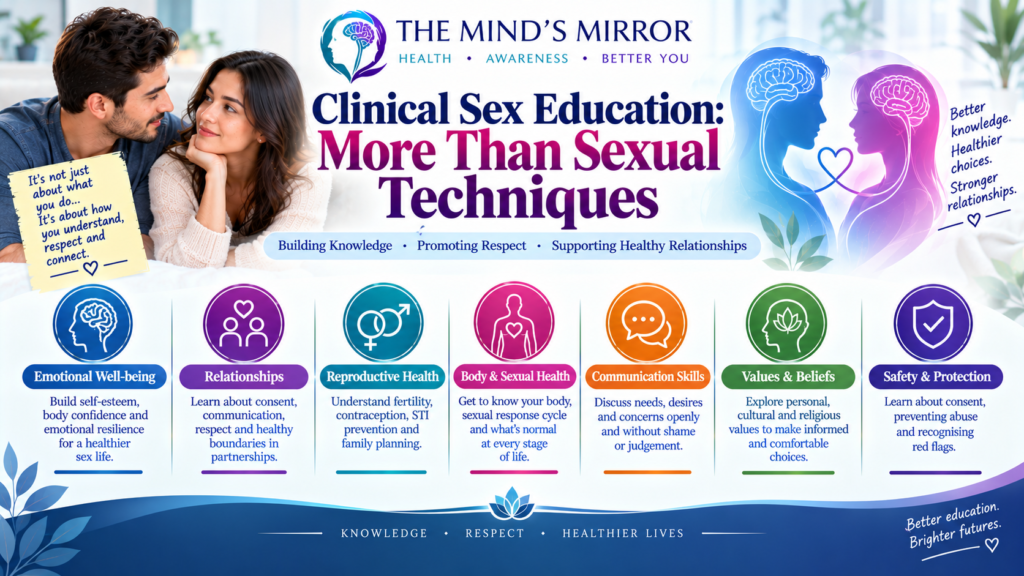
It should not be confused with explicit entertainment.
This course involves learning about human sexuality by means of education in an organized manner.
Important areas may include:
- Female sexual health
- Male sexual health
- Sexual desire
- Sexual arousal
- Sexual dysfunction
- Sexual pain
- Vaginismus
- Psychological influences
- Relationship dynamics
- Sexual communication
- Medical factors
- Clinical concerns
- Cultural considerations
- Islamic perspectives
- Professional ethics
Education of such nature could prove very beneficial to professionals in the healthcare industry and relationships sector.
Learn More Through the IMAHRKMI Clinical Sex Education Course
In case you are in any of the above-mentioned professions – that is healthcare professionals or medical students, counselors, relationships professionals or sexual educators, knowing why couples have issues related to sexuality can form part of your professional education.
IMAHRKMI Clinical Sex Education Course involves structured education on human sexuality from a medical, psychological, relationship, cultural and Islamic perspective.
It involves learning about aspects of sexual health beyond sexual techniques.
Students can learn more about:
- Female sexual health
- Male sexual health
- Sexual desire
- Sexual dysfunction
- Sexual pain
- Vaginismus
- Psychological factors
- Relationship and couple dynamics
- Sexual-health communication
- Clinical considerations
- Relevant Islamic perspectives
- Qur’anic verses and Hadith concerning these educational topics
- Professional and ethical considerations
This will be responsible education that can help the learner understand the cause of sexual disorders and ways to deal with them professionally.
Who Can Benefit From This Course?
Clinical sexual education can be particularly effective in helping:
- Physicians
- Healthcare professionals
- Medical students
- Mental-health professionals
- Counselors
- Relationship professionals
- Sexual-health educators
- Professionals dealing with married individuals
It can assist people in gaining better information about their sexual health instead of believing in misconceptions.
Final Thoughts
Why do couples stop enjoying sex after marriage?
There is rarely one right answer for everyone.
Sometimes the issue lies with stress.
Sometimes it is exhaustion.
Sometimes it is emotional distance.
Sometimes it is unresolved anger.
Sometimes one person simply does not have much sex drive.
Sometimes, there is some kind of medical problem, hormonal imbalance, side effects of medicines, dyspareunia, vaginismus, erectile dysfunction, stress, or depression.
Sometimes, there are some unreal expectations on their part.
And sometimes, they just have not been taught how to talk about intimacy.
For a Muslim couple, there can be issues of religion and culture that need to be discussed.
The most important thing is this:
Reduced sexual satisfaction doesn’t always imply reduced love either.
Instead of asking:
“Who is at fault?”
couples can ask:
“What has changed, what is changing our relationship, and what can we do to fix it?”
This is a question that offers an opportunity for healing.
Healthy marriages are not just about having frequent sex.
It also involves:
Companionship.
Mercy.
Respect.
Communication.
Emotional connection.
Mutual consideration.
Physical and psychological well-being.
When sexual issues are lasting, there’s no denying the importance of seeking professional help.
When couples get accurate information regarding their sexual health, they will be able to deal with difficult issues by gaining more knowledge rather than feeling embarrassed about them.
Enroll in the IMAHRKMI Clinical Sex Education Course
Do you want to understand marital intimacy from medical, psychological, relationship, and Islamic perspectives?
The IMAHRKMI Clinical Sex Education Course offers organized teaching of human sexuality, sexual health of women and men, sexual dysfunction, sexual pain, psychology, relationships, and Islamic education.
Learn the science. Learn the psychology. Learn relationships. Learn Islam.
Your questions demand an educated answer.