
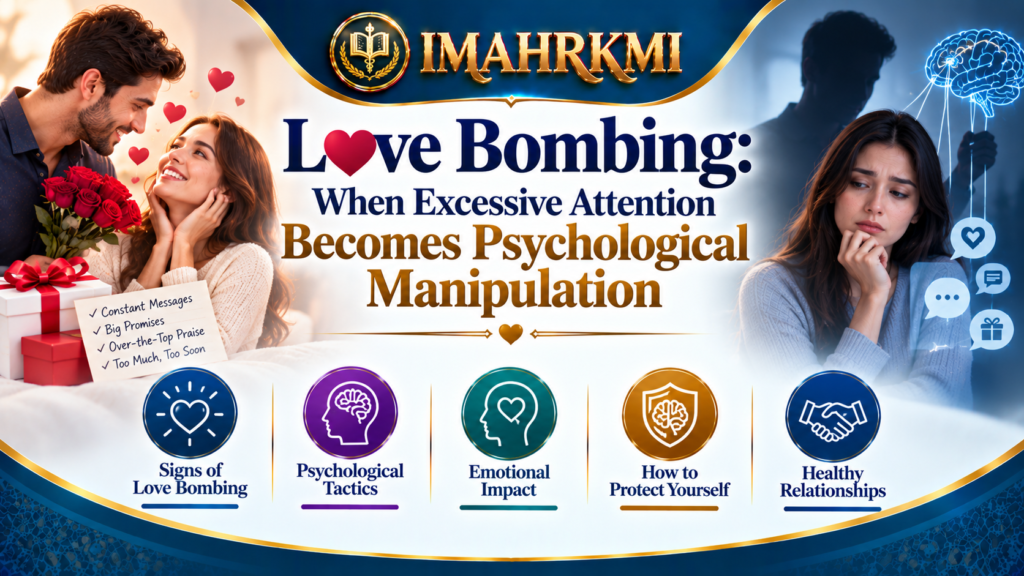
Love Bombing: When Excessive Attention Becomes Psychological Manipulation
At the beginning of a new relationship, intense excitement can feel wonderful.
Someone may message frequently, give thoughtful compliments, express strong affection, make future plans, and make you feel unusually valued. Sometimes this is simply genuine romantic excitement.
But what happens when intense attention becomes excessive, unusually rapid, or connected to pressure and control?
This is where the term love bombing is often used.
Love bombing generally refers to a pattern of overwhelming another person with affection, attention, praise, gifts, communication, or promises of closeness, particularly when these behaviors are used to accelerate attachment or gain influence.
It is important to understand that not every intense beginning to a relationship is love bombing.
Some people naturally express affection enthusiastically. A new relationship can also involve genuine excitement, frequent communication, and strong emotional connection.
The concern arises when excessive affection becomes part of a broader pattern of manipulation, control, dependency, or emotional pressure.
This article explores what love bombing means, common warning signs, the psychology behind it, how it can affect relationships, and how people can distinguish genuine affection from potentially manipulative behavior.
What Is Love Bombing?
Love bombing is a term used to describe an unusually intense pattern of affection, attention, praise, gifts, communication, or emotional closeness that may be used to rapidly establish attachment or influence another person.
It may involve:
- excessive compliments,
- constant messages,
- unusually intense declarations of love,
- extravagant attention,
- rapid discussions of marriage or a future together,
- excessive gifts,
- constant reassurance,
- pressure for immediate emotional closeness,
- or making the other person feel uniquely special.
Again, these behaviors are not automatically manipulative.
The important question is:
What happens after the intense affection is established?
If affection is followed by increasing control, jealousy, guilt, emotional pressure, or withdrawal, the earlier behavior may be understood differently.
Love Bombing vs. Genuine Affection
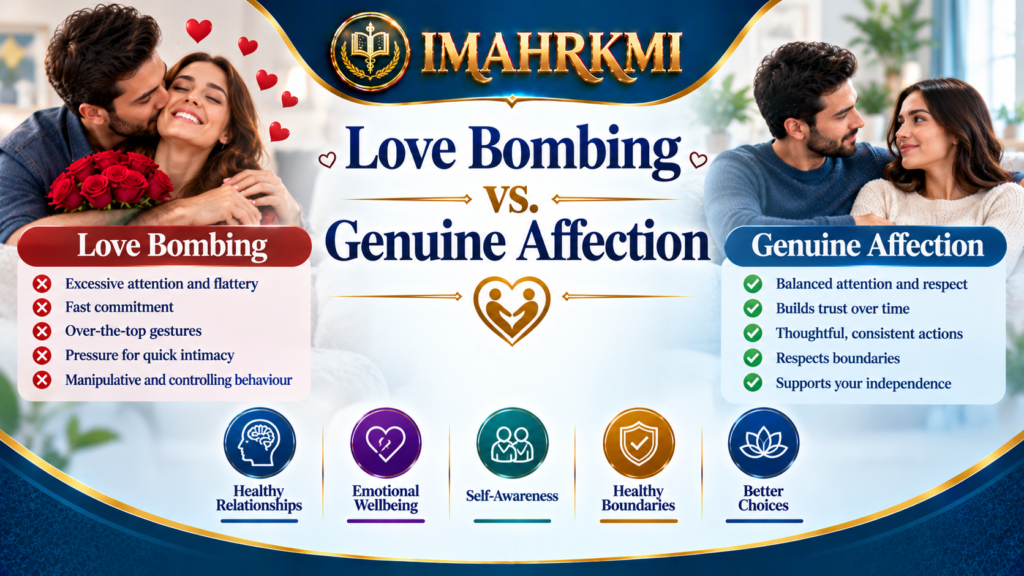
This distinction is extremely important.
A person can genuinely become excited about a new relationship.
They may:
- communicate frequently,
- give compliments,
- plan dates,
- express affection,
- discuss the future,
- or give thoughtful gifts.
None of these behaviors alone proves manipulation.
A healthier relationship generally allows affection to develop alongside:
- respect,
- realistic expectations,
- personal boundaries,
- independent decision-making,
- gradual trust,
- and freedom to say no.
A potentially concerning pattern may look different:
Intense affection → rapid attachment → pressure → control → emotional punishment.
The pattern is more important than any single romantic gesture.
Why Can Love Bombing Feel So Powerful?
Love bombing can be emotionally powerful because humans naturally respond to:
- attention,
- validation,
- affection,
- belonging,
- approval,
- admiration,
- and emotional connection.
When someone suddenly provides a great deal of positive attention, the experience can feel deeply rewarding.
A person may think:
“I’ve finally found someone who truly understands me.”
This emotional intensity can accelerate attachment before the individuals have had enough time to understand each other’s personalities, values, boundaries, and behavior under stress.
That is one reason psychological awareness can be useful.
10 Common Signs of Love Bombing
1. Extremely Intense Attention Very Early
One potential warning sign is an unusually high level of attention shortly after meeting.
The person may:
- message constantly,
- expect immediate responses,
- want to communicate throughout the day,
- become upset when you are unavailable,
- or quickly make you the center of their attention.
Frequent communication alone does not mean love bombing.
The concern increases when the intensity comes with expectations of immediate emotional availability.
2. Very Rapid Declarations of Love
Some people develop strong feelings quickly.
However, extremely intense declarations of love very early in a relationship may deserve thoughtful consideration, especially if they are accompanied by pressure to make major emotional or life decisions.
Examples may include:
- “You’re my soulmate.”
- “I’ve never felt this way about anyone.”
- “I know you’re the person I want to marry.”
- “I can’t imagine my life without you.”
Romantic statements are not inherently manipulative.
The concern arises when they are used to accelerate commitment before trust has naturally developed.
3. Excessive Compliments and Idealization
Love bombing may involve placing someone on an unrealistic pedestal.
You may be repeatedly told that you are:
- perfect,
- unlike everyone else,
- the only person who truly understands them,
- their ideal partner,
- or the answer to everything they have been looking for.
Healthy admiration can feel wonderful.
But idealization can become problematic if the person later becomes highly critical when you fail to meet unrealistic expectations.
4. Excessive Gifts
Gifts can be a healthy expression of affection.
The issue is not the gift itself.
The concern arises when gifts become psychologically transactional.
For example:
“After everything I’ve bought for you, how can you say no to me?”
In this situation, the gift has effectively become leverage.
Healthy generosity does not require obedience in return.
5. Pressure for Rapid Commitment
A potentially concerning pattern is pressure to make major decisions before sufficient trust has developed.
This may involve pressure to:
- define the relationship immediately,
- move in together,
- become financially connected,
- make marriage plans,
- reduce contact with others,
- or reorganize your life around the relationship.
Healthy relationships can progress quickly in some cases, but important decisions should remain voluntary and informed.
6. Expecting Constant Communication
At first, constant communication can feel romantic.
Over time, however, expectations may become controlling.
A person may become upset because:
- you did not answer immediately,
- you spent time with friends,
- you went to work,
- you were sleeping,
- or you wanted personal time.
The shift from:
“I love talking to you.”
to:
“Why weren’t you available to me?”
can be an important warning sign.
7. Ignoring Your Boundaries
This is one of the most significant warning signs.
Suppose you say:
“I need some time alone.”
A healthy partner may respect that boundary.
A manipulative response might involve:
- guilt,
- anger,
- accusations,
- excessive messaging,
- threats,
- or emotional withdrawal.
The problem is not affection.
The problem is failure to respect autonomy.
8. Creating Emotional Dependency
A potentially manipulative person may gradually encourage the idea that:
“You only need me.”
They may discourage relationships with:
- friends,
- family,
- colleagues,
- or other sources of support.
This can make the relationship increasingly central to the person’s emotional life.
Isolation can increase vulnerability to later psychological control.
9. Rapid Shift From Affection to Criticism
One concerning pattern is a sudden change in behavior after emotional attachment has developed.
The sequence may look like:
Idealization → attachment → criticism → control → reconciliation → renewed idealization.
The person may alternate between excessive affection and emotional punishment.
This can create an unstable emotional environment.
10. Affection Becomes Conditional
One of the strongest warning signs is when affection becomes a reward for compliance.
For example:
“If you really loved me, you would do what I asked.”
Or:
“Since you refused, don’t expect me to treat you the same way.”
This changes affection from genuine connection into a psychological bargaining tool.
The Love Bombing Cycle
In some unhealthy relationships, love bombing may form part of a broader cycle.
A simplified pattern can look like:
Stage 1: Intense Attention
The person receives unusually high levels of affection, praise, and attention.
Stage 2: Rapid Attachment
The relationship becomes emotionally intense very quickly.
Stage 3: Increased Expectations
The person begins expecting greater availability, loyalty, or compliance.
Stage 4: Control
Jealousy, pressure, criticism, guilt, or isolation may begin appearing.
Stage 5: Emotional Withdrawal
Affection may suddenly decrease when the other person resists control.
Stage 6: Reconciliation
The intense affection may return after conflict.
This cycle can become psychologically confusing.
However, not every relationship follows this pattern, and not every intense relationship becomes abusive.
Love Bombing and Narcissism
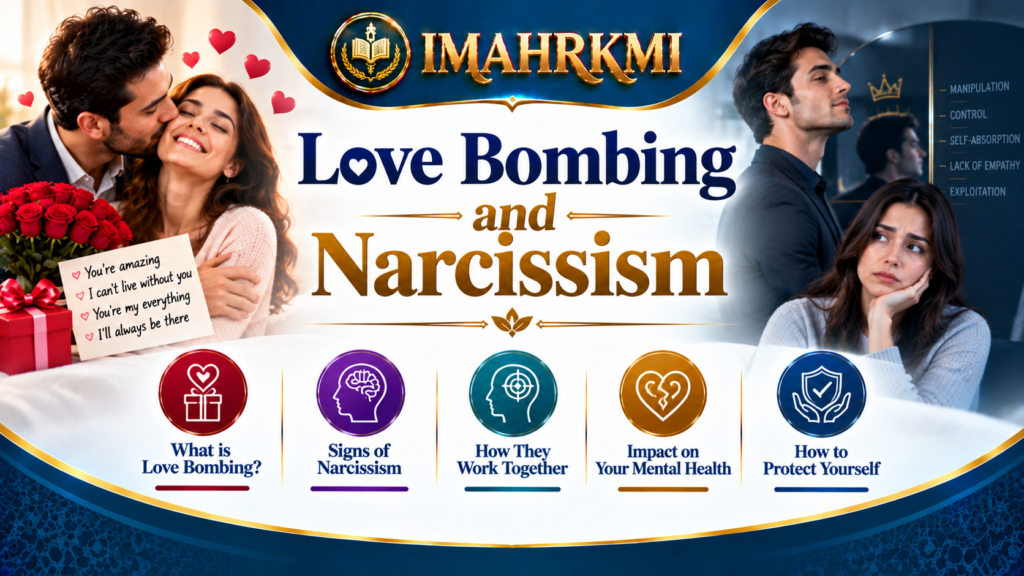
Online discussions often connect love bombing with narcissism.
There can be an association between manipulative relationship behaviors and certain personality traits, but it is important not to overgeneralize.
Love bombing does not automatically mean someone is a narcissist.
Narcissistic personality disorder is a specific psychiatric diagnosis that requires professional assessment.
A person may behave manipulatively without having narcissistic personality disorder.
Similarly, a person with narcissistic traits does not necessarily engage in every behavior commonly described online as love bombing.
Behavioral patterns and psychiatric diagnoses should not be confused.
Love Bombing and Dark Psychology
Love bombing is frequently discussed in popular Dark Psychology content because it involves concepts related to:
- emotional influence,
- attachment,
- persuasion,
- psychological vulnerability,
- social influence,
- dependency,
- interpersonal control,
- and manipulation.
However, “Dark Psychology” is not a formal psychiatric diagnosis or a single recognized clinical specialty.
Many of the underlying concepts can be studied through established psychological fields such as:
- social psychology,
- cognitive psychology,
- personality psychology,
- behavioral science,
- interpersonal psychology,
- communication,
- and decision-making.
Studying these concepts ethically means understanding how influence works so people can recognize unhealthy behavior and protect themselves.
Why Do People Become Vulnerable to Love Bombing?
Love bombing can affect anyone.
Certain circumstances may increase vulnerability, including:
Loneliness
Someone experiencing loneliness may find intense attention especially meaningful.
Recent Breakup
After emotional loss, intense validation may feel particularly comforting.
Low Self-Esteem
Someone who rarely receives positive attention may become strongly attached to someone who provides it.
Emotional Vulnerability
Periods of grief, stress, uncertainty, or major life transitions can increase the desire for emotional security.
Fear of Abandonment
Someone who strongly fears rejection may tolerate behaviors they would otherwise question.
Strong Desire for Marriage or Family
A person who urgently wants a committed relationship may be more receptive to rapid promises of a shared future.
None of these factors make someone responsible for being manipulated.
Understanding vulnerability is about prevention—not blame.
Love Bombing in Dating Relationships
Dating provides an environment where people are still learning about each other.
This makes it particularly important to distinguish:
Intensity from intimacy.
A relationship can become emotionally intense very quickly without necessarily having developed genuine trust.
Trust generally develops through observing how someone behaves over time.
Important questions include:
- Do they respect boundaries?
- Can they accept disagreement?
- How do they behave when disappointed?
- Do they respect your friends and family?
- Can they apologize?
- Do they accept responsibility?
- Do they respect your independence?
- Do their actions match their promises?
These questions may provide more useful information than romantic words alone.
Love Bombing in Marriage
Love bombing is usually discussed in dating and early relationships, but manipulative cycles can also occur in established marriages.
For example, a spouse may alternate between:
Intense affection → conflict → emotional withdrawal → excessive affection → renewed conflict.
This does not automatically mean the marriage involves love bombing.
Couples can experience genuine cycles of conflict and reconciliation.
Professional assessment should consider whether affection is being used deliberately or repeatedly as a means of controlling the other spouse.
Love Bombing and Emotional Manipulation
Love bombing can overlap with emotional manipulation when affection becomes a tool for psychological influence.
For example:
Affection → expectation → refusal → guilt → withdrawal → compliance → affection returns.
The concern is not simply that someone expresses strong love.
The concern is that affection becomes connected to control and compliance.
Love Bombing and Gaslighting
Love bombing and gaslighting are different concepts, although they may sometimes occur within the same unhealthy relationship.
Love Bombing
Often involves excessive affection, attention, idealization, or rapid attachment.
Gaslighting
Involves attempts to undermine another person’s confidence in their perception, memory, or judgment.
A relationship might contain one, the other, both, or neither.
It is better to examine actual behavior rather than automatically applying labels.
How Love Bombing Can Affect Psychological Well-Being
If intense affection is followed by manipulation or emotional control, the psychological consequences may include:
- confusion,
- anxiety,
- self-doubt,
- emotional dependency,
- fear of losing the relationship,
- difficulty establishing boundaries,
- reduced independence,
- emotional exhaustion.
The sudden contrast between affection and rejection can be particularly confusing.
A person may repeatedly try to restore the early emotional intensity they experienced at the beginning of the relationship.
Why Intermittent Affection Can Be Difficult to Resist
When affection and withdrawal alternate unpredictably, the relationship can become emotionally difficult to interpret.
For example:
Affection → withdrawal → affection → criticism → affection
The person may focus heavily on getting back to the positive phase.
This can reinforce emotional attachment even when the overall relationship has become unhealthy.
Understanding behavioral patterns can help people step back and evaluate the relationship more objectively.
How to Protect Yourself From Love Bombing
1. Slow Down Major Decisions
Strong emotions do not require immediate major commitments.
Give yourself time to understand the person.
2. Watch Behavior Over Time
Words are important, but consistent behavior provides additional information.
Ask:
How does this person behave when they don’t get what they want?
That question can reveal more than compliments.
3. Maintain Your Independent Life
Continue appropriate relationships with:
- friends,
- family,
- colleagues,
- hobbies,
- work,
- education,
- and personal interests.
Healthy relationships allow individuality.
4. Test Boundaries Respectfully
You do not need to manipulate someone to understand their behavior.
Simply communicate reasonable boundaries.
For example:
“I need some personal time tonight.”
Then observe the response.
Respect is an important indicator of relationship health.
5. Do Not Confuse Intensity With Compatibility
Someone can make you feel extraordinary and still be incompatible with you.
Compatibility includes:
- values,
- communication,
- emotional maturity,
- responsibility,
- boundaries,
- lifestyle,
- and long-term expectations.
6. Look for Consistency
Ask whether the person’s:
Words + Actions + Treatment of Others
are reasonably consistent.
A person who promises extraordinary love but regularly behaves disrespectfully should be evaluated by their behavior, not only their promises.
Questions to Ask Yourself
If you are unsure whether a relationship involves love bombing, consider:
- Did the relationship become extremely intense unusually quickly?
- Am I being pressured to make major decisions?
- Does this person respect my boundaries?
- Can I say no without punishment?
- Do they become angry when I am unavailable?
- Are they discouraging my friendships or family relationships?
- Are gifts or affection later used as leverage?
- Does their behavior change dramatically when I disagree?
- Do I feel increasingly dependent on their approval?
- Do I feel free to remain an independent person within the relationship?
These questions do not diagnose manipulation.
They can help you identify patterns worth examining.
What If You Realize You Are Being Manipulated?
Do not assume that confrontation is always the safest first step.
Consider the circumstances.
If the relationship is relatively safe, you may communicate boundaries clearly and observe whether the person respects them.
If there is intimidation, threats, coercion, violence, or fear of retaliation, seek appropriate professional and local support and prioritize safety.
A qualified mental-health professional can help you understand the relationship dynamics and develop an appropriate plan.
How Couples Can Prevent Unhealthy Manipulation
Psychological education is not only useful for identifying manipulation.
It can also help couples prevent unhealthy communication patterns.
Healthy couples can practice:
- direct communication,
- respectful disagreement,
- emotional regulation,
- realistic expectations,
- mutual boundaries,
- accountability,
- independent social support,
- and transparent decision-making.
Affection should strengthen connection—not eliminate autonomy.
When Professional Help May Be Appropriate
Professional support may be useful when relationship patterns are causing:
- persistent anxiety,
- significant emotional distress,
- loss of confidence,
- fear,
- repeated conflict,
- dependency,
- isolation,
- or difficulty making independent decisions.
Individual therapy can help someone understand their own emotional responses and relationship patterns.
Couples therapy may be appropriate when both partners are willing to participate safely and constructively.
When severe intimidation, coercive control, threats, or violence are present, individual support and safety planning may be more appropriate than immediately entering joint therapy.
Frequently Asked Questions About Love Bombing
What does love bombing mean?
Love bombing refers to an unusually intense pattern of affection, attention, praise, gifts, communication, or emotional closeness that may be used to rapidly establish attachment or influence.
Is love bombing always manipulation?
No. Intense affection can be genuine. The concern increases when excessive affection becomes connected to pressure, control, dependency, or emotional punishment.
Is love bombing a mental illness?
No. Love bombing is a behavioral term, not a psychiatric diagnosis.
Is love bombing always associated with narcissism?
No. Love bombing does not prove that someone has narcissistic personality disorder or any other mental disorder.
How long does love bombing last?
There is no fixed duration. Some intense relationship patterns may last days or weeks, while others may develop over a longer period. Duration alone does not determine whether behavior is manipulative.
Can love bombing happen in marriage?
Yes, although the term is more commonly used when discussing dating and early relationship dynamics. Similar cycles of intense affection and control can occur in established relationships.
Is excessive texting love bombing?
Not necessarily. Frequent communication may simply reflect mutual interest. It becomes more concerning when communication is accompanied by pressure, monitoring, guilt, or expectations of constant availability.
Are expensive gifts a sign of love bombing?
Not necessarily. Gifts can be genuine expressions of affection. The concern arises when gifts are later used as leverage or create an expectation of obedience.
How can I protect myself from love bombing?
Slow down major decisions, maintain your independent relationships, establish reasonable boundaries, observe behavior over time, and seek professional guidance if the relationship becomes psychologically distressing or controlling.
Final Thoughts
Love bombing can be difficult to recognize because it may initially feel like the opposite of manipulation.
It may feel like:
attention, admiration, romance, security, and finally being understood.
That is why the most important question is not:
“How much does this person love me?”
It is:
“How does this person treat my boundaries, independence, and right to make my own decisions?”
Genuine affection can coexist with autonomy.
Healthy love does not require psychological control.
A healthy relationship allows two people to become emotionally close while still maintaining dignity, independence, boundaries, friendships, responsibilities, and the freedom to disagree.
Understanding love bombing is therefore not about becoming suspicious of affection.
It is about learning to distinguish healthy emotional connection from patterns of psychological pressure and control.
Learn More About Psychological Manipulation and Human Behavior
Love bombing is only one concept within the broader study of psychological influence and manipulation.
If you want to understand how emotional manipulation, persuasion, cognitive biases, psychological control, vulnerability, deception, social influence, and human behavior can interact, structured psychological education can provide a broader foundation.
IMAHRKMI’s Dark Psychology Online Certificate/Diploma Program is designed as an educational program exploring psychological and behavioral concepts related to manipulation, influence, human behavior, cognitive processes, and psychological control.
The program covers areas such as:
- Psychological manipulation
- Emotional influence
- Gaslighting
- Cognitive biases
- Persuasion
- Psychological control
- Human behavior
- Vulnerability and decision-making
- Deception and interpersonal behavior
- Emotional pressure
- Ethical awareness and self-protection
The purpose of studying these subjects should be education, awareness, critical thinking, ethical understanding, and protection from harmful manipulation—not exploitation or control of other people.
Explore the IMAHRKMI Dark Psychology Online Certificate/Diploma Program to continue your study of psychological manipulation and human behavior through a structured educational program.
About the Author
Dr. Inayat Ullah, M.D.
Board-Certified Psychiatrist
AASECT-Certified Sex Therapist
Sexologist & Mental Health Specialist
Relationship & Couple Therapy Specialist
Director, IMAHRKMI
New York, USA