
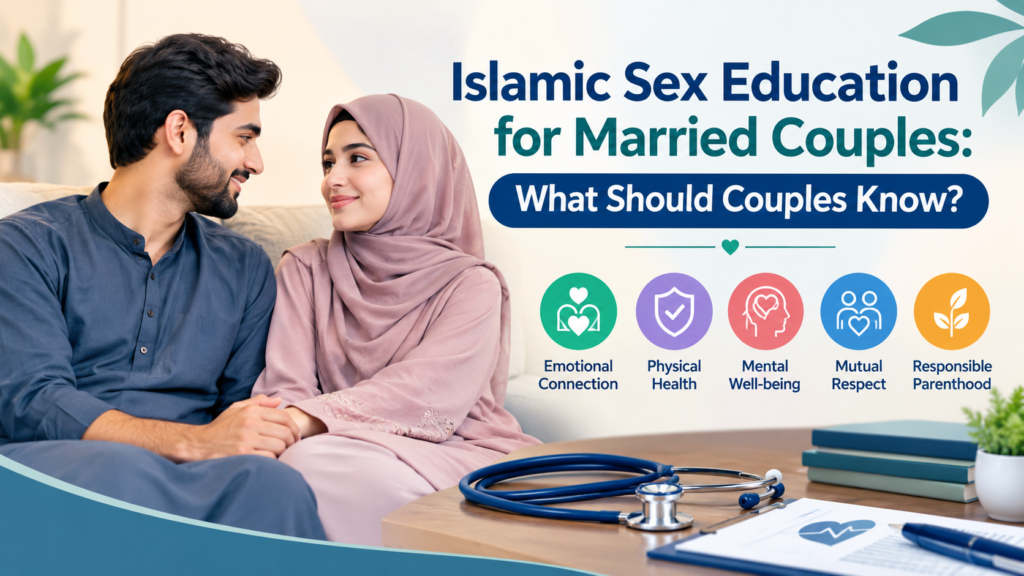
Islamic Sex Education for Married Couples: What Should Couples Know?
Sexual activity is essential in marriage; yet, most Muslim couples do not get much formal training regarding it.
Prior to marriage, one learns that sexual activities are private and must not be talked about.
Post-marriage, couples find themselves asking these following questions:
- Sexual desire
- Physical intimacy
- Sexual health
- Pregnancy
- Fertility
- Menstrual and postpartum changes
- Sexual pain
- Female sexual dysfunction
- Male sexual dysfunction
- Emotional intimacy
- Sexual communication
- Differences in sexual desire
- Islamic boundaries
- Hygiene and cleanliness
- When seeking assistance from professionals is required
Such topics can be quite embarrassing, which makes individuals seek answers anonymously online, from friends, social networking sites, culture, and/or myths.
And this gives rise to a significant query:
Can sexual education be consistent with Islam?
Yes.
Islamic sexual education in marriage is a mixture of religion, medicine, psychology, marital obligations, humility, and moral communication.
But one must not mistake Islamic sex education for pornographic films, entertainment, or anything explicit in nature.
Its purpose is knowledge, health, responsibility, marital well-being, and protection from misinformation.
What Is Islamic Sex Education?
Islamic sex education for married people is the scientific examination of sexual health in marriage with regard to Islamic teachings.
It can include:
Islamic knowledge + Medicine + Psychology + Marital education + Sexuality + Ethics
It entails learning not just the things that one should do and shouldn’t do, but also the knowledge of how:
- How sexual health works
- Why desire changes
- Sexual pain happens
- Psychological aspects influence intimacy
- Medical problems impact sex
- Wives and husbands talk respectfully
- Where professional help is required
- How the teachings of religion must be correctly interpreted
The teaching of Islamic sexuality must, therefore, be educative rather than sensational.
Why Do Married Couples Need Sexual Education?
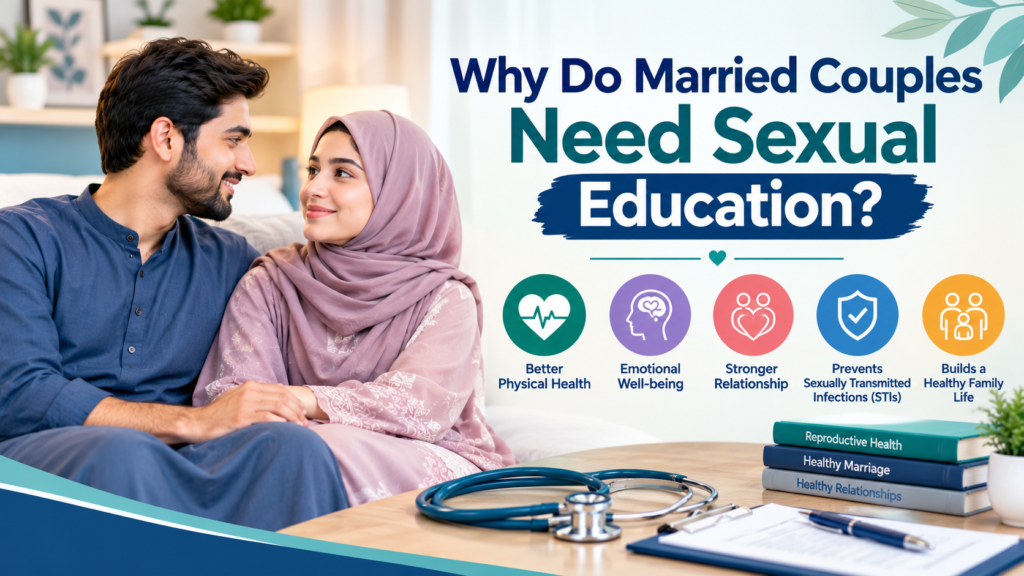
Getting married does not mean that one learns about sexuality.
One may learn about marriage and still have no idea of:
- Sexual anatomy
- Sexual physiology
- Female sexual health
- Male sexual health
- Sexual desire
- Sexual dysfunction
- Sexual pain
- Fertility
- Reproductive health
- Psychological influences on sexuality
- Relationship factors affecting intimacy
Ignorance leads to fear and misunderstandings.
The man can see his partner’s poor sex drive as an indication of rejection.
Similarly, the woman can consider her partner’s inability to have sex with her due to lack of sexual interest.
The two people can be experiencing pain but think that the pain is part of their lives.
Knowledge enables the couple to differentiate between a normal variation, relational problem, a health issue, and an expert one.
Is Sex Education Allowed in Islam?
Sexuality is not entirely ignored in the Islamic literature.
Issues related to marriage, menstruation, family, purity, modesty, sexuality, and marital relations are discussed in the Qur’an and Sunnah.
The key issue is how sexual knowledge is taught.
Education that promotes:
- Modesty
- Marriage
- Health
- Responsibility
- Mutual respect
- Protection from harm
- Accurate religious understanding
is entirely separate from material used for sexual arousal.
The proper context for Muslims, therefore, would be one that is private, respectful, educational, and responsible.
The Quran and Marriage
The Quran discusses marriage in the larger context of companionship, peace, love, and mercy.
God mentions that spouses are a source of tranquility and uses the terms affection and mercy when speaking about them.
This is especially relevant in talking about intimate relations within marriage.
Intimacy cannot be confined to sex only.
A healthy marriage includes:
- Emotional connection
- Companionship
- Respect
- Kindness
- Responsibility
- Family life
- Physical affection
- Sexual intimacy
Sex is just one aspect of the whole process of marriage.
The Concept of Affection and Mercy
The notion of mawaddah and rahmah in the Qur’an is a crucial approach to marriage.
A man and woman are more than just individuals whose needs clash.
These are couples who need to have empathy in their relationship.
This takes on more significance when sexual desire differs.
One of the spouses desires physical closeness often.
The latter could have less desire for:
- Stress
- Fatigue
- Pregnancy
- Postpartum changes
- Menopause
- Medical illness
- Sexual pain
- Anxiety
- Depression
- Medication effects
- Relationship difficulties
Knowing the facts would help avoid misplaced blame.
Marital Intimacy Is Not Only About Frequency
Misunderstanding #1: The success of marriage can be judged on the basis of how often the couple has sexual intercourse.
Not all couples will require the same frequency for intimacy.
People have different levels of sexual desire and function.
The couple might have differences due to:
- Age
- Health
- Hormones
- Stress
- Relationship quality
- Personality
- Life circumstances
- Pregnancy and parenting
- Psychological well-being
A more relevant question might be:
Can both partners discuss intimacy in a respectful manner, and are issues being dealt with properly?
Understanding Sexual Desire
Sexual desire is a factor that involves many different systems.
Some of these include:
Biology + Hormones + Psychology + Emotions + Relationship + Environment + Health
Desire may fluctuate in a person’s life.
The individual, who used to feel very sexually aroused before, may undergo a big shift later on.
This does not imply that the individual no longer loves his or her partner anymore.
There could be a medical, psychological, emotional, or relational reason for this.
Sexual Desire Differences Between Husband and Wife
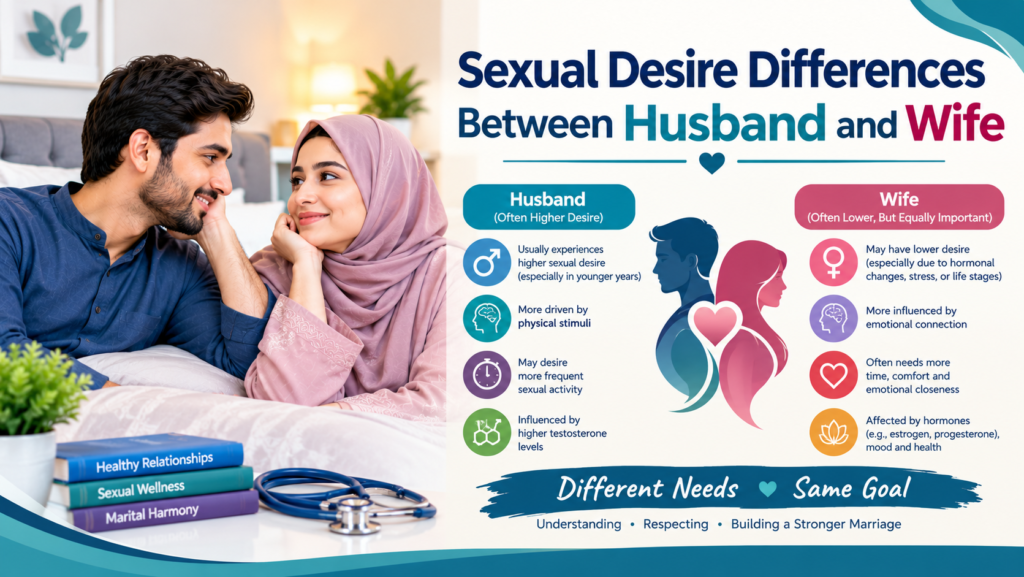
Wives and husbands might have varying sexual desires.
In some cases, the husband feels more desire than the wife.
Sometimes the wife does.
Sometimes, they might both have a desire for intimacy but at different times.
This kind of situation is commonly referred to as sexual desire discrepancy or desire mismatch.
A desire difference does not imply that any of the spouses is sexually abnormal.
Nevertheless, sexual desire conflict can adversely impact the marriage and may call for professional help.
Female Sexual Health Matters
Sexual education in Islam must consider men’s sexual desires too.
Women’s sexual health is an important issue.
Women can experience:
- Low sexual desire
- Sexual arousal difficulties
- Difficulty with orgasm
- Sexual pain
- Vaginismus
- Pelvic-floor problems
- Hormonal changes
- Postpartum sexual difficulties
- Menopausal sexual changes
It may have impact on sexual relations and their psychological state.
Sometimes, it may require some treatment from doctors, psychologists, or even therapists.
Vaginismus and Painful Sex
Vaginismus is one of the issues that explain the importance of sexual education.
Some women suffer from spasms or extreme difficulties in the process of vaginal penetration.
The experience can involve:
- Fear of pain
- Anticipatory anxiety
- Pain
- Difficulty with penetration
- Avoidance
- Significant distress
This woman needs to be told more than just to “try harder.”
Evaluation and treatment that is based on science and research could be effective.
Sexual discomfort is a matter of health, not morality.
Male Sexual Health Matters Too
Men may suffer from sexual issues, too.
These may include:
- Erectile difficulties
- Ejaculatory difficulties
- Low sexual desire
- Performance anxiety
- Medication-related sexual changes
- Factors influencing sexual dysfunction
Feelings of embarrassment can keep men from seeking assistance.
Sexual education based on Islam should promote responsible healthcare rather than embarrassment.
Sexual Health and Menstruation
It is a natural process and essential for a woman’s health.
Couples that practice Islam need to be aware of the Islamic guidance regarding menstruation as well as the medical facts about:
- Menstrual cycles
- Hormonal changes
- Menstrual symptoms
- Pain
- Abnormal bleeding
- Reproductive health
Both religious guidance and medical facts address two distinct questions.
Healthcare practitioners can deal with medical issues, and Islamic scholars can help resolve legal religious issues.
Pregnancy and Postpartum Intimacy
Pregnancy, birth, and the postpartum stage will greatly influence marital relations.
A woman may experience:
- Physical recovery
- Hormonal changes
- Fatigue
- Sleep deprivation
- Breastfeeding
- Pain
- Body-image changes
- Emotional changes
It is important for a man to realize that low libido during some specific stages can be completely justified.
The same way, couples should be aware of Islamic rulings on postpartum bleeding and marital relations.
Personal religious issues should be discussed with the scholars.
Menopause and Sexual Health
This is yet another instance where Islamic and medical teachings can be combined.
In a woman, there can be alterations in:
- Hormones
- Sexual desire
- Vaginal comfort
- Sleep
- Mood
- Energy
These are physical changes and cannot be assumed to be signs of disapproval of the husband by default.
Physiological examination can assist in suggesting suitable treatments.
Sexual Communication Between Husband and Wife
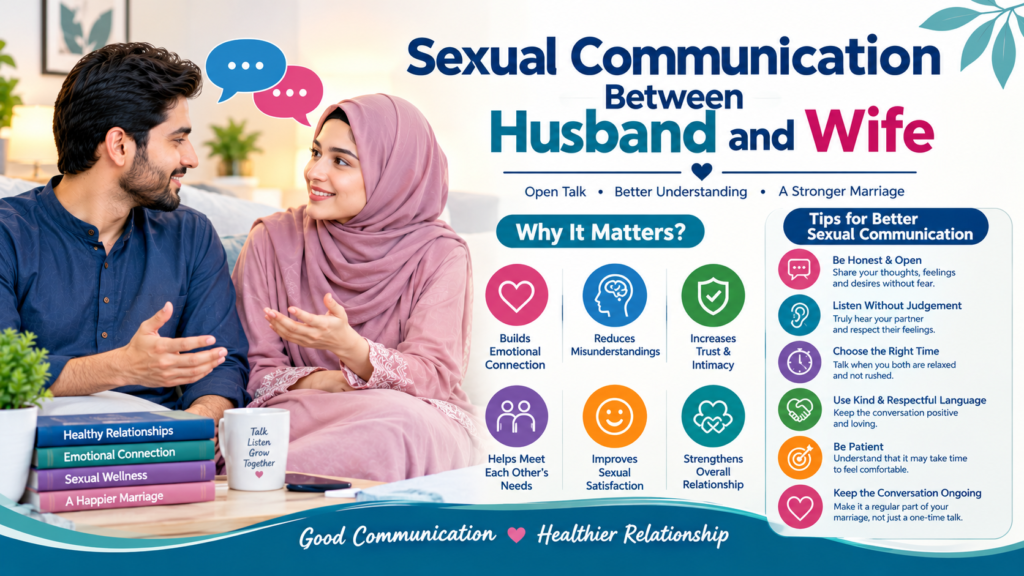
A key component of sexual wellness in marriage is communication.
Often, there are no classes where people learn how to talk about their issues concerning sexual relations in a civilized manner.
The talks might start with accusations like:
“You never want me.”
or:
“You only care about sex.”
It is likely to provoke an oppositional response.
A healthier approach is:
“What do you mean that we have different sexual needs? Let’s talk about it.”
Communication must be such that it brings about understanding and not humiliation.
Consent, Mutual Consideration, and Avoiding Harm
The issue of marital status does not render irrelevant the issue of respect, communication, and doing no harm.
The proper conduct of marital relations would never include:
- Force
- Threats
- Humiliation
- Intimidation
- Physical violence
- Deliberate harm
- Exploitation
Teachings of Islam on the subject of marriage must be placed within the larger context of ethics of respect, mercy, and doing no harm.
Legal questions regarding the marital relationship may be subjects of difference among scholars.
What Does Islam Say About Sexual Boundaries?
Sexual education among Muslims needs to incorporate the learning of the limits of behavior as opposed to only the permissible acts.
The couple must know that Islamic instruction entails laws on:
- Marriage
- Modesty
- Menstruation
- Postpartum bleeding
- Fasting
- Sexual relations
- Adultery
- Sexual behavior outside marriage
- Privacy
- Purity and cleanliness
There are some cases that are specific and vary from one school of Islam to another.
This implies that Islamic sex education must be able to tell apart:
Clear textual teachings
and
Areas involving scholarly interpretation or disagreement.
This is of immense importance.
Why Internet Advice Can Be Dangerous
The Internet offers vast quantities of sexual data through search engines and social media sites.
But not all information is accurate.
A Muslim couple can come across:
- Myths regarding culture posing as Islamic teachings
- Unverified Hadith
- Misquoted Qur’anic verses
- Opinions posing as religious laws
- Incorrect medical advice
- Educational materials that come in the form of pornography
- Unrealistic expectations about marriage
- Dangerous treatment recommendations
Professional education assists learners in being critical of their information.
Islamic Sex Education Should Not Be Pornography
This distinction deserves emphasis.
Pornography is not a replacement for sex education.
Pornographic material does not necessarily serve the purpose of educating a couple in:
- Human sexuality
- Sexual health
- Psychology
- Medical conditions
- Islamic ethics
- Relationship dynamics
It is important for professional education to remain within its boundaries and concentrate on gaining knowledge.
Sexual Problems Are Not Always Religious Problems
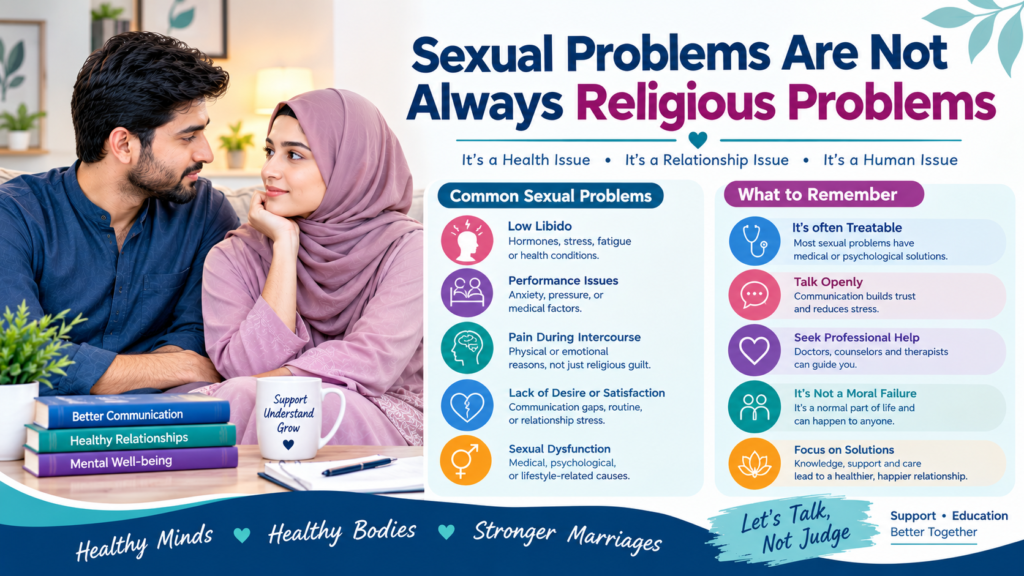
Questions asked by a couple facing sexual issues might include:
“Is our marriage spiritually weak?”
At times, matters of religion might come into play.
But there are other causes of sexual problems as well.
For example:
Low desire might be because of:
- Depression
- Anxiety
- Hormonal changes
- Medication
- Stress
- Relationship problems
Pain might be caused by:
- Vaginismus
- Pelvic-floor dysfunction
- Infection
- Hormonal changes
- Other medical conditions
Erectile problems could be related to:
- Vascular health
- Diabetes
- Medication
- Psychological factors
- Relationship stress
The holistic approach will not try to fit all sexual problems into one box.
The Role of Psychology in Islamic Sex Education
Sexuality is not solely based on biology.
Psychological aspects play a significant role.
These may include:
- Anxiety
- Depression
- Stress
- Body image
- Fear
- Previous negative experiences
- Relationship conflict
- Low self-esteem
- Performance anxiety
Recognizing psychological aspects is not against religion.
It acknowledges that humans are biological, psychological, social, and spiritual beings.
The Role of Medical Science
Medical sciences can help to explain:
- Sexual anatomy
- Hormonal changes
- Reproductive health
- Sexual dysfunction
- Sexual pain
- Fertility
- Medication effects
- Chronic diseases
- Menopause
- Pregnancy and postpartum changes
Islamic education can provide guidance in religion and ethics.
Medical education can provide scientific explanation.
There is no need to make these subjects unnecessarily rival each other.
When Should Couples See a Doctor?
It would be proper to consult a doctor in case of:
- Persistent sexual pain
- Sudden absence of sexual drive
- Erectile difficulties
- Significant hormonal symptoms
- Abnormal bleeding
- Persistent sexual dysfunction
- Depression or anxiety symptoms
- Concerns about medication effects
- Fertility concerns
- Other unexplained physical symptoms
Consultation with a doctor is not an indication of lack of faith.
Medical services are important in responsible health care.
When Should Couples Consider Sex Therapy?
Sexual therapy can be beneficial for couples facing issues relating to:
- Sexual desire
- Sexual communication
- Sexual dysfunction
- Sexual pain
- Vaginismus
- Performance anxiety
- Sexual dissatisfaction
- Persistent sexual conflict
An expert professional can be of assistance in determining contributing factors and devising a customized solution.
When Is Couple Therapy Helpful?
At times, the sexual issue could be a relationship problem that surfaces in the bedroom.
Couples therapy can be useful where there is:
- Emotional distance
- Resentment
- Communication breakdown
- Trust problems
- Repeated conflict
- Major differences in expectations
- Difficulty resolving sexual disagreements
Improving the relationship can also lead to improving sexual intimacy.
What Should Husbands Learn?
It is important for the husband to realize that the woman’s sexuality is not determined solely by her physical biology.
Important areas include:
- Female sexual health
- Hormonal changes
- Pregnancy
- Postpartum recovery
- Menopause
- Sexual pain
- Vaginismus
- Emotional intimacy
- Stress
- Psychological health
- Sexual desire differences
- Respectful communication
Learning about these topics may help dispel damaging stereotypes.
What Should Wives Learn?
The following topics may be beneficial for women to learn about as well:
- Male sexual health
- Erectile difficulties
- Sexual desire
- Performance anxiety
- Psychological factors
- Medication effects
- Relationship dynamics
- Sexual communication
- Relevant Islamic teachings
Sex education needs to target both genders.
Marriage involves two people.
What Should Both Spouses Learn?
Both the husband and wife need to understand:
1. Sexual health
Role of physical wellbeing on sexual activities.
2. Sexual psychology
Impact of emotions and mental well-being on libido and performance.
3. Relationship dynamics
How communication, trust, conflicts, and emotions impact intimate relations.
4. Islamic guidance
What the Quran and authentic Sunnah state regarding such issues in marriage.
5. Professional boundaries
When to consult a doctor, psychologist, sex therapist, couples therapist, or religious authority.
Common Myths About Islamic Sexuality
Myth 1: Married Muslims Do Not Need Sexual Education
Marriage cannot, on its own, give us scientific and religious enlightenment.
The problem of misinformation can be helped by education.
Myth 2: Sexual Problems Are Always a Sign of Weak Faith
Not necessarily.
Medical and psychological problems could affect our sexuality.
Myth 3: Low Desire Always Means Lack of Love
No.
There are several things that could cause desire.
Myth 4: Men Are Always More Sexually Interested
This is an oversimplification.
Individuals vary considerably.
Myth 5: Women Do Not Need Sexual Education
There are issues that women should be concerned about sexually.
Myth 6: Everything Found Online Is Islamic
No.
The Internet content needs to be compared with reliable sources.
How Can Couples Build a Healthier Marital Intimacy?
Healthy solutions may start from:
Communication
Speak without humiliating and accusing.
Education
Study from reliable medical and religious sources.
Health
Tackle both physical and mental issues.
Respect
Consider each partner as an individual who has his or her own requirements and limitations.
Compassion
Realize that desire does not remain constant.
Professional Support
If issues continue, seek proper assistance.
Religious Knowledge
Research Islamic literature from authentic sources.
Islamic Sex Education Requires Responsible Scholarship
One of the greatest difficulties in this area is the blend of:
Islam + culture + personal opinion + internet myths.
They should not be considered the same just because of that.
An education process that takes responsibility would differentiate between:
- Qur’anic teachings
- Authentic Hadith
- Classical Islamic jurisprudence
- Contemporary scholarly interpretation
- Cultural traditions
- Medical science
- Psychological research
It becomes a much more intellectually honest and responsible profession when it comes to sexual education.
Why Professional Islamic Sex Education Is Important
There is a marked difference between answering questions sexually and learning sexuality professionally.
Professional learners might need to know:
- Human sexual development
- Sexual anatomy
- Sexual physiology
- Female sexual health
- Male sexual health
- Sexual desire
- Sexual dysfunction
- Sexual pain
- Vaginismus
- Psychological influences
- Relationship dynamics
- Sexual communication
- Medical treatment principles
- Ethical boundaries
- Islamic perspectives
- Qur’an and authentic Hadith
- Scholarly differences
- Proper referral to the doctor and religion
It is for this reason that proper clinical sex education can be beneficial.
Clinical Sex Education: Beyond "How to Have Sex"
Sexual health education cannot be about sexual practices alone.
The more relevant questions are usually:
Why is desire low?
Why does intimacy cause pain?
Why has sexual functioning changed?
How does anxiety affect sexuality?
How do relationship problems influence desire?
How can couples communicate about sexual concerns?
What does Islamic scholarship actually say?
When should a couple seek professional help?
Such questions need proper education and not the myths on the internet.
IMAHRKMI Clinical Sex Education Course
The IMAHRKMI Clinical Sex Education Course is aimed at people who wish to learn about the science of human sexuality in an educational context.
The course will cover subjects like:
- Medical science
- Psychology
- Human sexuality
- Female sexual health
- Male sexual health
- Sexual desire
- Sexual dysfunction
- Sexual pain
- Vaginismus
- Relationship and couple dynamics
- Sexual communication
- Clinical perspectives
- Relevant Islamic perspectives
- Qur’an and Sahih Hadiths in education where appropriate
- Professional and ethical considerations
It aims to deliver knowledge that is scientifically accurate, psychologically sound, culturally appropriate, and well-grounded in the appropriate Islamic sources.
Who Should Study Islamic Sex Education?
The course may be of special interest to:
- Physicians
- Healthcare professionals
- Medical students
- Mental-health professionals
- Counselors
- Relationship professionals
- Sex educators
- Marriage professionals
- Professional counselors dealing with Muslim couples
This can also help individuals who want to learn about sexual health within their marriages through a learning process.
A Message to Muslim Married Couples
In case there is a sexual issue in your marriage, you should not always conclude that one person is responsible.
Ask:
Could there be a medical issue?
Could there be a psychological issue?
Could stress or exhaustion be affecting intimacy?
Could there be unresolved relationship conflict?
Could there be a misunderstanding of Islamic teachings?
Could both spouses benefit from better education?
Sometimes the best thing to do is the opposite of what one would think.
It is better understanding.
Final Thoughts
Sex education for married couples in Islam does not necessarily mean being vulgar.
It should be about knowledge, health, marriage, responsibility, modesty, compassion, and accurate understanding.
Comprehensive approach understands that sexual health entails various dimensions:
Medical + Psychological + Relationship + Religious + Ethical
Sexual health information can be beneficial for Muslim couples without compromising Islamic principles.
On the other hand, Islamic sexual education should be sensible enough to identify the truth about religion from cultural myths and misconceptions spread over the internet.
In case of any sexual problems, it may need the knowledge of various professionals.
Medical issue may need a doctor.
Psychological problems need professionals dealing in mental health.
Problems in relationships need couples counseling.
Sexual health problems need professionals dealing in sex therapy.
An issue concerning religion needs an Islamic scholar.
Good sexual education informs people on when and where to get the right help.
Learn More Through Professional Clinical Sex Education
To learn about human sexuality through the field of medicine, psychology, relationship patterns, clinical sexual education, and Islam in particular, one should enroll in the IMAHRKMI Clinical Sex Education Course.
Professional knowledge on sexual health.
Know the psychology of intimacy.
Discuss sexual health issues for both genders.
Consider marital sexual issues properly.
Understand the Qur’anic verses and Hadiths that are relevant to this issue.
Also, understand how sexual health education through professionals can contribute towards removing stigma and misconceptions.
Your questions deserve education—not misinformation.