
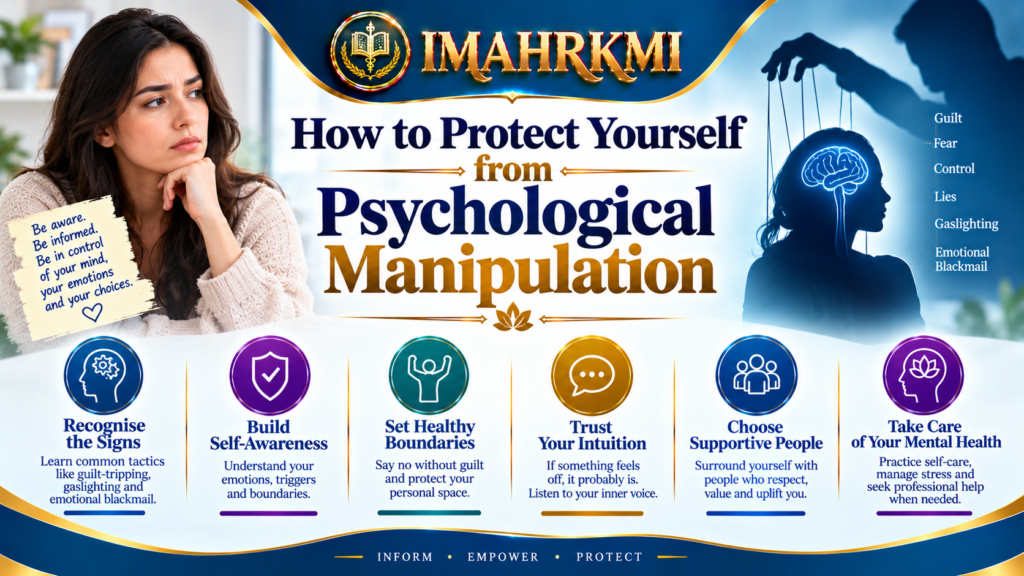
How to Protect Yourself from Psychological Manipulation
Psychological manipulation can occur in relationships, marriages, families, friendships, workplaces, social groups, and online interactions.
Sometimes manipulation is obvious. A person may use threats, intimidation, guilt, humiliation, or deliberate deception. In other situations, manipulation is much more subtle. It may appear as excessive concern, repeated questioning, emotional pressure, selective information, victim-playing, persistent criticism, or attempts to make another person doubt their own judgment.
One of the most important skills in protecting yourself from manipulation is learning to recognize patterns rather than isolated incidents.
Everyone can become emotionally influenced by other people. Healthy relationships naturally involve persuasion, compromise, emotional support, negotiation, and mutual influence. Psychological manipulation becomes concerning when influence repeatedly undermines a person’s autonomy, boundaries, confidence, judgment, or ability to make independent decisions.
Understanding psychological manipulation does not mean becoming suspicious of everyone.
It means becoming more psychologically aware.
The goal is not to manipulate manipulators back. The goal is to recognize unhealthy influence, protect your emotional and psychological boundaries, maintain independent judgment, and seek appropriate support when necessary.
What Is Psychological Manipulation?
Psychological manipulation refers broadly to attempts to influence another person’s thoughts, emotions, perceptions, decisions, or behavior through methods that may be deceptive, coercive, exploitative, or unfair.
Manipulation can involve emotions such as:
- Fear
- Guilt
- Shame
- Anxiety
- Jealousy
- Insecurity
- Obligation
- Sympathy
- Confusion
- Emotional dependency
A manipulative person may attempt to create a psychological environment in which another person feels that they have no reasonable choice.
For example, instead of saying:
“I would like you to consider my point of view.”
a person may communicate:
“If you really cared about me, you would do this.”
The second statement introduces emotional pressure rather than simply presenting an argument.
However, one emotionally difficult statement does not automatically prove that someone is manipulative.
The larger question is whether there is a repeated pattern of psychological pressure.
Psychological Manipulation vs Healthy Influence
Not every attempt to influence another person is manipulation.
Healthy influence is a normal part of human relationships.
A spouse may persuade a partner to consider a different decision. A doctor may recommend a treatment. A parent may encourage a child to develop healthier habits. A friend may express concern about someone’s behavior.
Healthy influence generally allows the other person to:
- Ask questions
- Disagree
- Take time to decide
- Maintain boundaries
- Consider alternatives
- Say no without punishment
- Make an independent decision
Psychological manipulation often becomes problematic when the person is pressured into compliance through fear, guilt, deception, humiliation, confusion, threats, or emotional punishment.
A useful question is:
“Am I being given information and freedom to decide, or am I being psychologically pressured until I give the desired answer?”
Why Is Psychological Manipulation So Effective?
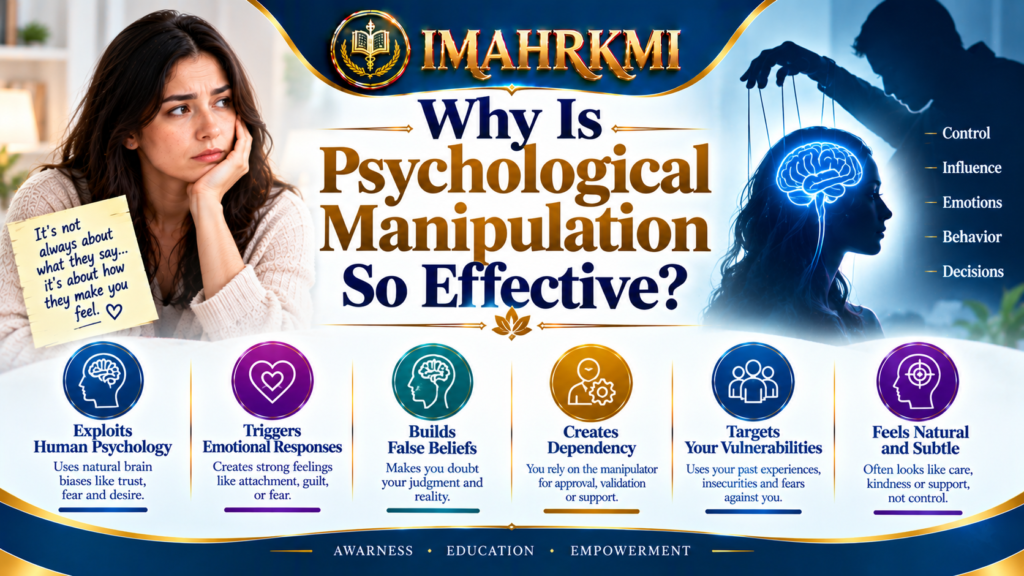
Manipulation can work because human decision-making is influenced by emotions, relationships, expectations, previous experiences, social pressure, and cognitive biases.
People are not purely logical decision-making systems.
Even highly educated, intelligent, successful, and confident individuals can become vulnerable under certain circumstances.
For example, vulnerability may increase during:
- Emotional distress
- Grief
- Loneliness
- Relationship conflict
- Major life transitions
- Financial pressure
- Social isolation
- Fear of abandonment
- Strong romantic attachment
- Professional uncertainty
- Exhaustion or chronic stress
This is why psychological self-protection requires more than intelligence.
It requires awareness.
1. Learn to Recognize Manipulation Patterns
The first step in protecting yourself is recognizing potential warning signs.
Common patterns may include:
Repeated guilt-tripping
Someone repeatedly makes you feel guilty whenever you make a decision they dislike.
Gaslighting
Someone persistently denies, distorts, or reframes events in ways that cause you to question your memory, perception, or judgment.
Emotional blackmail
Someone uses fear, guilt, withdrawal, threats, or emotional consequences to pressure you into doing something.
Silent treatment as punishment
Taking space during conflict can be healthy. Deliberately withdrawing communication to punish or control someone is different.
Blame shifting
The person consistently avoids responsibility and redirects every problem toward you.
Playing the victim
Someone may repeatedly portray themselves as the victim while refusing to acknowledge their contribution to the conflict.
Excessive control
The person attempts to control your friendships, communication, clothing, finances, activities, decisions, or access to other people.
Conditional affection
Affection, approval, attention, or emotional closeness may be repeatedly offered or withdrawn based on whether you comply.
Intimidation
The person uses fear, aggression, threats, humiliation, or implied consequences to influence your behavior.
Confusion
You frequently leave conversations feeling confused, guilty, emotionally exhausted, or uncertain about what actually happened.
One sign alone does not establish manipulation.
A persistent pattern is much more important.
2. Slow Down Important Decisions
Manipulation often becomes easier when decisions are made under intense emotional pressure.
A person may tell you:
- “You have to decide right now.”
- “If you loved me, you would do it immediately.”
- “Don’t talk to anyone else about this.”
- “You don’t need to think about it.”
- “Everyone else agrees with me.”
- “This is your only opportunity.”
Urgency can interfere with careful reasoning.
When possible, create psychological space.
You can say:
“I need some time to think about this before I make a decision.”
A healthy person may not always agree with your decision, but reasonable relationships generally allow room for thoughtful decision-making.
When someone becomes significantly more aggressive simply because you need time to think, that reaction itself may provide useful information.
3. Do Not Make Major Decisions While Emotionally Overwhelmed
Strong emotions can narrow attention.
When someone is extremely angry, frightened, guilty, excited, desperate, or emotionally attached, their ability to evaluate consequences may temporarily change.
Before making an important decision, ask:
- What exactly am I being asked to do?
- What are the consequences?
- What alternatives do I have?
- Would I make the same decision tomorrow?
- Am I choosing this freely?
- Am I afraid of what will happen if I say no?
- Would I advise a friend to make the same decision?
This brief pause can interrupt emotionally driven decision-making.
4. Separate Facts From Interpretations
Manipulation often becomes confusing because facts and interpretations become mixed together.
For example:
Fact:
“You did not answer my message for three hours.”
Interpretation:
“You ignored me because you don’t respect me.”
Accusation:
“You always treat me badly.”
These statements are not equivalent.
Learning to separate observable events from interpretations can improve critical thinking.
Ask yourself:
What do I actually know?
Then ask:
What am I being told to believe about what happened?
That distinction can be extremely valuable when dealing with psychological pressure.
5. Ask for Specific Examples
Manipulative communication may rely on vague accusations.
Statements such as:
- “You always do this.”
- “Nobody likes you.”
- “Everyone thinks you’re difficult.”
- “You never care about me.”
- “You are the problem.”
- “You know what you did.”
can create emotional pressure without providing clear information.
Instead of immediately defending yourself, ask:
“Can you give me a specific example?”
Specific questions can turn an emotionally confusing conversation into a more concrete discussion.
6. Maintain Healthy Boundaries
Boundaries are among the most important forms of psychological self-protection.
A boundary communicates what you are willing to accept and what you are not willing to accept.
Examples include:
- “I am willing to discuss this, but not while being insulted.”
- “I need time before making that decision.”
- “I don’t want to discuss my private information with other people.”
- “I respect your opinion, but I will make my own decision.”
- “If the conversation becomes threatening, I will end it.”
A boundary is not necessarily an attempt to control another person.
It is a statement about your own participation and choices.
7. Do Not Over-Explain Every Boundary
People who are repeatedly pressured may begin believing that they must provide a long explanation for every decision.
They may spend hours defending:
- Why they said no
- Why they need privacy
- Why they want time
- Why they disagree
- Why they cannot help
- Why they made a particular decision
Sometimes excessive explanation creates additional opportunities for argument.
A simple statement can be enough.
For example:
“I understand that you disagree, but this is my decision.”
You do not always need to win an argument in order to maintain a boundary.
8. Maintain Independent Relationships
Social isolation can increase vulnerability to manipulation.
Healthy relationships should not require you to abandon everyone else.
Maintain appropriate connections with:
- Family
- Trusted friends
- Professional colleagues
- Mentors
- Community members
- Qualified mental health professionals when appropriate
Independent relationships provide perspective.
If one person becomes the only source of emotional support, approval, information, or validation, dependency can increase.
Psychological independence does not mean emotional isolation.
It means maintaining more than one source of perspective and support.
9. Protect Your Private Information
Personal information can become psychologically powerful when placed in the wrong hands.
Be thoughtful about sharing:
- Personal fears
- Financial information
- Relationship conflicts
- Family problems
- Past trauma
- Professional vulnerabilities
- Private communications
- Passwords and security information
- Sensitive photographs or documents
Trust should generally develop over time.
You do not have to reveal everything simply because someone asks.
A healthy relationship can tolerate appropriate privacy.
10. Watch for Attempts to Control Your Social Environment
Manipulation sometimes involves gradually reducing a person’s access to other perspectives.
Warning signs may include someone repeatedly telling you:
- “Your family is against us.”
- “Your friends don’t understand you.”
- “You should stop talking to them.”
- “Only I truly understand you.”
- “You don’t need anyone else.”
Sometimes relationships genuinely require distance from harmful people. The important issue is who is making the decision and why.
If someone consistently tries to isolate you from everyone who might challenge their influence, caution is appropriate.
11. Keep a Record When Situations Become Confusing
When appropriate and safe, keeping factual notes can help clarify patterns.
For example, you might record:
- Date
- What happened
- What was actually said
- What decision was requested
- How you responded
- What happened afterward
The purpose is not to become obsessed with documenting every disagreement.
The purpose is to preserve your perspective when repeated conflicts cause confusion.
This can be particularly useful when you repeatedly hear contradictory versions of the same event.
For legal, workplace, or safety matters, however, documentation should also follow applicable laws and organizational policies.
12. Do Not Automatically Trust Emotional Intensity
Intensity is not the same as sincerity.
A person can be extremely emotional while still behaving unfairly.
Likewise, someone can speak calmly while attempting to control another person’s choices.
Therefore, evaluate behavior rather than emotional intensity alone.
Ask:
Does this person’s behavior consistently respect my autonomy?
That question is often more useful than:
“Does this person seem emotional?”
13. Pay Attention to How Someone Responds to "No"
One of the most informative psychological tests in a relationship is not how someone responds when you agree with them.
It is how they respond when you disagree.
A healthy person may feel disappointed but can generally acknowledge your right to make your own decision.
A concerning pattern may involve:
- Anger
- Threats
- Humiliation
- Withdrawal of affection
- Repeated pressure
- Guilt
- Intimidation
- Personal attacks
- Attempts to involve other people against you
A person’s response to boundaries can reveal important information about the relationship dynamic.
14. Avoid Fighting Manipulation With Manipulation
One of the most important principles of psychological self-protection is:
Do not become what you are trying to protect yourself from.
If someone uses guilt, deception, intimidation, or psychological pressure against you, responding with the same tactics may escalate the situation.
Instead, focus on:
- Clear communication
- Boundaries
- Facts
- Emotional regulation
- Distance when necessary
- Support
- Professional guidance
Self-protection does not require psychological retaliation.
15. Develop Critical Thinking
Critical thinking is one of the strongest long-term defenses against manipulation.
Before accepting a claim, ask:
What is the evidence?
Is there objective information supporting the statement?
Who benefits?
Would accepting this claim primarily benefit the person making it?
What alternatives exist?
Are you being presented with only two choices when other options are available?
Is there artificial urgency?
Are you being pressured to decide immediately?
Is emotion replacing evidence?
Are fear, guilt, anger, or excitement being used instead of facts?
Can I verify this independently?
Would another trustworthy source provide the same information?
These questions are useful in relationships, workplaces, advertising, social media, politics, business, and everyday life.
16. Understand Cognitive Biases
Psychological manipulation can sometimes take advantage of normal cognitive biases.
Examples include:
- Confirmation bias
- Recency effects
- Availability bias
- Authority bias
- Social proof
- Loss aversion
- Reciprocity
- Sunk-cost thinking
For example, a person may continue investing in an unhealthy relationship simply because they have already invested many years in it.
The thought may become:
“I’ve already given so much to this relationship, so I cannot leave.”
But previous investment does not necessarily determine whether continuing is healthy.
Understanding cognitive biases helps people examine decisions more objectively.
17. Be Careful With Excessive Guilt
Healthy guilt can sometimes signal that we have violated our values or harmed someone.
Manipulative guilt is different.
It may sound like:
“After everything I’ve done for you, this is how you treat me?”
or:
“If you were a good husband/wife/friend/child, you would do this.”
The important question is:
Did I actually violate an ethical responsibility, or am I being pressured to feel guilty because I refused someone’s demand?
That distinction can prevent unnecessary emotional compliance.
18. Learn to Recognize Emotional Blackmail
Emotional blackmail often creates a psychological equation:
“Do what I want, or experience an emotional consequence.”
The consequence may involve:
- Anger
- Withdrawal
- Threats
- Shame
- Rejection
- Public embarrassment
- Relationship pressure
A healthier response is to identify the underlying choice.
Ask:
“Is this person asking me to consider something, or are they making me afraid to refuse?”
That question can reveal an important difference between communication and coercive pressure.
19. Protect Yourself From Online Manipulation
Psychological manipulation is not limited to face-to-face relationships.
Online environments can amplify manipulation through:
- Social media algorithms
- Fake authority
- Emotional headlines
- Misleading statistics
- Artificial urgency
- Fear-based content
- False social proof
- Scams
- Catfishing
- Impersonation
- Coordinated misinformation
Before sharing emotionally provocative content, pause.
Ask:
Who created this?
What do they want me to believe or do?
Can the claim be independently verified?
Digital literacy is increasingly part of psychological self-protection.
20. Know When Professional Support Is Appropriate
Sometimes manipulation becomes too complicated to evaluate alone.
Professional support may be useful when you experience:
- Persistent anxiety
- Severe confusion
- Loss of self-confidence
- Relationship distress
- Emotional dependency
- Repeated coercive pressure
- Difficulty establishing boundaries
- Fear of someone’s reaction
- Social isolation
- Significant deterioration in daily functioning
A qualified mental health professional can help you examine patterns without automatically labeling either person as a “manipulator.”
Professional support should focus on understanding behavior, improving psychological safety, strengthening decision-making, and determining appropriate next steps.
Psychological Manipulation and Relationships
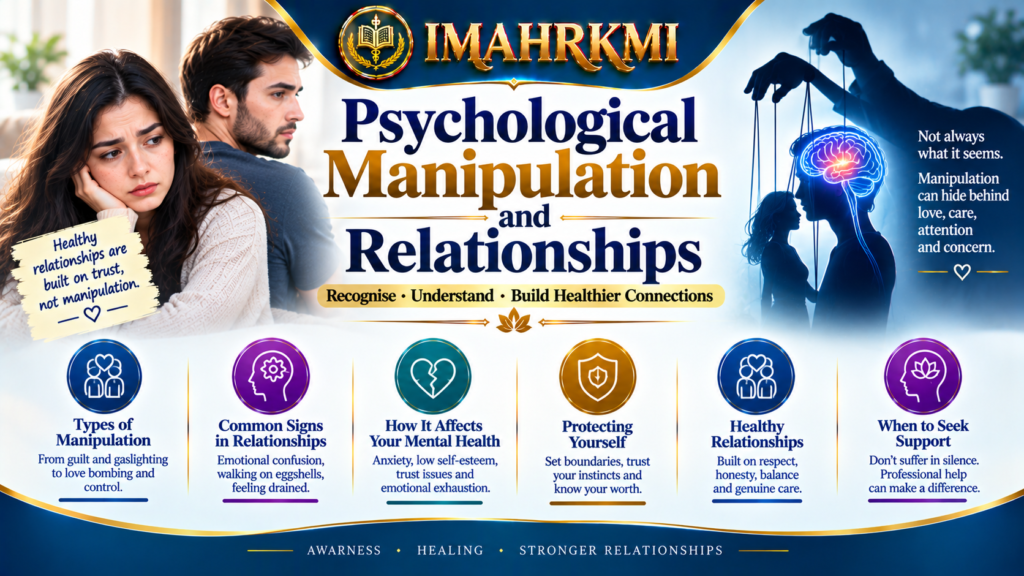
Relationships require compromise.
Therefore, it is important not to interpret every disagreement as manipulation.
A healthy relationship can include:
- Different opinions
- Negotiation
- Disappointment
- Conflict
- Compromise
- Emotional reactions
- Mistakes
- Apologies
- Changing one’s mind
The concern increases when there is a repeated pattern of:
pressure + control + deception + punishment + loss of autonomy.
Healthy relationships allow both people to remain individuals.
Psychological Manipulation in Marriage
Marriage involves emotional, financial, family, and sometimes religious expectations.
This complexity can create opportunities for unhealthy psychological pressure.
Manipulation in marriage may involve:
- Using affection as punishment
- Repeated guilt-tripping
- Controlling finances
- Isolating a spouse
- Threatening abandonment
- Using children as emotional leverage
- Repeated humiliation
- Controlling communication
- Misusing personal vulnerabilities
- Pressuring a spouse into unwanted decisions
Healthy marriage requires mutual respect, communication, responsibility, and consideration for each person’s dignity and autonomy.
A disagreement between spouses does not automatically mean manipulation.
The pattern and impact matter.
Psychological Manipulation and Religion
Religion can provide moral guidance, emotional support, responsibility, and a framework for personal behavior.
However, religious language can also be misused by individuals to create excessive fear, guilt, or control.
A person may selectively use religious concepts to pressure someone into doing what they want.
It is therefore important to distinguish between:
genuine religious guidance
and
personal psychological pressure presented as religious authority.
When a specific religious ruling is involved, people should seek guidance from qualified and trustworthy religious scholars rather than relying on someone using religion as a tool of personal control.
Does Manipulation Always Mean the Person Is a Narcissist?
No.
This is an important distinction.
Manipulative behavior does not automatically mean that someone has narcissistic personality disorder or another mental health diagnosis.
People can behave manipulatively for many reasons, including:
- Learned behavior
- Insecurity
- Poor communication
- Fear
- Emotional immaturity
- Relationship patterns
- Personality traits
- Stress
- Desire for control
- Deliberate exploitation
A diagnosis requires appropriate professional assessment.
Psychological education should focus on observable patterns rather than casually diagnosing people based on internet descriptions.
Is "Dark Psychology" a Formal Psychological Specialty?
The term Dark Psychology is widely used online to describe topics related to manipulation, influence, deception, coercion, psychological control, persuasion, and harmful interpersonal behavior.
However, “Dark Psychology” is not generally recognized as a formal clinical specialty or diagnosis within mainstream professional psychology.
Many of the subjects discussed under this popular label overlap with established areas such as:
- Social psychology
- Cognitive psychology
- Personality psychology
- Behavioral science
- Communication
- Decision-making
- Persuasion
- Interpersonal relationships
- Emotional regulation
Studying these subjects ethically can help people understand how influence works and, importantly, how to recognize unhealthy influence.
The Most Powerful Protection: Psychological Awareness
You do not need to become suspicious of everyone.
You need to become more aware of:
- Your emotions
- Your boundaries
- Your decision-making patterns
- Your vulnerabilities
- Your cognitive biases
- Relationship dynamics
- Communication patterns
- Sources of information
- Repeated behavioral patterns
The stronger your psychological awareness becomes, the less likely you are to automatically react to pressure.
A Simple Psychological Self-Protection Checklist
When you feel psychologically pressured, ask yourself:
1. What exactly is happening?
Describe the behavior without labels.
2. What am I being asked to do?
Identify the specific request.
3. What happens if I say no?
Look at the consequences.
4. Am I being given time to think?
If not, why?
5. Am I being made to feel guilty or afraid?
Identify the emotional pressure.
6. Can I verify the information?
Check facts independently.
7. Can I discuss this with someone I trust?
Seek an outside perspective.
8. Are my boundaries being respected?
Observe behavior rather than promises.
9. Is this an isolated incident or a repeated pattern?
Patterns are more informative than single events.
10. Is my autonomy being respected?
This may be the most important question.
What If You Realize You Have Been Manipulated?
Recognizing manipulation can produce many emotions.
You may feel:
- Angry
- Embarrassed
- Betrayed
- Confused
- Ashamed
- Disappointed
- Afraid
- Emotionally exhausted
Try not to blame yourself.
Manipulation works partly because humans naturally trust, connect, cooperate, seek approval, and respond to emotional relationships.
The goal is not to punish yourself for trusting someone.
The goal is to understand what happened and improve your future psychological boundaries.
You can ask:
What did I learn?
What warning signs did I overlook?
What boundaries do I need now?
Who can provide objective support?
What decisions should I avoid making under pressure?
Learning from an experience can be more useful than repeatedly blaming yourself for it.
When Manipulation Becomes a Safety Issue
Some situations go beyond ordinary interpersonal conflict.
If psychological pressure is accompanied by threats, stalking, physical violence, sexual coercion, severe financial control, or fear for your immediate safety, the priority should be safety rather than winning an argument.
In such circumstances, seek appropriate professional, legal, emergency, or domestic-violence support based on your location and situation.
Do not assume that you must confront the person directly if doing so could increase your risk.
Frequently Asked Questions
Can anyone be manipulated?
Yes. Intelligence and education do not make a person completely immune to psychological influence.
Is every persuasive person manipulative?
No. Healthy persuasion respects autonomy and allows people to make informed choices.
Is guilt always manipulation?
No. Genuine guilt can occur when someone recognizes that they have harmed another person. Manipulative guilt involves using guilt as repeated psychological pressure to obtain compliance.
Is gaslighting the same as manipulation?
Gaslighting is one form of psychological manipulation involving patterns that can undermine a person’s confidence in their memory, perception, or judgment.
Can manipulation happen in a healthy relationship?
Occasional unhealthy behavior can occur in almost any relationship. The important issue is whether there is a repeated pattern and whether the people involved are willing to recognize and correct it.
Should I manipulate a manipulative person back?
Generally, no. Retaliatory manipulation can escalate conflict and create a destructive cycle.
How can I become harder to manipulate?
Develop psychological awareness, critical thinking, emotional regulation, healthy boundaries, independent relationships, and the ability to slow down important decisions.
Does learning about Dark Psychology make someone manipulative?
Not necessarily. Ethical psychological education can be used for awareness, self-protection, communication, and understanding human behavior. The purpose of education matters.
Final Thoughts
Psychological manipulation becomes easier to recognize when you stop looking only at individual statements and start examining behavioral patterns.
Ask yourself:
Is my autonomy respected?
Can I disagree safely?
Can I say no without punishment?
Am I being given accurate information?
Can I take time to think?
Can I maintain relationships outside this person?
Are my boundaries respected?
These questions can help you identify unhealthy psychological dynamics without automatically labeling every difficult interaction as manipulation.
The strongest defense against psychological manipulation is not manipulation itself.
It is psychological awareness.
Understanding how emotions, cognitive biases, persuasion, social pressure, deception, and interpersonal dynamics influence human behavior can help individuals make more independent and informed decisions.
Learn More About Psychological Manipulation and Dark Psychology
If you want to go beyond basic awareness and study the psychology behind manipulation, persuasion, psychological control, cognitive biases, emotional influence, deception, vulnerability, decision-making, and human behavior, structured education can provide a more comprehensive foundation.
The IMAHRKMI Dark Psychology Online Certificate/Diploma Program is designed for educational and professional understanding of psychological influence and manipulation-related concepts.
The program explores topics such as:
- Psychological manipulation
- Emotional influence
- Psychological control
- Persuasion
- Cognitive biases
- Human behavior
- Vulnerability and decision-making
- Deception
- Emotional pressure
- Manipulation awareness
- Ethical psychological understanding
- Self-protection and critical thinking
The purpose of studying these subjects should not be to exploit, control, or psychologically harm other people.
The purpose should be education, awareness, ethical understanding, and protection.
Learn how psychological influence works so you can recognize unhealthy patterns, think more critically, and protect your psychological autonomy.