
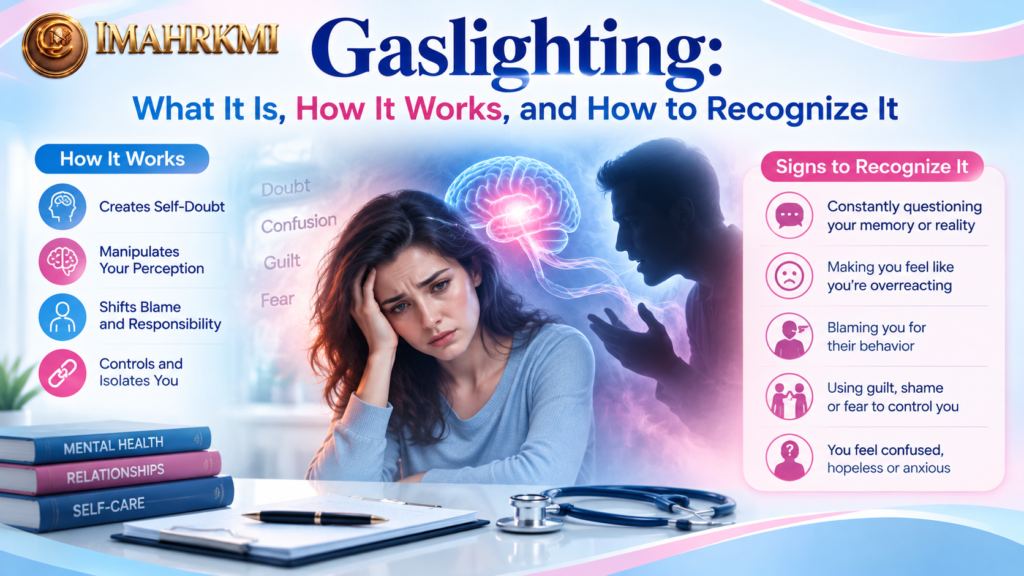
Gaslighting: What It Is, How It Works, and How to Recognize It
Have you ever walked away from a conversation feeling confused about what actually happened?
Perhaps you clearly remember something someone said or did, but after talking to them, you begin questioning your own memory. Maybe you express that something hurt you, only to be told that you are “too sensitive.” Or you raise a legitimate concern and end up apologizing for bringing it up.
Occasional disagreements about memories or interpretations are normal. People can genuinely remember events differently. However, when a person repeatedly uses denial, distortion, contradiction, blame, or other manipulative communication patterns to make another person doubt their own perception, this can become gaslighting.
Gaslighting is commonly discussed in the context of psychological manipulation and emotionally harmful relationships. Understanding the concept can help people recognize unhealthy communication patterns without automatically labeling every disagreement or relationship conflict as gaslighting.
This article examines gaslighting from psychological, relationship, and behavioral perspectives and explains why recognizing manipulation is an important part of psychological education.
What Is Gaslighting?
Gaslighting is a pattern of psychological manipulation in which a person attempts to make another person question their memory, perception, judgment, or understanding of events.
The term comes from the 1938 stage play Gas Light and later film adaptations, in which a husband manipulates circumstances in a way that causes his wife to question her own perception of reality.
In modern psychological discussions, the term is generally used to describe a pattern rather than one isolated disagreement.
For example, a single statement such as:
“I remember the conversation differently.”
is not necessarily gaslighting.
But a repeated pattern such as:
- denying events that clearly occurred,
- repeatedly rewriting conversations,
- insisting the other person is imagining things,
- dismissing legitimate concerns,
- shifting responsibility,
- attacking the person’s ability to remember,
- creating confusion,
- and causing the person to increasingly distrust their own judgment
may represent a more concerning pattern of manipulation.
The pattern, context, intention, power dynamics, and psychological impact all matter.
Gaslighting vs. Normal Disagreement
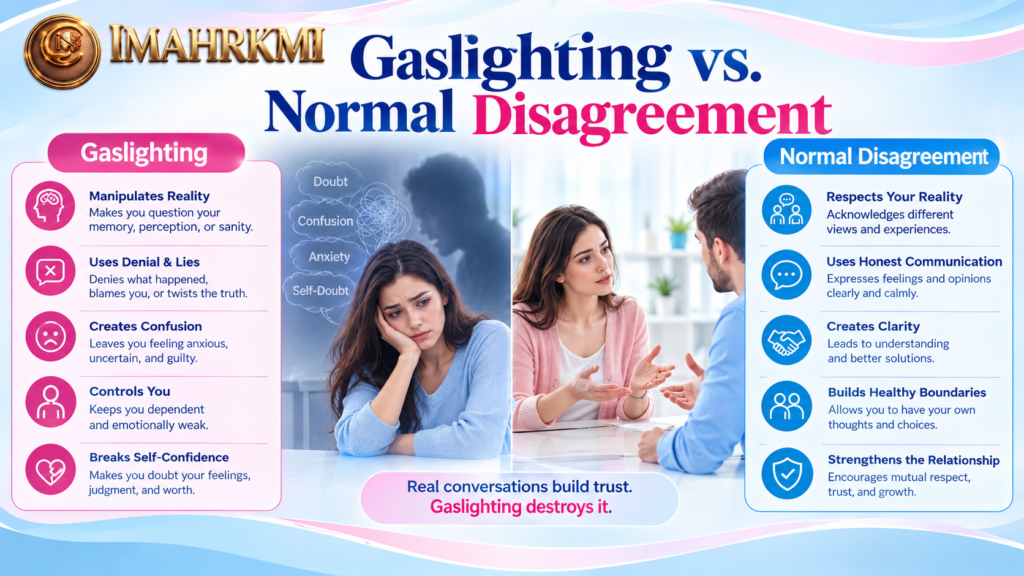
This distinction is extremely important.
Not every disagreement is psychological manipulation.
Two people can honestly remember the same event differently. Human memory is not a perfect recording system. Stress, attention, emotions, time, and individual interpretation can influence how people remember experiences.
For example:
Person A:
“I remember you saying that yesterday.”
Person B:
“I honestly don’t remember saying that.”
This disagreement alone does not establish gaslighting.
A more concerning interaction may involve a repeated pattern where one person consistently attempts to undermine the other’s confidence in their own perception:
“You always imagine things. You can’t trust your memory. You’re becoming irrational. None of this happened.”
Again, one sentence alone does not provide enough information to diagnose a relationship pattern.
The broader behavioral pattern matters.
Why Is Gaslighting Psychologically Powerful?
Gaslighting can be powerful because it targets something fundamental to psychological functioning: confidence in one’s own perception and judgment.
People normally rely on their memories, observations, emotions, and interpretations to make decisions.
When someone repeatedly challenges these internal reference points, uncertainty can develop.
The person may begin asking:
- “Did I misunderstand?”
- “Maybe I remember it incorrectly.”
- “Am I overreacting?”
- “Maybe I’m the problem.”
- “Should I apologize?”
- “Can I trust my own judgment?”
Over time, repeated uncertainty can affect confidence and emotional stability.
This is one reason psychological manipulation can become particularly harmful when it occurs repeatedly within a close relationship.
Common Signs of Gaslighting
Gaslighting does not always look dramatic. In many situations, manipulation develops gradually.
Some potential warning signs include the following.
1. Repeated Denial of Events
The person repeatedly denies things that you remember occurring.
They may insist:
- “That never happened.”
- “I never said that.”
- “You’re making that up.”
One disagreement does not establish gaslighting. Repeated denial as part of a broader pattern deserves closer attention.
2. Making You Question Your Memory
A manipulative person may repeatedly suggest that your memory is unreliable.
You may begin depending on their version of events rather than trusting your own observations.
This can gradually weaken confidence in your decision-making.
3. Dismissing Your Feelings
Another warning sign is repeatedly minimizing legitimate emotional concerns.
Examples may include:
- “You’re too sensitive.”
- “You’re making a big deal out of nothing.”
- “You’re always emotional.”
- “You can’t take a joke.”
Healthy relationships allow people to discuss feelings without automatically invalidating them.
4. Changing the Subject When Confronted
Instead of addressing the original issue, the person changes the conversation.
For example, you may raise a concern about something they did, and suddenly the discussion becomes about your personality, your mistakes, or something you did months earlier.
This can prevent the original issue from being addressed.
5. Shifting Responsibility
A manipulative communication pattern may involve constantly turning the responsibility back onto the other person.
Instead of:
“I understand that my behavior hurt you.”
the response becomes:
“You made me behave that way.”
Responsibility becomes difficult to establish because the discussion continually moves away from the original behavior.
6. Making You Apologize for Raising a Concern
Some people eventually find themselves apologizing simply because they attempted to discuss a problem.
This can create an unhealthy pattern:
Concern → denial → argument → confusion → self-doubt → apology.
If this repeatedly occurs, it may be worth examining the communication pattern more carefully.
Gaslighting in Romantic Relationships
Gaslighting can occur in romantic relationships, including dating relationships and marriages.
Because romantic partners often have extensive knowledge of each other’s emotions, vulnerabilities, routines, and personal history, manipulation can become particularly influential.
Potential relationship warning signs include:
- repeatedly denying hurtful behavior,
- manipulating conversations,
- minimizing a partner’s feelings,
- using personal vulnerabilities against them,
- creating fear of raising concerns,
- making the partner constantly question themselves,
- refusing accountability,
- repeatedly turning every conflict into the partner’s fault.
However, couples should be careful about using the word gaslighting as a weapon.
A marriage can contain misunderstandings, poor communication, defensiveness, unresolved resentment, and emotional immaturity without necessarily involving deliberate psychological manipulation.
Professional assessment should consider the overall pattern.
Gaslighting in Family Relationships
Gaslighting is not limited to romantic relationships.
It can occur within:
- parent-child relationships,
- sibling relationships,
- extended families,
- friendships,
- professional environments,
- and other interpersonal relationships.
For example, a family member may repeatedly dismiss another person’s recollection of important events or use shame and blame to discourage them from expressing concerns.
The emotional consequences can become significant when the individual has limited ability to distance themselves from the relationship.
Gaslighting in the Workplace
Psychological manipulation can also occur in professional environments.
Potential examples include:
- denying previous instructions,
- changing expectations without acknowledging the change,
- blaming employees for decisions they did not make,
- repeatedly questioning an employee’s competence,
- minimizing legitimate workplace concerns,
- creating confusion about responsibilities.
However, workplace misunderstandings can also arise from poor communication, inadequate documentation, organizational problems, or conflicting expectations.
Therefore, documentation, clear communication, and appropriate organizational procedures can be useful when concerns arise.
Gaslighting and Emotional Manipulation
Gaslighting can overlap with broader forms of emotional manipulation.
Manipulation generally involves attempts to influence another person’s thoughts, emotions, decisions, or behavior in ways that may benefit the manipulator.
Possible psychological pressure points can include:
- fear,
- guilt,
- shame,
- insecurity,
- dependency,
- social pressure,
- approval seeking,
- uncertainty.
Understanding these patterns is one reason psychological education can be useful.
The goal should not be to teach people how to manipulate others. It should be to help people recognize unhealthy influence, think critically, establish appropriate boundaries, and protect their psychological well-being.
Does Gaslighting Always Mean the Person Is a Narcissist?
No.
This is one of the most common misconceptions.
A person who demonstrates manipulative behavior should not automatically be diagnosed with narcissistic personality disorder.
Narcissistic personality disorder is a specific clinical diagnosis requiring appropriate professional assessment.
Similarly, gaslighting behavior alone does not prove that someone has:
- narcissistic personality disorder,
- psychopathy,
- antisocial personality disorder,
- or any other mental disorder.
A behavior and a psychiatric diagnosis are not the same thing.
This distinction is particularly important in online mental-health education, where personality labels are often used too casually.
Gaslighting and the "Dark Psychology" Concept
The phrase Dark Psychology is commonly used online to describe topics involving manipulation, persuasion, deception, influence, coercive behavior, and psychological control.
It is not a formal psychiatric diagnosis or a single established clinical specialty.
Nevertheless, the underlying psychological topics can be studied through established areas of psychology, including:
- social psychology,
- cognitive psychology,
- personality psychology,
- behavioral science,
- communication,
- interpersonal relationships,
- decision-making,
- persuasion,
- and psychological assessment.
Studying these concepts from an ethical perspective can help individuals understand how influence works and how manipulation can affect decision-making.
The purpose of responsible education should be awareness and protection—not exploitation.
Why Do People Become Vulnerable to Manipulation?
Anyone can potentially experience manipulation.
Vulnerability does not necessarily mean that someone is weak or unintelligent.
Certain circumstances may make people more vulnerable, including:
Emotional Dependency
When a person’s emotional well-being becomes heavily dependent on another person’s approval, rejection can become especially powerful.
Low Self-Confidence
People who frequently doubt themselves may be more likely to accept another person’s interpretation without questioning it.
Fear of Abandonment
Fear of losing an important relationship can make someone tolerate unhealthy communication.
Social Isolation
Limited access to trusted friends, family, or professionals can make it harder to obtain an independent perspective.
Stress and Exhaustion
High stress can affect concentration, emotional regulation, and decision-making.
Previous Negative Experiences
Previous experiences of emotional abuse or manipulation may influence how a person responds to similar situations later.
Understanding vulnerability is not about blaming the person being manipulated.
It is about identifying circumstances in which stronger psychological support may be needed.
Psychological Effects of Repeated Gaslighting
The effects vary from person to person.
Repeated psychological manipulation may contribute to:
- self-doubt,
- confusion,
- anxiety,
- reduced confidence,
- emotional exhaustion,
- difficulty making decisions,
- excessive apologizing,
- fear of confrontation,
- social withdrawal,
- difficulty trusting one’s judgment.
Some people may begin documenting conversations or repeatedly seeking reassurance because they no longer feel confident in their own recollection.
If psychological distress becomes persistent or severe, professional mental-health support may be appropriate.
How to Protect Yourself from Gaslighting
Recognizing manipulation is only the first step.
1. Pay Attention to Patterns
Do not judge an entire relationship based on one difficult conversation.
Look for repeated patterns over time.
Ask:
“What happens repeatedly when I raise a legitimate concern?”
2. Maintain Independent Perspectives
Trusted friends, family members, counselors, or qualified professionals may sometimes provide an outside perspective.
This does not mean automatically believing someone else’s interpretation either.
The goal is to develop a more balanced understanding.
3. Keep Important Information Organized
In professional or serious interpersonal situations, maintaining appropriate records of important communications can help clarify what was actually agreed upon.
Documentation can be particularly useful in workplace or administrative situations.
4. Establish Boundaries
Healthy boundaries communicate what behavior you will and will not accept.
Boundaries are not threats.
They are clear statements about your own decisions and limits.
5. Avoid Endless Arguments About Reality
If every conversation becomes an attempt to prove what happened, the discussion can become exhausting.
Sometimes stepping away and returning to the issue later is healthier than remaining trapped in an escalating argument.
6. Seek Professional Support
A mental-health professional can help you understand:
- whether the relationship involves manipulation,
- whether communication problems are mutual,
- how stress is affecting you,
- what boundaries may be appropriate,
- and whether additional support is needed.
If there is intimidation, threats, coercion, or fear for personal safety, safety planning and appropriate professional or local support should take priority.
What Should You Do If You Think You Are Being Gaslighted?
Start with observation rather than immediately labeling the other person.
Ask yourself:
- Is this an isolated disagreement or a repeated pattern?
- Does the person ever accept responsibility?
- Are my concerns consistently dismissed?
- Do conversations leave me chronically confused?
- Am I increasingly afraid to express reasonable concerns?
- Have I become dependent on the other person’s version of events?
- Do I have trusted people with whom I can discuss what is happening?
- Would professional counseling help me understand the situation?
These questions can help you examine the relationship more objectively.
Gaslighting Does Not Mean Every Difficult Person Is an Abuser
This is another important distinction.
People can be:
- defensive,
- immature,
- forgetful,
- emotionally reactive,
- poor communicators,
- conflict-avoidant,
- or insensitive
without intentionally engaging in gaslighting.
A clinical or educational approach should avoid automatically diagnosing people based on a few examples.
The focus should be on observable behavior, repeated patterns, psychological impact, relationship dynamics, and safety.
How Psychological Education Can Help
Understanding psychological manipulation can improve psychological awareness.
People who understand concepts such as:
- cognitive biases,
- emotional influence,
- persuasion,
- social pressure,
- manipulation,
- deception,
- psychological control,
- emotional dependency,
- interpersonal dynamics,
may be better prepared to recognize unhealthy patterns.
However, knowledge should be used ethically.
The objective is not to control other people.
The objective is to understand human behavior, recognize manipulation, improve critical thinking, and develop healthier interpersonal boundaries.
When Should You Seek Professional Help?
Consider speaking with a qualified mental-health professional if you experience:
- persistent anxiety,
- significant loss of self-confidence,
- emotional distress,
- fear within a relationship,
- difficulty making everyday decisions,
- social isolation,
- repeated psychological conflict,
- or difficulty determining whether a relationship is healthy.
Couples therapy may sometimes be appropriate when both partners are willing to participate safely and constructively.
Individual therapy may be more appropriate when a person needs private support, particularly when there are significant power differences, intimidation, or concerns about safety.
If there is immediate danger, threats, physical violence, or coercive control, safety should take priority over relationship counseling.
Frequently Asked Questions About Gaslighting
What is gaslighting in simple words?
Gaslighting refers to a pattern of psychological manipulation that causes a person to increasingly question their own memory, perception, judgment, or understanding of events.
Is gaslighting always intentional?
Intent can be difficult to determine from the outside. A professional assessment should focus on the observable pattern and its impact rather than assuming someone’s internal motives.
Is gaslighting the same as lying?
No. Lying involves deliberately providing false information. Gaslighting generally refers to a broader pattern of manipulation that undermines another person’s confidence in their perception or judgment.
Can gaslighting happen in marriage?
Yes. Manipulative communication patterns can occur in romantic relationships and marriages, but normal marital disagreement should not automatically be labeled gaslighting.
Is gaslighting a mental illness?
No. Gaslighting is not itself a psychiatric diagnosis.
Does gaslighting mean someone is a narcissist?
No. A person can display manipulative behavior without having narcissistic personality disorder.
Can therapy help after gaslighting?
Professional mental-health support can help a person understand relationship patterns, rebuild confidence, improve boundaries, and address anxiety or emotional distress when present.
Final Thoughts
Gaslighting is an important concept within discussions of psychological manipulation because it involves one of the most significant consequences of unhealthy influence: losing confidence in your own ability to understand what is happening around you.
At the same time, responsible psychological education requires balance.
Not every disagreement is gaslighting.
Not every defensive person is a narcissist.
Not every relationship problem is psychological abuse.
The most useful approach is to examine patterns, context, communication, power dynamics, accountability, emotional impact, and safety.
Learning about manipulation should ultimately make people more psychologically informed—not more fearful of ordinary human disagreement.
Understanding psychology can help you recognize unhealthy influence, think more critically, communicate more effectively, and protect your emotional well-being.
Learn More About Psychological Manipulation and Human Behavior
If you want to go beyond the basic definition of gaslighting and develop a broader understanding of psychological manipulation, persuasion, cognitive biases, psychological control, emotional influence, deception, vulnerability, and human behavior, structured education can provide a more systematic foundation.
IMAHRKMI’s Dark Psychology Online Certificate/Diploma Program is designed as an educational program exploring psychological and behavioral concepts related to influence, manipulation, human behavior, cognitive processes, and psychological control.
The program is particularly relevant for learners who want to understand:
- How psychological influence works
- Why people become vulnerable to manipulation
- Cognitive biases and decision-making
- Emotional manipulation
- Psychological control
- Persuasion and influence
- Human behavior
- Deception and interpersonal behavior
- Psychological vulnerability
- Ethical awareness and self-protection
The purpose of studying these subjects should be knowledge, awareness, ethical understanding, and protection from harmful manipulation—not exploitation of other people.
Explore the IMAHRKMI Dark Psychology Online Certificate/Diploma Program to study these concepts in a structured educational format.
About the Author
Dr. Inayat Ullah, M.D.
Board-Certified Psychiatrist
AASECT-Certified Sex Therapist
Sexologist & Mental Health Specialist
Relationship & Couple Therapy Specialist
Director, IMAHRKMI
New York, USA