
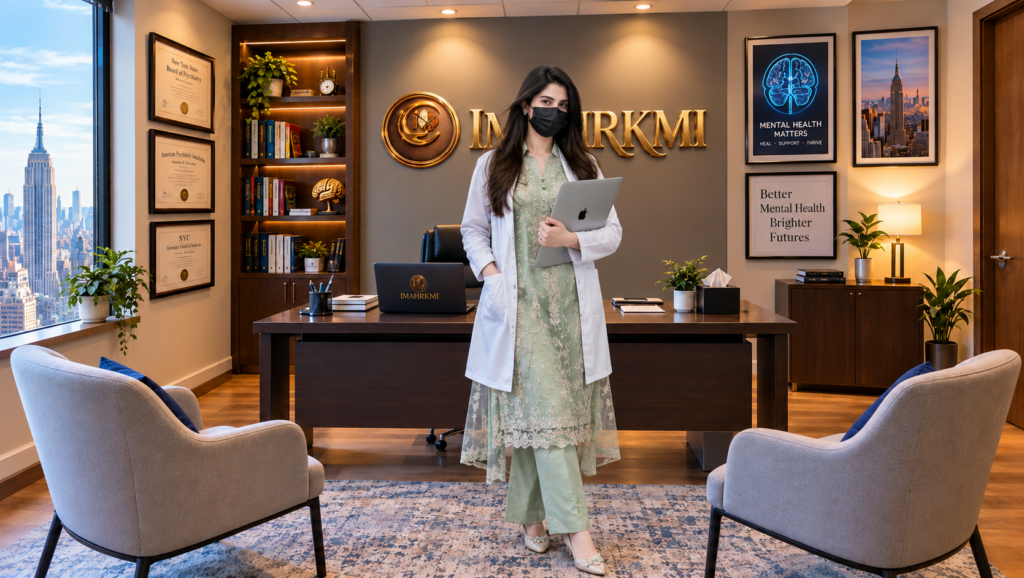
Iqra Tahir | Clinical Psychologist | Sialkot, Pakistan
Introduction
Mental health is an important aspect of overall human health. Growing awareness of psychological problems requires more and more trained professionals in order to help people suffering from mental health issues. As more and more people become aware of psychological problems and need support from people who understand human behaviour and can deal with them in an ethical and sensitive manner.
Iqra Tahir is an emerging professional in the field of clinical psychology. She is a postgraduate student, currently completing her supervised clinical experience, whilst furthering her knowledge and skills through her postgraduate studies.
Iqra has completed her Bachelor of Science in Applied Psychology degree and is continuing to further her knowledge of psychological assessment, clinical observation and evidence-based mental health interventions as she completes her MS Clinical Psychology degree.
Academic and Professional Development
For individuals who are interested in Psychology and explore the complex human interactions including human behaviour, emotions, thoughts and social experiences, a solid academic background is required.
Iqra Tahir is a graduate of BS in Applied Psychology program. Her interest in scientific study of human psychological processes continues to grow from this base of knowledge.
Applied psychology is the connection between psychological principles and real life situations.
This knowledge is useful for people who want to work in clinical settings, in educational settings, in mental health settings and in a variety of other settings where there are a range of professional roles that require an understanding of the major theories of behavior, learning, personality and child and adult emotional development.
Iqra is building on her undergraduate education by studying for her MS in Clinical Psychology at the University of Management and Technology (UMT). This is an important stage in her professional development, allowing her to explore in more depth the different psychological problems and approaches of clinical psychology.
The study of psychology is continually developing and every person has a different background, different personalities and experiences.
As developing professionals, we need to treat every individual with due care and respect and avoid making assumptions about people and how they think and behave and seek to apply generalizations to them.
Clinical Internship: Connecting Knowledge with Practice
Iqra Tahir is currently completing an ongoing clinical psychology internship at Advance Medical City where she is gaining experience in clinical situations under supervision of professionals working in the field of mental health.
She learns from her internship how client behaviour looks like; how clinical communication works and what kind of tasks a mental health care institution expects from its personnel. By learning to apply psychological concepts in a real-life setting, psychology trainees gain valuable experience and insight into how concepts learned in the classroom can be applied in real-life clinical situations.
All of a person’s words and expressions of emotion, behaviour and responses to situations can give valuable information to a developing psychologist and he must interpret these in detail.
Understanding Mental Status Examination and Psychological Assessment
One area of clinical knowledge Iqra is studying for in relation to her training as a mental health professional is that of the Mental Status Examination (MSE). The MSE is a structured way of describing a person’s current psychological functioning.
The MSE may cover appearance, behaviour, speech, mood, affect, thought, content, perception, cognition, insight and judgment depending on clinical circumstances and helps to organize and make sense of clinical observations to arrive at a wider understanding of a patient’s presentation.
Exploring Psychopathology and Diagnostic Understanding
Psychopathology refers to psychological symptoms, behaviours and dysfunction affecting an individual’s emotions and/or mental health in some way. An introductory understanding of the various ways in which psychological distress can manifest is important for the developing psychologist.
Academically and clinically, Iqra has begun to learn some of the diagnostic criteria for mental health and neurological conditions as outlined in the Diagnostic and Statistical Manual of Mental Disorders, Fifth Edition, Text Revision (DSM-5-TR).
Whilst becoming familiar with the diagnostic criteria for various conditions can be an important part of a trainee’s learning, recognizing a potential symptom or cluster of symptoms is not in itself sufficient to make a diagnosis of a clinical condition. A full diagnosis depends on a suitable assessment, a suitable history, consideration of alternative explanations and professional competence.
It is important to take a careful approach to any symptoms presented by an individual as these can differ from person to person and can be affected by a number of factors including the individual’s physical health, their environment, their relationships and their experiences.
The Biopsychosocial Approach and Case Formulation
There is no single cause of human behaviour and therefore many emotional problems occur as a result of interactions between biological, psychological and social factors. The biopsychosocial approach is a way that professionals can consider these different dimensions when trying to make sense of a person’s problems.
From Iqra’s knowledge on case formulation using the 5 Ps: presenting, predisposing, precipitating, perpetuating and protective factors.
There are five key areas to consider when exploring information regarding a person’s difficulties. Presenting factors are the current issues affecting the individual, predisposing factors look at the factors that have increased the individual’s vulnerability, Events which trigger the development of problems are referred to as precipitating factors. Factors which sustain a problem and those which offer protection are also noted.
Skills
- Communication- She is a strong interpersonal communicator.
- Problem solving- She has an ability to solve clients’ problems and to support client well-being.
- Enthusiastic- She is one of the enthusiastic mental health professional and dedicated psychologist.
- Leadership- She also has a strong leadership quality.
- Team player- She is one of the supportive and cooperative team members.
- Innovative- She has an ability to utilizes innovative thinking to address complex challenges faced by clients.
Evidence based Practice & Lifelong Learning
The growing body of new research and of psychologists’ professional experience of delivering psychological support to people with mental health problems is continuously increasing our knowledge and psychologists must keep themselves up-to-date with the current research on mental health.
She will continue to enhance my theoretical knowledge and improve her skills during postgraduate studies and clinical placement, under proper supervision. She will learn, receive feedback and reflect on her professional experiences.
Digital Presence
She also conducts her webinars, talk shows or workshops live to raise awareness about mental health. She also serves her role in participating in different webinars and programs as a host and cohost. She also going to perform her role as a speaker in different shows or events. I am also able to provide online counselling confidential sessions to the clients for helping individuals to coping their concerns and provide healthy solutions. Her vlogs and video sessions are also available on:
These are the platforms are designed not only for my clients or my own patients but these are open for everyone who want to learn more about psychology and get more information and awareness of mental health.
I motivate everyone to follow and subscribes this channel to get awareness and consultation with me or with our professionals experienced psychologist and psychiatrist involved in team IMAHRKMI to get more benefit and continues updates about mental health issues.
Conclusion
Iqra Tahir shares her clinical psychology experience. Iqra has completed her BS in Applied Psychology. She is studying for her MS in Clinical Psychology at UMT and has recently completed her internship at Advance Medical City.
Mental status examination, introductory psychopathology, psychological assessment, case formulation, and ethical mental health practice are the main areas that the student is learning. In addition to these learning areas, effective communication, empathy, observation and responsibility for working in a professional manner.