
Emotional Manipulation: 10 Psychological Tactics You Should Know
Human beings influence one another every day.
Parents influence children. Teachers influence students. Doctors influence patients. Friends influence friends. Couples influence each other. Employers influence employees. Advertising influences consumers.
Influence itself is not necessarily harmful.
The problem begins when a person repeatedly attempts to influence another person’s emotions, judgment, decisions, or behavior through deception, pressure, fear, guilt, shame, confusion, or exploitation of vulnerabilities.
This is commonly described as emotional manipulation.
Emotional manipulation can be subtle. It does not always involve shouting, threats, or obvious aggression. Sometimes it appears as excessive guilt, silent treatment, emotional pressure, victim-playing, deliberate confusion, or making another person feel responsible for someone else’s emotions.
Understanding these patterns is important because people are often more vulnerable to manipulation when they are emotionally attached to the person influencing them.
This article explains what emotional manipulation is, identifies common manipulation tactics, discusses its effects on relationships and mental well-being, and explains how psychological education can help people recognize unhealthy influence.
What Is Emotional Manipulation?
Emotional manipulation is a pattern of influencing another person’s emotions or behavior in a way that unfairly exploits their psychological vulnerabilities or pressures them toward a desired outcome.
A manipulative person may attempt to activate emotions such as:
- guilt,
- fear,
- shame,
- anxiety,
- obligation,
- insecurity,
- jealousy,
- sympathy,
- or fear of rejection.
The objective may be to gain control, avoid responsibility, obtain compliance, or influence another person’s decisions.
However, it is important to understand that not every emotional interaction is manipulation.
For example, saying:
“Your behavior hurt me, and I would like us to discuss it.”
is normal emotional communication.
By contrast:
“If you really loved me, you would do exactly what I want.”
may represent emotional pressure.
The difference often depends on the pattern, context, power dynamics, intention, and freedom of choice involved.
Emotional Influence vs. Emotional Manipulation
Healthy relationships involve emotional influence.
Partners influence each other’s decisions. Parents influence children. Friends offer advice. Professionals make recommendations.
Healthy influence generally allows the other person to:
- think independently,
- ask questions,
- disagree,
- make an informed decision,
- and maintain reasonable boundaries.
Manipulation becomes concerning when emotional pressure is used to undermine those freedoms.
For example:
Healthy communication:
“I disagree with your decision, but I respect that it is your choice.”
Manipulative communication:
“If you make that decision, you clearly don’t care about me.”
The second statement attempts to connect the person’s decision with guilt and emotional punishment.
Why Does Emotional Manipulation Work?
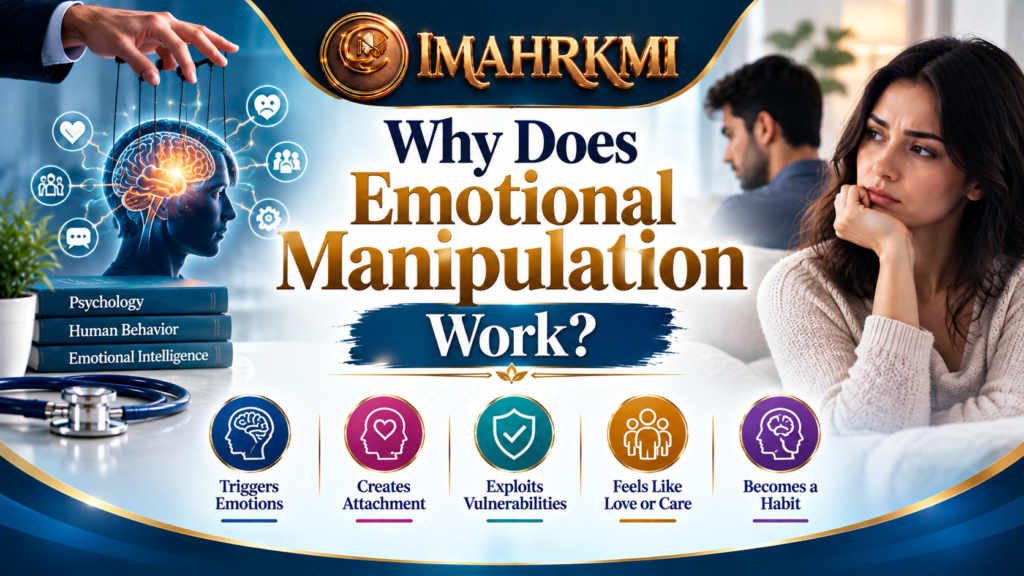
Emotional manipulation can work because emotions influence human decision-making.
When people are frightened, ashamed, guilty, emotionally attached, or under intense pressure, they may make decisions differently than they would in a calm state.
Manipulators may exploit predictable psychological tendencies such as:
- desire for approval,
- fear of rejection,
- need for belonging,
- responsibility toward others,
- fear of conflict,
- desire to avoid guilt,
- uncertainty,
- emotional dependency.
This does not mean that people who experience manipulation are weak.
Anyone can become vulnerable under the right circumstances.
Stress, loneliness, exhaustion, grief, relationship dependency, financial pressure, and social isolation can increase vulnerability.
10 Common Emotional Manipulation Tactics
1. Guilt Tripping
Guilt can be a powerful emotional motivator.
A person may attempt to make you feel guilty for:
- saying no,
- establishing a boundary,
- spending time with other people,
- making an independent decision,
- expressing disagreement,
- or prioritizing your own legitimate needs.
For example:
“After everything I’ve done for you, this is how you treat me?”
One expression of disappointment does not automatically constitute manipulation. The concern arises when guilt is repeatedly used as a tool to control another person’s choices.
2. Emotional Blackmail
Emotional blackmail involves using emotional pressure, fear, punishment, or threatened consequences to influence another person’s behavior.
A person may communicate:
“If you don’t do what I want, I’ll leave you.”
or:
“If you tell anyone about this, you’ll regret it.”
Emotional blackmail can become particularly harmful when the person being pressured feels trapped or believes they cannot safely say no.
3. Gaslighting
Gaslighting is a specific form of psychological manipulation involving attempts to make another person question their memory, perception, or understanding of events.
Examples may include repeatedly:
- denying events,
- contradicting conversations,
- dismissing concerns,
- questioning someone’s memory,
- or insisting that the other person is imagining problems.
Gaslighting and emotional manipulation can overlap, but they are not identical concepts.
Read our related article: Gaslighting: What It Is, How It Works, and How to Recognize It.
4. Silent Treatment
Silence can have many meanings.
Someone may need time to calm down after an argument. Taking space is not automatically abusive or manipulative.
The problem arises when silence is deliberately used as a repeated punishment or control mechanism.
For example, someone may intentionally withdraw communication until the other person agrees to their demands.
The psychological impact can include:
- anxiety,
- uncertainty,
- fear of rejection,
- excessive apologizing,
- and pressure to surrender a legitimate position simply to restore communication.
Healthy boundaries and temporary space are different from using silence as psychological punishment.
5. Playing the Victim
Some manipulative interactions involve repeatedly portraying oneself as the victim in order to avoid responsibility.
For example:
You raise a legitimate concern.
Instead of discussing the behavior, the other person responds:
“Everyone always attacks me. I’m always the bad person.”
The conversation then shifts from the original concern to comforting the person who was being held accountable.
Being genuinely hurt or victimized is not manipulation.
The concern is the repeated use of victimhood to avoid reasonable accountability.
6. Shame and Humiliation
Shame can be used to control behavior.
A person may attack another individual’s:
- intelligence,
- appearance,
- personality,
- family,
- education,
- income,
- relationships,
- or past mistakes.
Statements such as:
“No one else would ever want you.”
can damage self-confidence and increase psychological dependency.
Repeated humiliation is particularly concerning when it causes someone to believe they are incapable of functioning independently.
7. Fear-Based Pressure
Fear is one of the strongest human emotions.
Manipulation can involve creating fear of:
- abandonment,
- rejection,
- social consequences,
- financial loss,
- humiliation,
- retaliation,
- or relationship breakdown.
Fear-based pressure becomes especially serious when threats or intimidation are involved.
If someone feels physically unsafe, immediate safety and professional or local support should take priority.
8. Excessive Flattery and Love Bombing
Positive attention is not inherently manipulative.
People naturally compliment and appreciate each other.
However, excessive attention, intense promises, or unusually rapid emotional closeness may sometimes be used to create dependency or lower someone’s psychological defenses.
This is often discussed under the term love bombing, particularly in unhealthy relationship dynamics.
A pattern may look like:
Intense attention → rapid attachment → increased dependency → pressure or control.
Not every intense relationship beginning follows this pattern, so context matters.
9. Threatening to Withdraw Affection
Affection can become a tool of control when it is repeatedly made conditional on obedience.
For example:
“If you don’t do what I want, don’t expect me to love you.”
In healthy relationships, disagreement does not automatically eliminate someone’s basic dignity, respect, or emotional security.
Conditional affection can create fear and dependency over time.
10. Creating Confusion
Some manipulative communication becomes difficult to follow because the person continually changes:
- explanations,
- accusations,
- expectations,
- stories,
- or standards.
The result can be psychological exhaustion.
The other person may eventually stop questioning the situation simply because they want the conflict to end.
This is one reason clarity, documentation when appropriate, boundaries, and independent perspectives can be useful.
Emotional Manipulation in Romantic Relationships
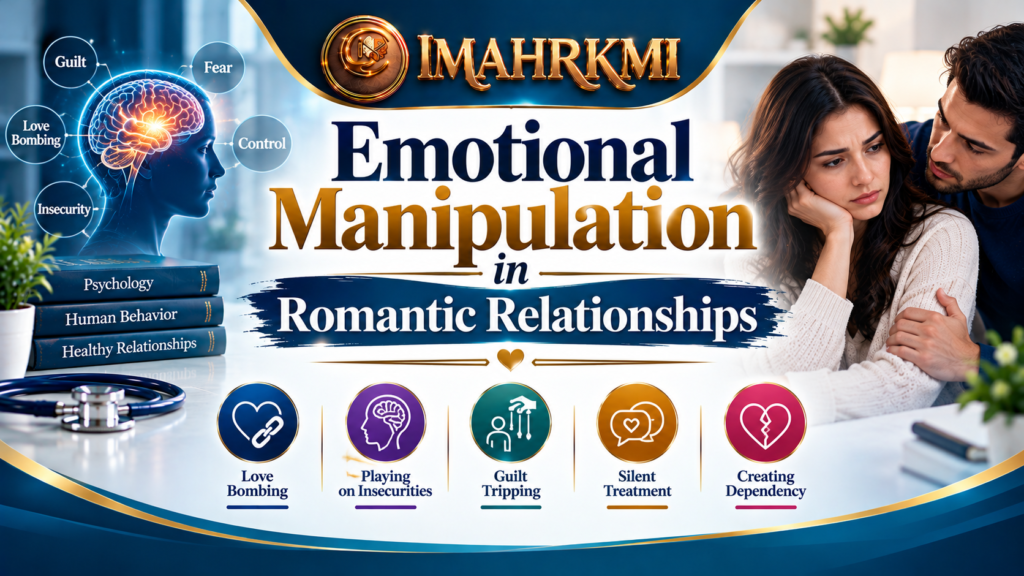
Romantic relationships can become particularly vulnerable to emotional manipulation because partners often have deep emotional knowledge about each other.
A partner may know:
- what you fear,
- what makes you feel guilty,
- what makes you insecure,
- what you value,
- what you are afraid of losing.
In a healthy relationship, this knowledge is used with care.
In an unhealthy relationship, it can potentially be used as psychological leverage.
Warning signs may include:
- repeated guilt-based pressure,
- controlling friendships,
- excessive jealousy,
- threats of abandonment,
- deliberate humiliation,
- emotional punishment,
- constant blame,
- refusal to accept responsibility,
- pressure to surrender reasonable boundaries.
However, relationship conflict should not automatically be labeled emotional manipulation.
A professional assessment should consider the frequency, severity, context, reciprocity, and psychological impact of the behavior.
Emotional Manipulation in Marriage
Marriage involves emotional interdependence, which can be healthy.
Spouses naturally consider each other’s needs and feelings.
The problem arises when emotional dependence becomes a tool for control.
Examples may include:
- using guilt to pressure a spouse,
- threatening divorce during every disagreement,
- deliberately withholding affection as punishment,
- using children to pressure a partner,
- repeatedly humiliating a spouse,
- controlling social relationships,
- creating fear around disagreement.
Healthy marriage requires communication, mutual respect, responsibility, and the ability to disagree without psychological punishment.
Emotional Manipulation in Friendships
Manipulation is not limited to romantic relationships.
A friend may repeatedly:
- make you feel guilty for having other friends,
- demand constant availability,
- become angry when you say no,
- use personal information against you,
- threaten to end the friendship,
- or make you feel responsible for their emotional stability.
A healthy friendship allows both people to have boundaries and independent lives.
Emotional Manipulation at Work
Workplace manipulation can take different forms.
Potential examples include:
- guilt-based pressure to work beyond reasonable expectations,
- taking credit for another person’s work,
- shifting blame,
- creating fear around disagreement,
- deliberately withholding information,
- using humiliation to control employees.
However, workplace stress and poor management do not automatically equal emotional manipulation.
Specific patterns should be evaluated in context.
Documentation, clear communication, and appropriate organizational procedures can help employees respond to serious workplace concerns.
How Emotional Manipulation Affects Mental Health
Repeated manipulation can have psychological consequences.
A person may begin experiencing:
Self-Doubt
They may increasingly question whether their feelings and decisions are legitimate.
Anxiety
They may constantly anticipate the next argument, accusation, or emotional reaction.
Guilt
They may feel responsible for another person’s emotions.
Low Self-Esteem
Repeated criticism and humiliation can gradually damage self-confidence.
Emotional Exhaustion
Constantly managing another person’s reactions can become psychologically draining.
Difficulty Setting Boundaries
A person may become afraid to say no.
Social Isolation
Manipulative relationships can sometimes discourage outside friendships and support systems.
The severity of these effects varies between individuals.
Why Intelligent People Can Be Manipulated
A common misconception is:
“Only weak or unintelligent people are manipulated.”
This is false.
Intelligence does not eliminate emotional vulnerability.
Highly educated and successful individuals can experience manipulation because manipulation frequently operates through emotional attachment, social pressure, trust, fear, uncertainty, and psychological needs, rather than simply through lack of intelligence.
A person can be highly intelligent and still become vulnerable when:
- they deeply love someone,
- they fear losing a relationship,
- they are exhausted,
- they are isolated,
- they are grieving,
- they depend financially on someone,
- or they desperately want approval.
Understanding this helps reduce victim-blaming.
Emotional Manipulation and Cognitive Biases
Human decision-making is influenced by cognitive biases and mental shortcuts.
Some psychological tendencies that can influence decisions include:
- confirmation bias,
- authority bias,
- social proof,
- loss aversion,
- availability bias,
- commitment effects,
- reciprocity expectations.
Manipulative individuals may sometimes exploit these tendencies.
For example, someone may create the impression that:
“Everyone agrees with me.”
This can activate social pressure.
Or:
“I’ve already done so much for you.”
This may activate a sense of obligation or reciprocity.
Understanding cognitive biases does not mean every use of persuasion is manipulation.
The ethical issue is whether psychological influence is being used transparently and respectfully or exploitatively.
How to Recognize Emotional Manipulation
Instead of focusing on one sentence, look for patterns.
Ask yourself:
Does the person respect my right to say no?
Can I disagree without being punished?
Can I express concerns without being humiliated?
Does the person accept responsibility?
Do they repeatedly make me feel guilty for having reasonable boundaries?
Do conversations frequently leave me confused or emotionally exhausted?
Am I becoming afraid to express my actual opinion?
Do I feel responsible for maintaining the other person’s emotional stability?
Have I become increasingly isolated from friends or family?
These questions can help identify unhealthy relationship patterns.
How to Respond to Emotional Manipulation
Stay Calm
Manipulation can become stronger when conversations become emotionally chaotic.
Taking time to regulate emotions can help you think more clearly.
Identify the Behavior
Instead of arguing about the person’s character, focus on the behavior.
For example:
“I am willing to discuss this, but I am not comfortable being pressured through guilt.”
Establish Boundaries
A boundary should clearly communicate what you will do.
For example:
“If the conversation becomes insulting, I will end the conversation and return to it later.”
Avoid Over-Explaining
Sometimes people feel that they must provide an endless justification for saying no.
You are generally allowed to have reasonable boundaries without defending every detail.
Seek Independent Perspective
Trusted people and qualified professionals can sometimes help you see patterns that are difficult to recognize from inside a stressful relationship.
What Not to Do
If you believe you are being manipulated, avoid responding with manipulation of your own.
Do not attempt to:
- psychologically control the other person,
- deliberately exploit their weaknesses,
- retaliate through emotional punishment,
- manipulate them back,
- or use psychological tactics to “win.”
The goal of psychological education should be awareness and healthier decision-making, not psychological warfare.
When Professional Help May Be Appropriate
Consider speaking with a qualified mental-health professional if emotional manipulation is causing:
- significant anxiety,
- persistent sadness,
- loss of self-confidence,
- relationship distress,
- difficulty making decisions,
- fear,
- social isolation,
- or ongoing emotional exhaustion.
Individual therapy may help someone understand their experiences and strengthen boundaries.
Couples therapy may be appropriate when both partners are willing to participate safely and there is sufficient emotional and physical safety for joint work.
When intimidation, threats, violence, or severe coercive control are present, individual support and safety planning may be more appropriate than immediately beginning joint therapy.
Emotional Manipulation Is Not Always Obvious
One of the most important lessons is that manipulation does not always look aggressive.
It may look like:
- kindness with hidden expectations,
- excessive concern,
- constant disappointment,
- exaggerated vulnerability,
- repeated apologies followed by the same behavior,
- intense affection,
- fear of abandonment,
- or apparently reasonable requests that gradually eliminate another person’s independence.
This is why understanding psychological patterns is more useful than memorizing a list of “tricks.”
The same behavior can have very different meanings depending on context.
The Ethical Study of Dark Psychology
The term Dark Psychology is widely used in popular education to describe subjects involving manipulation, persuasion, deception, influence, psychological control, and vulnerabilities in human behavior.
It is not a formal psychiatric diagnosis or a single recognized clinical specialty.
However, many of the underlying topics can be examined through established psychological fields such as:
- social psychology,
- cognitive psychology,
- personality psychology,
- behavioral science,
- communication,
- interpersonal psychology,
- decision-making,
- and persuasion research.
Studying these subjects responsibly means understanding how influence works and how people can protect themselves from harmful influence.
Knowledge should not be used to exploit another person’s vulnerabilities.
Emotional Manipulation vs. Healthy Persuasion
Persuasion itself is not inherently harmful.
A doctor may persuade a patient to follow evidence-based treatment.
A teacher may persuade a student to study.
A spouse may explain why they prefer one decision.
A business may persuade consumers to purchase a product.
The ethical difference often involves:
Transparency + freedom of choice + respect + informed decision-making.
Manipulation becomes concerning when psychological pressure is used to undermine those principles.
Frequently Asked Questions
What is emotional manipulation?
Emotional manipulation is a pattern of influencing another person’s emotions or behavior by exploiting psychological vulnerabilities or using unfair emotional pressure.
What are common emotional manipulation tactics?
Commonly discussed tactics include guilt-tripping, emotional blackmail, gaslighting, shame, fear-based pressure, silent treatment, excessive flattery, victim-playing, conditional affection, and creating confusion.
Is emotional manipulation always intentional?
Intent can be difficult to determine. Professionals generally focus on observable patterns, context, impact, and relationship dynamics rather than assuming a person’s internal motivation.
Is emotional manipulation the same as emotional abuse?
The terms overlap, but they are not necessarily identical. Repeated, severe, controlling, or harmful manipulation may occur within emotionally abusive relationships, but each situation should be assessed individually.
Can emotional manipulation happen in marriage?
Yes. It can occur in marriages, dating relationships, friendships, families, and workplaces.
Can intelligent people be manipulated?
Yes. Emotional attachment, stress, fear, dependency, and social pressure can affect anyone.
Is gaslighting a form of emotional manipulation?
Gaslighting is often discussed as a specific form of psychological manipulation involving attempts to undermine another person’s confidence in their perception, memory, or judgment.
Can therapy help with emotional manipulation?
Professional therapy can help individuals understand unhealthy relationship patterns, strengthen boundaries, address emotional distress, and develop healthier communication strategies.
Final Thoughts
Emotional manipulation is not simply about one person saying something hurtful.
The more important question is whether there is a repeated pattern of using psychological pressure to influence another person’s emotions, decisions, boundaries, or behavior unfairly.
Understanding manipulation can help people recognize unhealthy patterns earlier.
It can also reduce victim-blaming.
Being manipulated does not mean that a person is weak, unintelligent, or incapable.
Human beings are emotional and social by nature. Trust, love, belonging, fear, responsibility, and attachment all influence behavior.
The goal of psychological education is therefore not to make people suspicious of everyone around them.
The goal is to help people develop:
- psychological awareness,
- critical thinking,
- emotional intelligence,
- healthy boundaries,
- informed decision-making,
- and the ability to recognize harmful patterns.
Learn More About Psychological Manipulation and Human Behavior
If you want to understand emotional manipulation beyond basic warning signs, a broader study of psychological influence, cognitive biases, persuasion, psychological control, human behavior, vulnerability, deception, and interpersonal dynamics can provide a more structured foundation.
IMAHRKMI’s Dark Psychology Online Certificate/Diploma Program is designed as an educational program covering psychological and behavioral concepts related to manipulation, influence, human behavior, cognitive processes, and psychological control.
The program can be particularly relevant for learners who want to study:
- Emotional manipulation
- Psychological influence
- Gaslighting
- Cognitive biases
- Persuasion
- Psychological control
- Human behavior
- Vulnerability and decision-making
- Deception and interpersonal behavior
- Ethical awareness and self-protection
The purpose of studying these subjects should be education, awareness, ethical understanding, and protection from harmful manipulation—not exploitation or control of other people.
Explore the IMAHRKMI Dark Psychology Online Certificate/Diploma Program to learn these concepts through a structured educational program.
About the Author
Dr. Inayat Ullah, M.D.
Board-Certified Psychiatrist
AASECT-Certified Sex Therapist
Sexologist & Mental Health Specialist
Relationship & Couple Therapy Specialist
Director, IMAHRKMI
New York, USA