
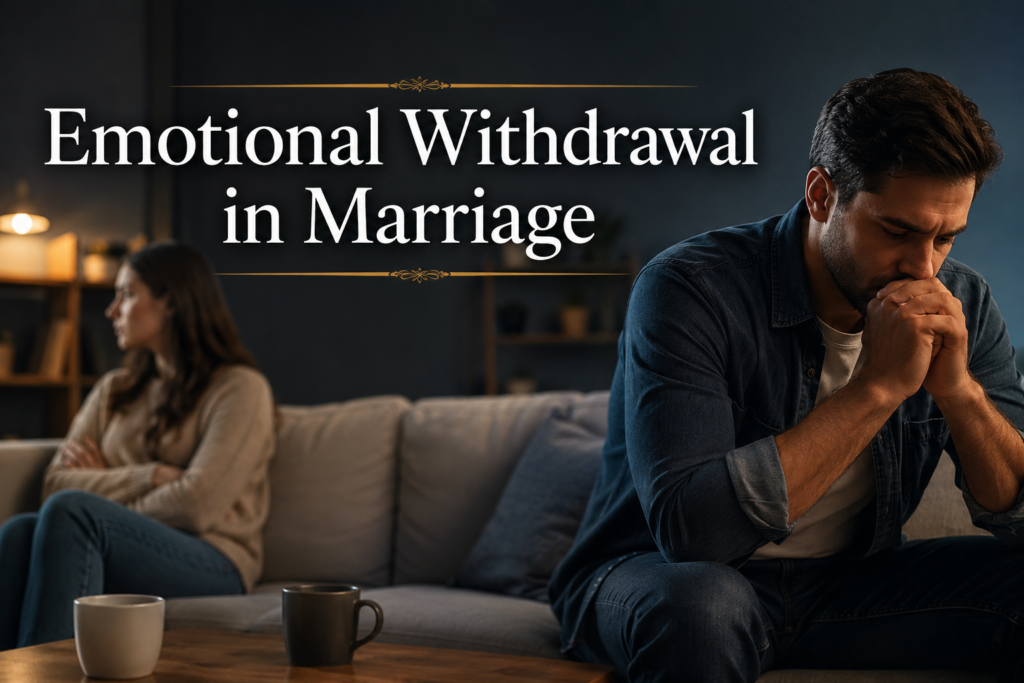
When Rejection Turns Into Emotional Withdrawal in Marriage: A Psychiatric and Sexual Health Perspective
Marriage involves emotional intimacy, communication, mutual respect, companionship, and, for consenting adults, physical and sexual intimacy. When one spouse repeatedly attempts to communicate, seek emotional closeness, or initiate physical intimacy while the other consistently refuses, avoids discussion, or provides repeated excuses, the relationship may gradually develop a pattern of emotional disconnection and withdrawal.
From a psychiatric and relationship-psychology perspective, this situation should not automatically be interpreted as evidence that one spouse is “bad,” “uncaring,” or mentally ill. Persistent rejection can have many possible causes, including unresolved marital conflict, psychological distress, sexual health concerns, relationship dissatisfaction, communication difficulties, trauma, medical conditions, hormonal factors, anxiety, depression, or differences in sexual desire.
At the same time, repeatedly suppressing one’s emotional and sexual needs without addressing the underlying problem can contribute to resentment, loneliness, frustration, and emotional withdrawal.
This is why comprehensive sex education and sexual health education are important components of healthy adult relationships.
Understanding Emotional Withdrawal in Marriage
Emotional withdrawal occurs when a person gradually reduces emotional engagement with a spouse. Instead of continuing to discuss feelings, needs, affection, or relationship concerns, the individual may become quiet, detached, and less emotionally responsive.
In some marriages, emotional withdrawal develops after repeated unsuccessful attempts to repair the relationship.
The pattern may look like this:
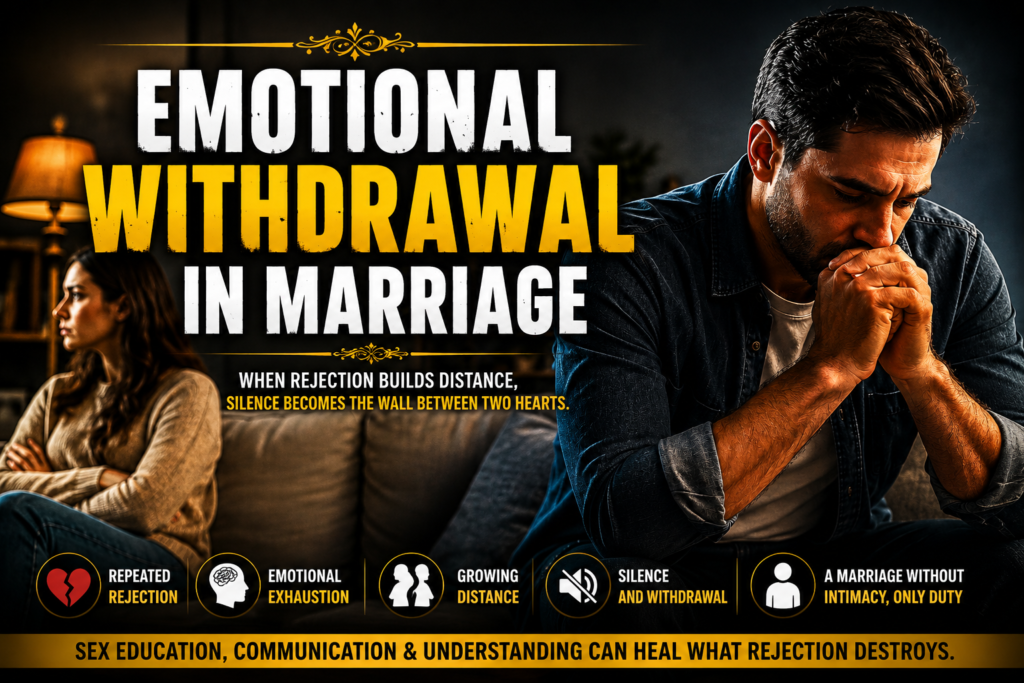
Repeated rejection → frustration → repeated attempts to communicate → continued avoidance → emotional exhaustion → withdrawal → reduced intimacy → further relationship deterioration
Relationship researchers often discuss related interaction patterns as demand-withdraw dynamics, in which one partner repeatedly seeks engagement or change while the other responds by avoiding, withdrawing, or shutting down.
Over time, both partners can become trapped in a negative interaction cycle.
When a Husband Stops Expressing His Needs
A husband who repeatedly experiences rejection may initially attempt to communicate, explain his feelings, show affection, initiate intimacy, or encourage his spouse to discuss the problem.
If those attempts repeatedly fail, he may eventually stop expressing his needs.
He may stop asking for affection.
He may stop initiating physical intimacy.
He may stop discussing sexual concerns.
He may stop sharing his emotional needs.
He may stop complaining altogether.
From the outside, this can appear to be indifference. Psychologically, however, it may represent emotional exhaustion, defensive withdrawal, or learned disengagement from an unresolved relationship problem.
This does not mean that every emotionally withdrawn spouse has the same psychological explanation. A qualified mental health professional must evaluate the individual circumstances before making a clinical interpretation.
Sexual Rejection and Its Psychological Impact
Sexual intimacy is a sensitive component of many adult marriages. Sexual rejection can sometimes produce feelings of disappointment, inadequacy, loneliness, frustration, or emotional distance, particularly when there is no opportunity for respectful communication about the underlying reasons.
However, it is essential to distinguish between sexual rejection and sexual coercion.
Every adult has the right to decline sexual activity. Consent must be voluntary, informed, and ongoing. Marriage does not eliminate an individual’s right to bodily autonomy.
Therefore, the solution to repeated sexual refusal is not pressure, intimidation, manipulation, or coercion.
The appropriate response is to understand why the problem exists and whether both partners are willing to address it.
Why Sex Education Is Important in Marriage
Sex education is not limited to teaching adolescents about reproduction.
Comprehensive sexual health education can help adults understand:
- Human sexual development
- Sexual anatomy and physiology
- Sexual and reproductive health
- Consent and personal boundaries
- Healthy sexual communication
- Common sexual misconceptions
- Differences in sexual desire
- Sexual dysfunction
- Psychological factors affecting intimacy
- The relationship between stress and sexual desire
- Medical causes of sexual difficulties
- When professional medical or psychological care is appropriate
A lack of accurate sexual health information can cause couples to interpret normal differences in sexual desire as personal rejection, disrespect, or lack of love.
For example, reduced sexual desire may sometimes be associated with stress, depression, anxiety, relationship conflict, medications, hormonal changes, chronic medical conditions, pain, sleep problems, or other health factors.
Without appropriate sexual health literacy, couples may blame one another instead of identifying the underlying issue.
Sexual Health Literacy Can Prevent Misunderstanding
Sexual health literacy means having accurate, evidence-based knowledge about sexual health and knowing how to communicate and make informed decisions regarding sexual well-being.
In marriage, this knowledge can help couples understand that:
Low sexual desire does not automatically mean lack of love.
Sexual difficulty does not automatically mean rejection of the spouse.
A difference in libido does not automatically indicate incompatibility.
Declining sexual activity does not automatically indicate a psychiatric disorder.
At the same time, persistent avoidance of intimacy should not simply be ignored when it is causing significant distress or relationship dysfunction.
The underlying cause deserves attention.
Psychological and Medical Factors Behind Sexual Avoidance
Repeated sexual avoidance may have psychological, relational, or medical contributors.
Potential factors may include:
Psychological Factors
- Anxiety
- Depression
- Chronic stress
- Relationship-related distress
- Trauma-related symptoms
- Negative body image
- Fear of intimacy
- Low self-esteem
- Emotional resentment
Relationship Factors
- Poor communication
- Unresolved marital conflict
- Lack of emotional intimacy
- Previous relationship injuries
- Perceived criticism
- Loss of trust
- Different expectations regarding intimacy
Medical and Sexual Health Factors
- Pain during sexual activity
- Hormonal changes
- Certain medications
- Chronic illness
- Sleep disorders
- Sexual dysfunction
- Pregnancy-related changes
- Menopausal changes
- Other gynecological or urological conditions
For this reason, persistent changes in sexual desire or sexual functioning may warrant evaluation by an appropriate healthcare professional.
Why Communication Matters More Than Blame
A common mistake in distressed marriages is turning the situation into a courtroom:
“Who is responsible?”
“Who started it?”
“Who rejected whom first?”
“Who is the problem?”
A more clinically useful approach is:
What is happening between the two people?
The goal of couples therapy is often to identify destructive interaction patterns and help partners communicate their needs more effectively.
Instead of:
“You never want me.”
A healthier communication approach may be:
“I feel emotionally distant from you, and I would like us to understand what is happening between us.”
Instead of:
“You always reject me.”
A more constructive approach may be:
“I feel hurt and disconnected when we repeatedly avoid discussing our intimacy.”
This difference in communication can significantly change the emotional tone of a conversation.
When Silence Becomes Emotional Disconnection
Temporary space during an argument can sometimes help partners regulate their emotions.
However, prolonged silence, avoidance, refusal to communicate, and complete emotional disengagement can become problematic when they prevent the couple from addressing important relationship concerns.
A spouse may eventually think:
“I no longer expect anything.”
“I do not want to discuss it anymore.”
“There is no point in trying.”
This can be a significant warning sign.
The absence of arguments does not necessarily mean that a marriage is healthy.
Sometimes the conflict has simply changed from open disagreement to emotional disengagement.
Why Some Spouses Begin Looking Elsewhere for Emotional Validation
When emotional intimacy has deteriorated, some individuals may become vulnerable to seeking emotional validation outside the marriage.
Someone who feels consistently ignored, rejected, or emotionally disconnected may become attracted to another person who listens, appreciates, or validates them.
However, developing an outside emotional or sexual relationship generally does not resolve the underlying marital problem. It can introduce additional psychological complications, secrecy, guilt, betrayal, and relationship instability.
A healthier approach is to address the marital problem directly through respectful communication and, when appropriate, professional couples counseling.
What Happens When the Previously Rejected Spouse Finally Stops Trying?
One of the most misunderstood stages of relationship deterioration occurs when the person who previously pursued closeness suddenly stops pursuing it.
The spouse may wonder:
“Why does he no longer talk to me?”
“Why does he no longer seek affection?”
“Why does he no longer initiate intimacy?”
“Why has he become so emotionally distant?”
This change can occur because repeated unsuccessful attempts have produced emotional exhaustion.
The person may not have stopped caring overnight.
He may simply have stopped believing that further attempts will change anything.
That distinction is clinically important.
When the Other Spouse Begins to Regret the Distance
Sometimes a spouse recognizes the seriousness of the problem only after emotional withdrawal has already occurred.
Regret may develop when the individual realizes that the other partner is no longer seeking attention, affection, communication, or intimacy.
At this stage, simply demanding that the relationship return to the way it was may not be enough.
Trust, emotional safety, communication, and intimacy may need to be rebuilt gradually.
Sexual Education Should Include Both Rights and Responsibilities
Healthy sex education should never teach entitlement to another person’s body.
It should teach both rights and responsibilities.
Individuals should understand:
- The importance of consent
- Respect for personal boundaries
- Sexual and reproductive health
- Healthy communication
- Mutual respect
- Sexual anatomy and physiology
- Common sexual health conditions
- Psychological influences on sexual functioning
- The importance of seeking medical care for persistent problems
Sex education therefore has an important role not only in preventing misinformation but also in helping adults develop healthier expectations about intimacy and communication.
When Professional Help Is Appropriate
Couples should consider professional help when:
- Sexual or emotional rejection has become persistent
- Communication repeatedly breaks down
- One or both partners feel chronically resentful
- Physical intimacy has completely disappeared
- Emotional withdrawal is increasing
- The same conflict repeatedly returns
- Either partner experiences significant psychological distress
- Sexual dysfunction or pain may be involved
- Medical or psychiatric factors may be contributing
- Both partners want to repair the relationship but cannot do so independently
Depending on the circumstances, appropriate professionals may include a psychiatrist, psychologist, licensed marriage and family therapist, couples therapist, gynecologist, urologist, or other qualified healthcare professional.
A Balanced Psychiatric Perspective
The most important point is that persistent marital rejection should not automatically be diagnosed as a psychiatric disorder.
Likewise, a spouse who eventually withdraws should not automatically be labeled emotionally abusive, narcissistic, depressed, or mentally ill without a proper clinical assessment.
Human relationships are complex.
A psychiatrist or psychologist would generally need to evaluate the individual’s symptoms, history, relationship dynamics, medical factors, psychological state, and level of functional impairment before making a diagnosis.
The objective should not be to assign blame.
The objective should be to understand the underlying causes and determine whether the relationship can be repaired.
Conclusion
When one spouse repeatedly seeks emotional or physical closeness and the other repeatedly refuses, avoids, or disengages, the relationship can gradually move from communication to frustration, from frustration to emotional exhaustion, and from emotional exhaustion to withdrawal.
If this cycle continues for a long time, both partners may eventually experience loneliness within the same marriage.
This is why sex education, sexual health education, psychological awareness, consent education, and healthy marital communication are so important.
Accurate sexual health information can help couples distinguish between normal differences in sexual desire, relationship problems, psychological distress, and genuine medical or sexual health conditions.
The solution is not coercion.
The solution is not humiliation.
The solution is not revenge or immediately replacing one partner with another person.
The healthier approach is respectful communication, evidence-based sexual health education, appropriate medical evaluation, and professional couples counseling when necessary.
A healthy marriage does not require two people to have identical emotional or sexual needs. It requires two people who are willing to understand those differences, respect each other’s boundaries, communicate honestly, and seek appropriate help when the relationship becomes difficult to repair alone.
Sexual health education is therefore not merely about sexual activity. It is also about knowledge, consent, communication, emotional well-being, responsible decision-making, and understanding the physical and psychological factors that influence intimate relationships.