
Overthinking and Negative Thoughts Management 2 Months Online Course
Many individuals face many situations in their daily life where overthinking and negative thoughts hold their full body and mind results in disturbing overall performance in all areas of life like workplace, home, relationship and other factors also affected by negative thoughts and their overthinking. Overthinking often begins with a trigger. It may be a difficult conversation, a mistake at work or relationship concern or issues.
Not every difficult thought is overthinking. One of the most useful distinctions is between rumination, worry and problem solving. Rumination generally looks backward. Worry usually points towards the future. But problem solving is different.
What is Overthinking?
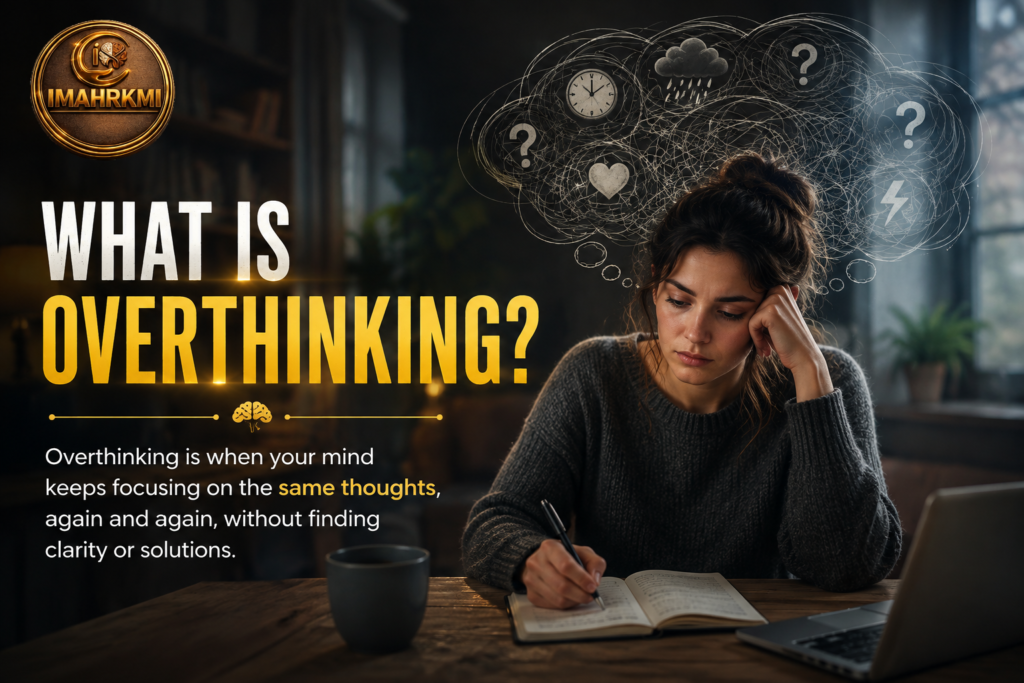
Overthinking scan becomes a daily habit. A small concern becomes a long chain of questions. One mistake becomes proof of personal failure. Overthinking is more than simply thinking deeply about an issue. There are two types of thinks which is Productive Thinking and other one is Un-Productive Thinking. Productive Thinking usually has a direction. It helps a persons understand something, make small or large decisions in life or help to solve a problem. Un-Productive Thinking behaves differently in which involves like mind may feel busy but being mentally busy is note the same.
Repeating Thoughts
The brain can automatically focus on threats. In some situations, this may be helpful in enabling a person to prepare to deal with danger. However, in other situations this automatic focus on threats can become excessive.
In some cases, people believe that worrying is useful for preparing for future problems. Therefore, they engage in mental rehearsal of all the possible problems, which they hope will prevent them from happening. Unfortunately, mental rehearsal cannot guarantee certainty. The anxious feelings can then cause the person to engage in more mental checking, leading to even more feelings of uncertainty.
Understanding Automatic Thoughts

Most thoughts occur before we have consciously chosen to have them. Here is an example of how someone might automatically think a thought. The first example is a short message from someone and the person automatically thinks that the other person is angry with them. These are automatic thoughts. By instead saying to yourself “I’m having the thought that I’m going to fail” you’ve a person can mentally say, “I am noticing the thought that I might fail.”
That small change creates distance. The thought becomes something the mind is producing rather than something the person must obey.
Common Thinking Traps
Overthinking often becomes stronger because of predictable thinking errors.
Catastrophizing
Catastrophizing turns a possibility into a disaster.
A small problem becomes the beginning of the worst possible outcome.
Mind Reading
Mind reading involves assuming that we know what another person thinks without reliable evidence.
All-or-Nothing Thinking
This pattern divides situations into extremes.
A person may believe that if they do not perform perfectly, they have completely failed.
Mental Filtering
Mental filtering focuses heavily on negative information while overlooking everything else.
Someone might receive nine positive comments and one criticism but spend the entire evening thinking about the criticism.
Emotional Reasoning
Emotional reasoning treats feelings as proof.
“I feel afraid; therefore, something must be wrong.”
Building a Personal Anti-Overthinking Routine
A personal routine might look like this: Notice the thought. Label the thought. Decide whether any action is possible. Examine the thought. Interrupt the cycle of thought. Take one useful action.
Using Grounding to Return to the Present

Grounding is useful when attention becomes trapped in imagined situations. One way to Ground yourself is to focus your attention on the different features of your environment. The present moment is lacking in information about possible dangers that our imagination would like to supply.
Overthinking frequently includes self-criticism. “I should have known better.” “I always ruin things.” “I am not good enough.” Such statements rarely improve performance. They often increase emotional pressure and make future mistakes more frightening.
A better approach is compassionate accountability. Switch to compassionate accountability. Most everyday decisions do not provide perfect certainty.
Test or Manage Thoughts
One of the strongest ways to manage negative thinking is to investigate it. The goal is not to replace negative thinking with unrealistic positivity, A balanced thought might be I made a mistake and i do not know what everyone thinks about me. I can learn from the mistake and improve my work and performance in all aspects of our life.
Conclusion
Course offers students a comprehensive set of cognitive and behavioural skills with which to stop repetitive negative thinking (RNT), chronic rumination, negative and critical inner dialogues, and cognitive fixation. By practicing to detach from automatic thoughts, to test out cognitive predictions, to bring about cognitive diffusion.