
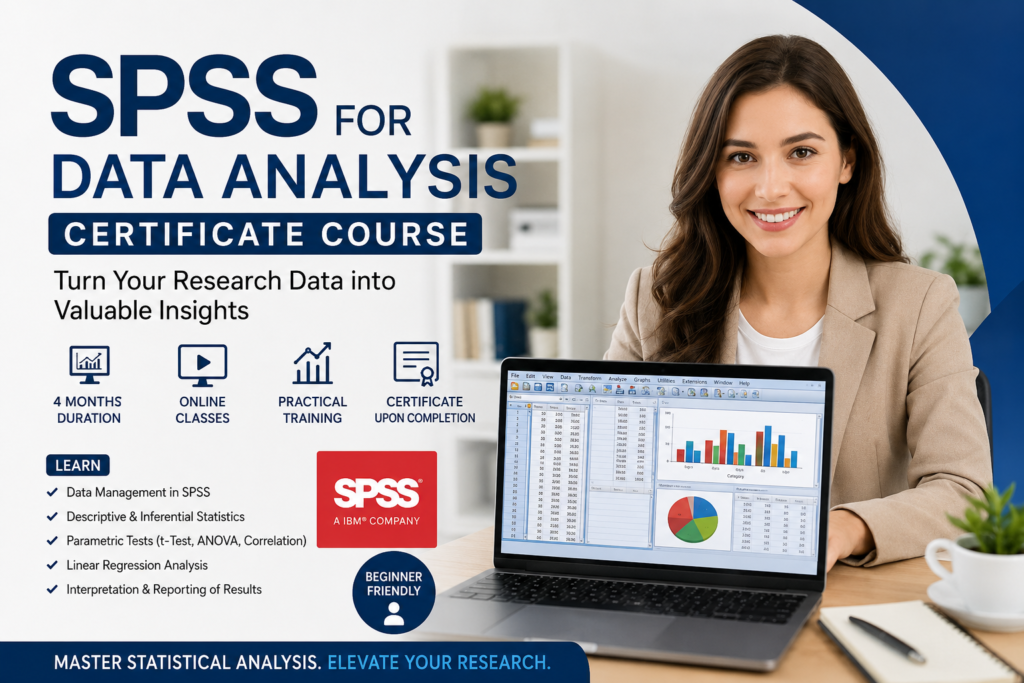
SPSS for Data Analysis Certificate Course: Turn Your Research Data into Valuable Insights
Why Is It Important to Know SPSS in Modern Day?
In today’s world where data rules decisions, the ability to work with and make sense of information becomes a very important skill to have in many areas, from academic life and healthcare to business and research. Regardless of whether you perform your thesis, evaluate performance of your organization, publish results of your research, or simply make a decision based on data, knowledge of statistical analysis becomes an absolute must.
This is always a case whereby a lot of students and even professionals end up collecting an enormous amount of information that cannot be analyzed appropriately. This causes a number of problems for them since they may end up making mistakes that will waste a lot of time during their research work. The SPSS program is one of the most widely used software when it comes to data analysis.
The SPSS for Data Analysis Certificate Course will provide you with necessary practical skills in working with data and statistical analysis.
Course Description
The Certificate Course in SPSS for Data Analysis is an intensive training course aimed at introducing learners to the basics of SPSS and its use in quantitative studies.
This course covers the most commonly used parametric statistical methods in academia and industry. Learners will acquire knowledge about data entry, data preparation and management, execution of descriptive and inferential statistics, statistical assumptions and their testing, and interpretation of statistical results.
Unlike pure theory oriented statistics courses, the practical aspect is prioritized in this program with the help of demonstrations and real datasets analysis. Upon completion of the course, participants will have the necessary analytical skills to perform statistical analysis independently.
Course Information
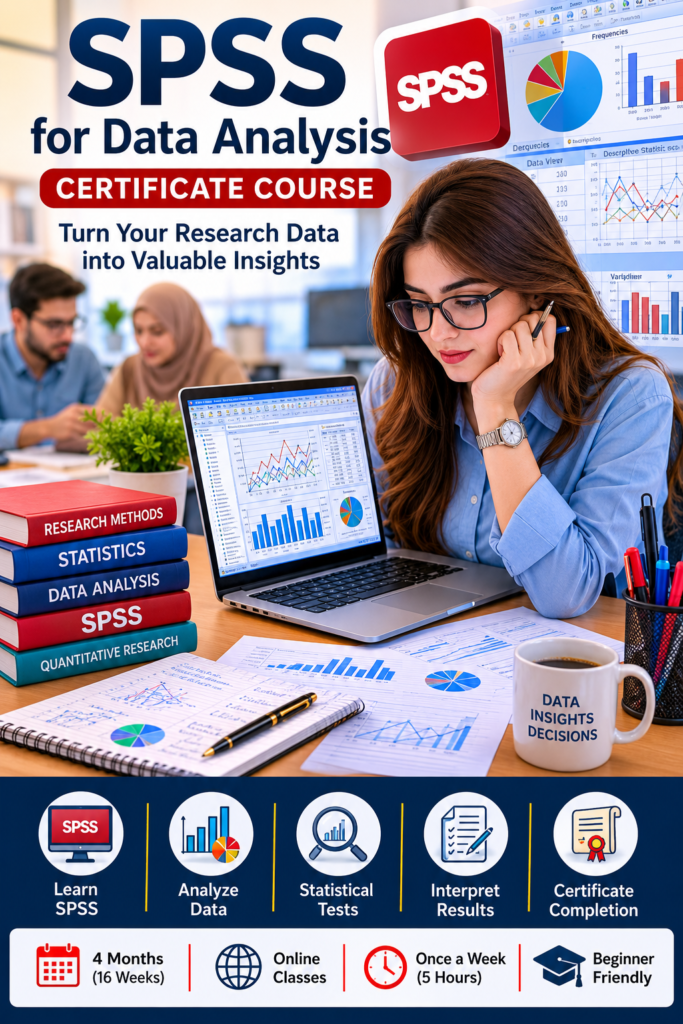
- Duration: 4 Months (16 Weeks)
- Method of Teaching: Online
- Classes: Once a week (5 hours a day)
- Course Level: Beginner
Suitable For
This course will be suitable for:
- Undergraduate and graduate students
- People working on theses and dissertations
- Researchers in academic fields
- Healthcare professionals
- Human resource professionals
- Social scientists
- Anyone who would like to learn data analysis
- Beginners with little to no statistical background
What is SPSS Good For?

SPSS is among the most popular and reliable statistical programs in academia, research organizations, and businesses all over the world.
SPSS is beneficial because:
Easier Statistical Analysis
Through SPSS, users can complete statistical calculations effortlessly, without having extensive programming skills.
Better Research Quality
By doing correct statistical calculations, you can increase the credibility of your research, making sure that the conclusions made will be valid.
Academic/Career Advantage
The ability to process data and analyze it is valued among employers. By learning SPSS, you can improve your career prospects in many areas.
Eliminate Fear from Your Research Projects
Many people are afraid of statistics. Through this course, you will remove the fear and doubts from your projects.
Key Features of the Course
Practical Learning Environment
Students will be working in SPSS itself during the entire duration of the course instead of merely learning about the theories involved.
Analysis of Real Datasets
Students will get to practice their knowledge with authentic datasets that will help them comprehend the application of statistics in real research.
Best for Novices
The information contained in this course is designed particularly for individuals who are new to SPSS and Statistics. The theories will be introduced to the learners step by step.
Parametric Statistics
The course entails major parametric statistical tests commonly utilized in researches, theses, dissertations, and other professional assignments.
Online Classes
Live online sessions give room for discussion and solving problems along with one on one support of the instructor.
Interpretation of Results
Students will learn to interpret and present the results properly in a professional manner.
Skills Acquired Through This Course
- Use SPSS interface
- Create, manipulate, and handle datasets
- Distinguish among types of variables
- Perform descriptive statistics
- Perform data cleaning and screening procedures
- Check for the assumptions for parametric testing
- Perform important statistical tests using SPSS
- Select appropriate statistical tests for your research questions
- Interpret results from statistical testing
- Present your results in professional research papers
These skills would form a good basis for doing research and decision making.
Modules of the Course at a Glance
Module 1: Introduction to SPSS and Research Data
The course starts with a general discussion of the basics of quantitative research, variables, research data design, and use of statistics in research.
Module 2: Data Entry and Dataset Creation
Students get hands on training for creation of datasets, coding of variables, management of missing data, and organization of data in SPSS.
Module 3: Data Cleaning and Screening
In this module, emphasis is placed on cleaning the data and screening the data for various reasons including accuracy of data.
Module 4: Descriptive Statistics
This module involves description of data through use of frequencies, measures of central tendency, measures of variability, and graphs.
Module 5: Parametric Statistics: Testing of Assumptions
Before performing any inferential analysis, students will be taught about statistical assumptions like normality, homogeneity of variance, linearity, and reliability test using Cronbach’s alpha.
Module 6: Pearson Product-Moment Correlation Test
In this module, students will be introduced to ways of examining relationships between variables by using Pearson Product-Moment Correlation Test
Module 7: t-Test
This module covers Independent Samples t-Tests, testing assumptions, effect size, and results interpretation.
Module 8: One-way ANOVA
In this module, students will learn about comparing groups using ANOVA along with post hoc testing and interpreting significant differences.
Module 9: Linear Regression
In this last module, students will be introduced to Simple Linear Regression used to understand the predictive relationship between independent and dependent variables.
Program Teaching Methodology
The training program makes use of the following teaching method that is interactive and practical:
- Interactive online sessions
- Practical SPSS tutorials
- Statistics practice
- Real world data set analysis
- Case study learning
- Interpretation of SPSS output
- Q&A sessions
- Certification and Evaluation
Performance of the trainees will be evaluated as follows:
- Practice exercises
- SPSS assignment
- Class participation
- Final practical test
Requirements for Certification
Trainees will receive a certificate upon completing the following requirements:
- At least 80% attendance
- Course work & practice
- Practical test
Conclusion
The process of analysis of data is absolutely essential when it comes to doing research work or any other professional work. No matter what – whether you are conducting research for your thesis, writing research papers, analyzing organizational outcomes, or looking into the data and trying to make certain decisions, SPSS will help you analyze the data.
Certificate Course in SPSS for Data Analysis is the perfect solution if you need to acquire statistical analysis skills. This course will provide the participants with all the skills needed in order to perform their analysis independently.
This course is ideal for those who want to develop their research skills, learn how to analyze data, and gain practical skills working with one of the most popular programs for statistical data analysis.