

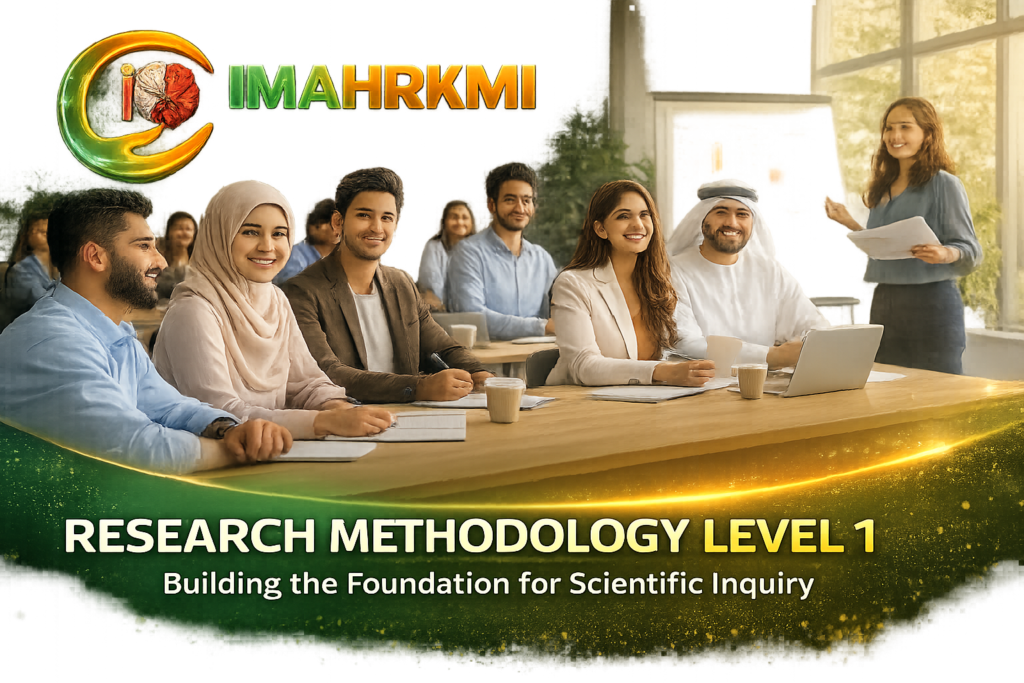
Research Methodology Level 1: Building the Foundation for Scientific Inquiry
Introduction: Why Research Skills Matter More Than Ever
In today’s age of evidence-based practices, research is no longer confined to only academia
or science alone. Everyone, ranging from healthcare practitioners, educators, social
scientists, to students needs to know how to research, understand, and critically analyze the
research processes. Regardless of whether you are working on a thesis, a project,
intervention evaluation, or evidence-based practice, research skills can make all the
difference in the effectiveness of what you do.
Through conducting research, people can systematically investigate issues, gain insight into
things and come up with answers. The only challenge is that there are so many aspects to
research that most students and researchers have a hard time comprehending it all. A
research training course will go a long way in helping with such issues.
The level 1 research methodology course is specifically crafted in a way that ensures
trainees learn about all aspects of the research process effectively.
Course Overview
Level 1 Research Methodology is a 4-months program that provides a comprehensive
introduction to the basic concepts of scientific research. Through the course, the participants
will go through all stages of research, starting from choosing a research topic and ending
with creating a professional research proposal.
This program is intended for people who have little or no research experience at all.
Course Description

Duration: Four Months (16 Weeks)
Method: Virtual Classroom Using Google Meet
Frequency: Once a Week for Five Hours
Level: Beginner and Intermediate
The Course Is Suitable for:
● Undergraduate Students
● Postgraduate Students
● Thesis Writers
● Researchers
● Health Care Providers
● Teachers
● Social Sciences / Psychologists
● People Who Want to Learn Research Techniques
Reasons to Take This Course?
For many students, research is introduced into their studies in the form of an undergraduate
dissertation or a postgraduate project. However, without any proper training or guidance, it
becomes difficult to conduct research effectively. This course will make understanding of
research techniques and methodologies easy for participants.
Participants will learn the basic concepts underlying research as well as their application in
practical situations. This will enable them to gain hands-on experience which will be of great
benefit to them in the coming years of academic and professional life.
Key Characteristics of the Course
A Wealth of Teaching Materials
The current course involves teaching materials that include everything related to the
research process. Consequently, students receive all necessary information for future
studies.
Practical Aspect of the Learning Process
In addition to the explanation of the theoretical background related to the research process,
the course provides learners with a chance to practice certain research skills, such as writing
proposals, conducting literature review, choosing appropriate sampling techniques, as well
as creating questionnaires.
Online Interactive Classes
Students can join online interactive classes that take place using a learning platform, namely
Google Meet.
Writing Proposals
One more benefit of this course is the opportunity to complete a mini-research proposal as
part of the course.
Course Suitable for Beginners
Since the current course is suitable for people who have just started exploring research, it
explains topics that are comprehensible for non-researchers as well.
Online Classrooms
The courses take place in online classrooms.
What Can You Expect To Learn From This Course?
● Upon completing this course, you will be able to acquire the following skills:
● Knowledge of basics of scientific research
● Identification of research problems and formulation of research questions
● Identification of research objectives and formulating research hypotheses
● Writing literature reviews
● Identification of research gaps in archival research
● Selection of appropriate research design
● Appropriate sampling methods
● Development of research instruments/tools
● Reliability and validity knowledge
● Ethical issues in research
● Writing research proposals/reports
Module Topics
Module 1: Introduction to Research
At the outset, students are introduced to the concept of research, its importance, different
types of research, and what research essentially is all about. Furthermore, there is
discussion on research processes, and characteristics of research.
Module 2: Research Variables and Design
Here, students learn about independent variables, dependent variables, operational
definition, types of variables, types of research design such as experimental and
non-experimental research design, cross-sectional studies, and longitudinal studies.
Module 3: Formulating Research Problems and Hypotheses
In this module, students will be acquainted with research problem formulation, research
questions, objectives, and hypotheses. The module includes several practical activities for
formulating research designs.
Module 4: Literature Review
Students are introduced to database search techniques, literature review, gaps in research,
and synthesis of information.
Module 5: Population and Sample
Students are introduced to population vs. sample, probability vs. non-probability sampling,
and sample size estimation.
Module 6: Research Instruments and Interviewing
The participants are introduced to selecting instruments for conducting research,
interviewing, issues of validity and reliability, development of questionnaires.
Module 7: Ethical Issues
The ethical issues cannot be ignored during the course of carrying out any type of research.
Herein the participants are briefed about how to achieve
Module 8: Proposal Writing and Research Report Writing
The last module would introduce participants to proposal writing and research report writing.
Teaching methodology
The training adopts a participant-centred method by ensuring that participants:
● Participate in live interactive sessions
● Discuss case studies
● Engage in guided activities
● Undertake group discussions
● Perform proposal development activities
This combination of methodologies will not only help the participants understand the
concepts involved but also help them apply those concepts practically in research.
Requirements for Certification
For successful completion of the training programme and certification, participants are
expected to:
● Have a minimum attendance rate of 80%
● Complete all coursework and other activities
● Submit the final mini research proposal
Conclusion
In any case, it is vital for you to realize the significance of using research as an extremely
powerful tool when dealing with problems, producing knowledge, and making decisions
based on data. Whether you prepare for writing your thesis or other projects, try to do
something in your professional sphere or want to develop your analytical skills, learning
about the fundamentals of research methodology will benefit you greatly.
With the help of the Research Methodology Level 1 course, you will be able to become a
competent researcher in just a few days thanks to the assistance provided by
knowledgeable teachers and various practice-oriented assignments.
This way, taking part in the Research Methodology Level 1 course, you will be able to get
one step closer to becoming a competent researcher.